
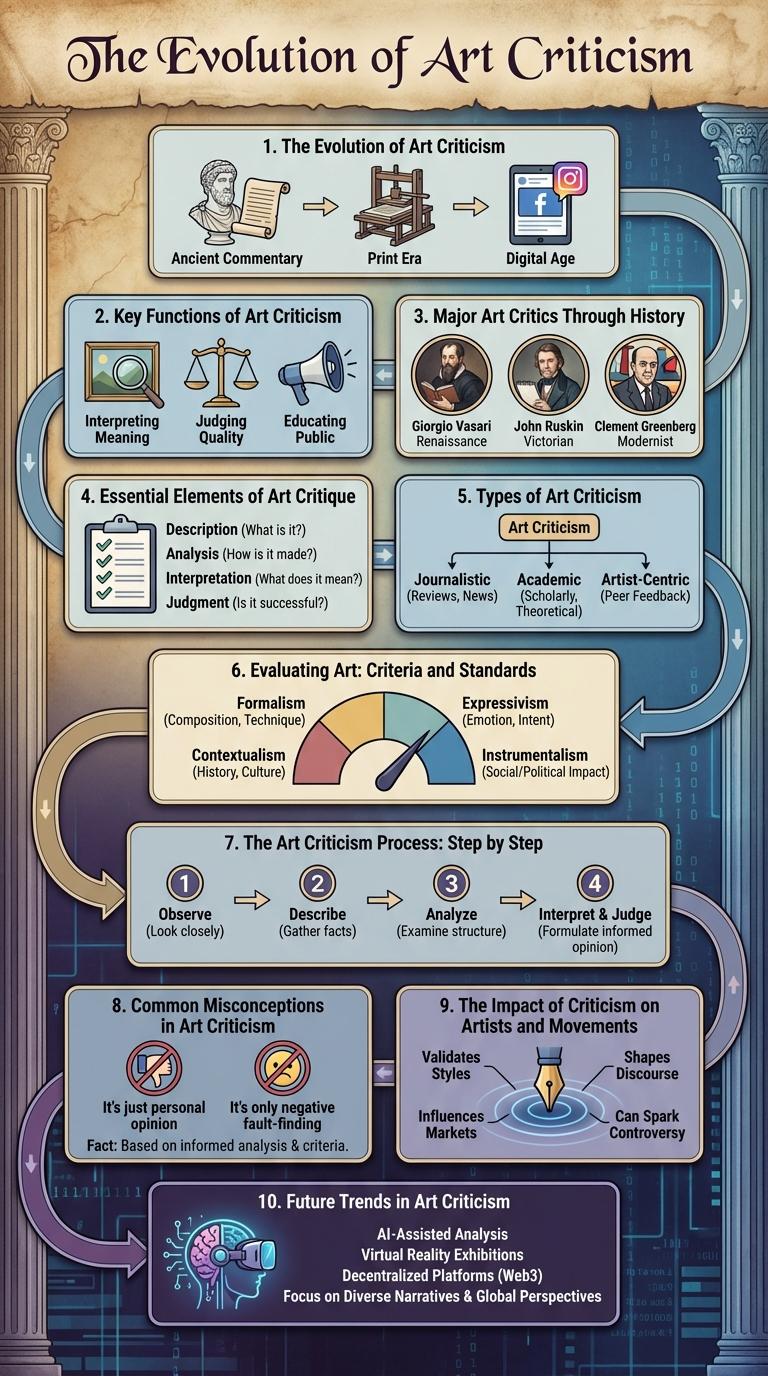
Art criticism evaluates and interprets works of art, offering insights into their meaning, technique, and cultural significance. This infographic breaks down key concepts, methodologies, and notable critics that shape the field. Understanding these elements enhances appreciation and deepens the conversation around artistic creations.
The Evolution of Art Criticism
| Period | Key Developments in Art Criticism |
|---|---|
| Ancient Greece & Rome | Art criticism focused on aesthetic principles and representation; philosophers like Plato and Aristotle discussed beauty and mimesis. |
| Renaissance | Criticism emphasized proportion, perspective, and humanism; Giorgio Vasari pioneered artist biographies and evaluative commentary. |
| 18th Century Enlightenment | Emergence of formal aesthetics; critics such as Denis Diderot introduced objective criteria concerning taste and artistic merit. |
| 19th Century Romanticism & Modernism | Shift to subjective interpretation; critics like Charles Baudelaire and John Ruskin championed emotion, innovation, and social context. |
| 20th Century to Present | Diversification of critical methods; postmodernism challenges conventions, incorporates cultural theory, and multimedia analysis. |
Key Functions of Art Criticism
What are the key functions of art criticism? Art criticism evaluates and interprets artworks, providing deeper understanding and context. It bridges the gap between the artist's intent and the audience's perception.
How does art criticism influence artists and viewers? It offers constructive feedback that helps artists refine their creative process. For viewers, it enhances appreciation by explaining symbolism, technique, and historical significance.
Why is art criticism essential in the art world? It establishes standards of quality and authenticity, guiding collectors, galleries, and museums. Art criticism also fosters cultural dialogue and preserves artistic heritage.
| Key Function | Description |
|---|---|
| Evaluation | Assessing artistic merit and technical skill. |
| Interpretation | Explaining meaning, themes, and context. |
| Education | Informing audiences about art history and techniques. |
| Guidance | Directing artists and collectors through critical feedback. |
| Cultural Preservation | Maintaining and promoting artistic heritage. |
Major Art Critics Through History
Art criticism has evolved through the insights of influential figures who shaped the understanding of art over centuries. Key critics have contributed diverse perspectives that enriched the discourse on aesthetics and creativity.
- John Ruskin - Pioneered art criticism in the 19th century, emphasizing moral and social values in art.
- Clive Bell - Introduced the concept of "significant form" to evaluate art based on formal qualities.
- Clement Greenberg - Advocated for modernist painting and formalist criticism in the mid-20th century.
These critics' philosophies continue to influence contemporary art analysis and appreciation.
Essential Elements of Art Critique
Art criticism involves analyzing and evaluating artworks based on various fundamental elements. Essential elements of art critique include description, analysis, interpretation, and judgment, each providing a structured approach to understanding art. These elements help viewers engage deeply with artworks, fostering a more meaningful appreciation and critical perspective.
Types of Art Criticism
Art criticism involves analyzing and evaluating works of art to understand their meaning, technique, and impact. Different types of art criticism offer unique perspectives and criteria for judging artistic creations.
- Formalism - Focuses on the visual elements of art like composition, color, and line without considering context.
- Contextual Criticism - Examines the social, political, and historical background influencing the artwork.
- Expressive Criticism - Evaluates how well an artwork conveys the artist's emotions and intentions.
- Feminist Criticism - Analyzes art through the lens of gender roles and power dynamics.
- Marxist Criticism - Studies art in relation to class struggle, economic factors, and ideology.
Evaluating Art: Criteria and Standards
Art criticism involves evaluating artworks based on criteria such as composition, technique, and emotional impact. Standards for assessment include originality, use of color, balance, and the ability to convey meaning or provoke thought. Understanding these criteria helps viewers and critics appreciate the depth and intentions behind each piece.
The Art Criticism Process: Step by Step
Art criticism involves a systematic method to evaluate and interpret artworks. Understanding this process enhances both appreciation and analysis.
- Description - Observe the artwork closely, noting details like color, form, texture, and composition.
- Analysis - Examine how the elements of art work together and the techniques used by the artist.
- Interpretation - Explore the meaning, themes, and emotional impact conveyed by the artwork.
- Evaluation - Assess the artwork's success in achieving its intended effect and its significance.
- Conclusion - Summarize insights and personal response to form a coherent critical judgment.
Common Misconceptions in Art Criticism
Art criticism is often misunderstood as mere personal opinion rather than a structured analysis of artistic elements and context. Many believe it to be exclusive to experts, but it is accessible to anyone willing to engage thoughtfully with art.
Common misconceptions include thinking art criticism only involves negative judgment or is purely subjective. In reality, it combines objective evaluation with cultural, historical, and emotional considerations to provide deeper insight.
The Impact of Criticism on Artists and Movements
Art criticism profoundly shapes the trajectory of artists and entire movements by influencing public perception and market value. Constructive criticism encourages innovation, pushing artists to refine their techniques and explore new concepts.
Historical art movements like Impressionism gained momentum through critical support that challenged traditional norms. Negative criticism can hinder artistic growth but also provoke strong responses that define an artist's legacy.