
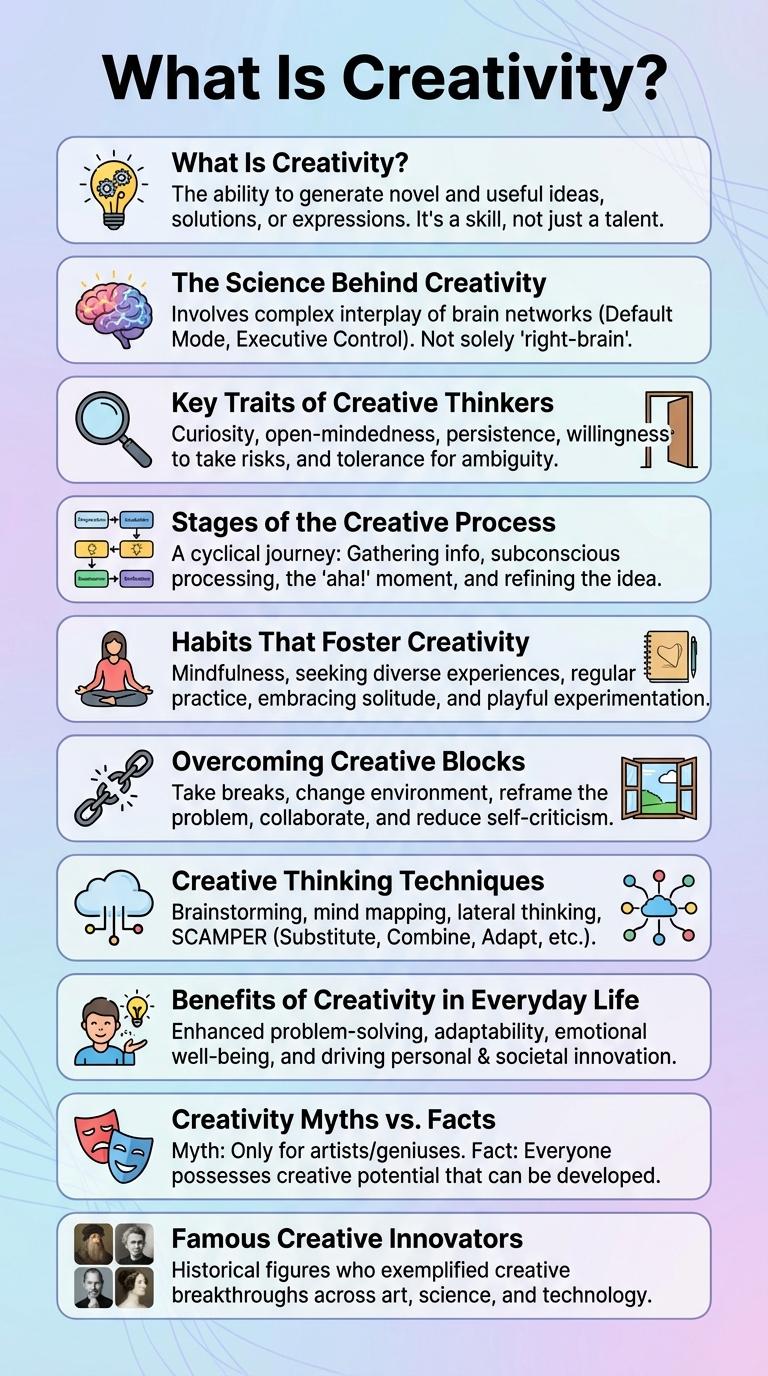
Creativity fuels innovation by connecting ideas in new and meaningful ways. Visual representations like infographics simplify complex concepts, making it easier to grasp creative processes and techniques. Understanding creativity through imagery enhances engagement and inspires fresh thinking.
What Is Creativity?
What is creativity? Creativity is the ability to generate original ideas and solutions by thinking outside the box. It involves combining knowledge, imagination, and innovation to produce unique outcomes.
The Science Behind Creativity
Creativity stems from complex interactions within the brain's neural networks, engaging multiple regions simultaneously. Scientific research reveals how cognitive flexibility, brain connectivity, and neurotransmitters contribute to innovative thinking.
- Default Mode Network - This brain network activates during mind-wandering and imagination, essential for generating creative ideas.
- Prefrontal Cortex - Responsible for decision-making and problem-solving, this region supports the organization and evaluation of creative thoughts.
- Dopamine Levels - Dopamine, a key neurotransmitter, enhances motivation and reward processing, influencing creative performance.
Key Traits of Creative Thinkers
Creative thinkers display a unique blend of curiosity and open-mindedness that drives their innovation. They embrace challenges and explore diverse perspectives to generate original ideas.
Key traits include imagination, risk-taking, and adaptability, allowing them to navigate uncertainty with ease. These individuals often exhibit high levels of intrinsic motivation and a passion for problem-solving.
Stages of the Creative Process
Creativity involves multiple stages that transform ideas into innovative outcomes. Understanding these stages helps enhance problem-solving and artistic expression.
- Preparation - Gathering information and resources to understand the problem or challenge.
- Incubation - Letting ideas develop subconsciously without active effort.
- Illumination - Experiencing a sudden insight or creative breakthrough.
- Evaluation - Critically assessing ideas and selecting the most viable solution.
- Implementation - Putting the chosen idea into practical use or production.
Habits That Foster Creativity
Creativity thrives through consistent habits that stimulate the mind and environment. Practices like daily brainstorming, embracing curiosity, and setting aside time for reflection significantly boost innovative thinking. Creating a routine that incorporates diverse experiences and continuous learning helps maintain a fertile ground for creative ideas.
Overcoming Creative Blocks
Creative blocks often stem from stress, fear of failure, or lack of inspiration. Techniques such as mindfulness, taking breaks, and changing the environment can help reignite creativity. Embracing imperfection and experimenting without pressure encourages original ideas to flow freely.
Creative Thinking Techniques
| Creative Thinking Technique | Description |
|---|---|
| Brainstorming | Generating a wide range of ideas without immediate judgment to encourage free flow of thoughts. |
| Mind Mapping | Visual representation of ideas branching from a central concept to organize and explore connections. |
| SCAMPER | Using prompts like Substitute, Combine, Adapt, Modify, Put to another use, Eliminate, and Reverse to innovate. |
| Role Playing | Adopting different perspectives to explore new approaches and solutions creatively. |
| Six Thinking Hats | Analyzing ideas through different thinking styles such as emotional, logical, and creative viewpoints. |
Benefits of Creativity in Everyday Life
Creativity enhances problem-solving skills by encouraging innovative thinking and diverse approaches. It fosters adaptability, helping individuals navigate challenges with original solutions.
Engaging in creative activities reduces stress and boosts mental well-being. It also promotes personal growth by enabling self-expression and deeper self-awareness.
Creativity Myths vs. Facts
Creativity is often misunderstood due to widespread myths that limit our understanding of its true nature. Separating these myths from facts helps unlock the full potential of creative thinking.
Many believe creativity is an innate talent only a few possess, but research shows it can be developed through practice and learning. Contrary to the myth that creativity is purely artistic, it plays a vital role in problem-solving and innovation across all fields. Recognizing facts about creativity encourages a growth mindset and broadens opportunities for creative expression.