
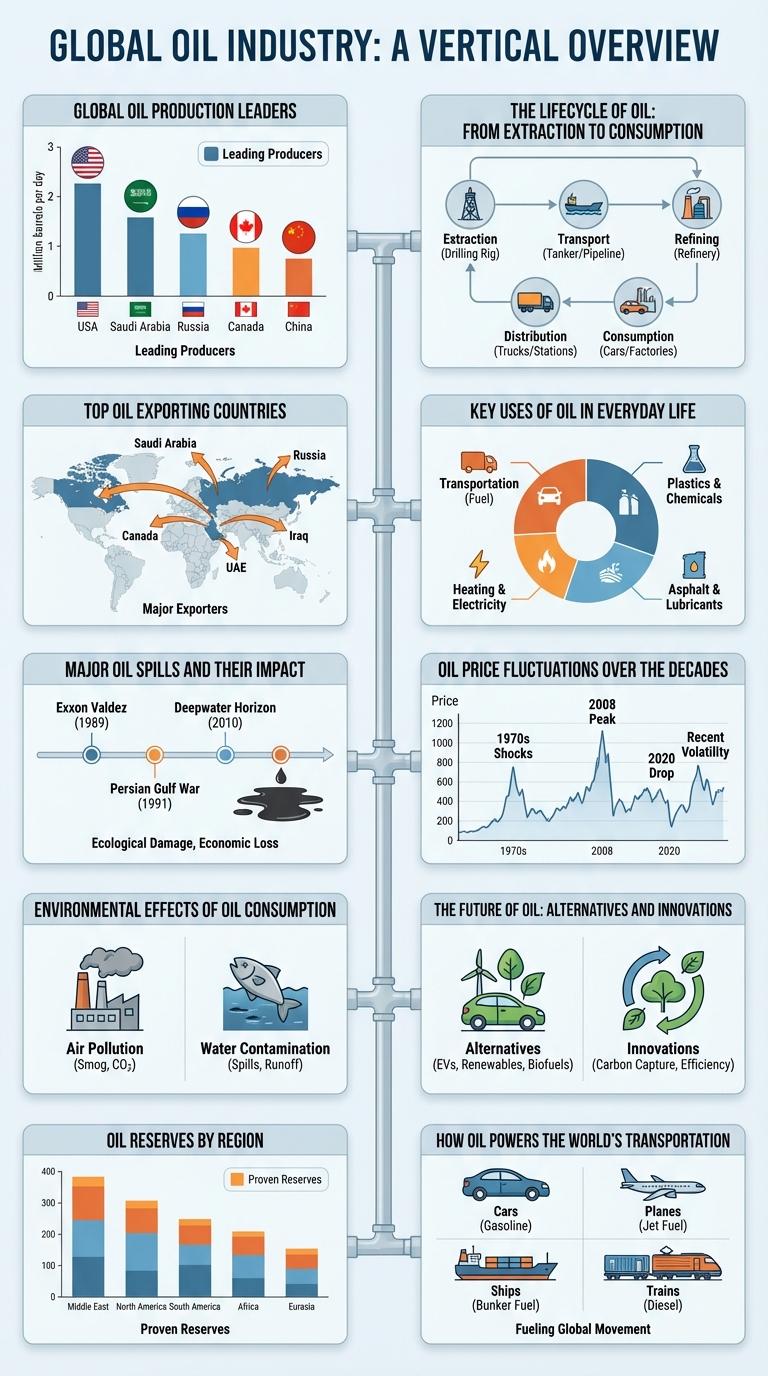
Oil remains a critical resource fueling global economies and powering industries worldwide. This infographic presents key data on oil production, consumption, and reserves, highlighting trends shaping the energy sector. Understanding these insights helps evaluate the ongoing impact of oil on environmental and economic landscapes.
Global Oil Production Leaders
Global oil production is dominated by a few key countries responsible for the majority of the world's output. These leaders shape energy markets and influence global economic dynamics significantly.
Top producers include the United States, Saudi Arabia, and Russia, each contributing millions of barrels per day. Their production levels impact oil prices, supply chains, and geopolitical strategies worldwide.
The Lifecycle of Oil: From Extraction to Consumption
The lifecycle of oil begins with extraction, where crude oil is pumped from underground reservoirs using advanced drilling technologies. The extracted crude undergoes refining processes to produce various fuels and petrochemical products essential for transportation, industry, and everyday use. Finally, these products reach consumers through distribution networks, powering vehicles, heating homes, and manufacturing goods worldwide.
Top Oil Exporting Countries
The global oil market is dominated by a few key countries that lead in exports, significantly influencing energy prices worldwide. Understanding the top oil exporting countries provides insight into global economic and geopolitical strategies.
These nations leverage vast oil reserves and advanced infrastructure to meet international demand efficiently.
- Saudi Arabia - The largest oil exporter, supplying over 7 million barrels per day, holds the world's second-largest proven oil reserves.
- Russia - A major player exporting around 5 million barrels daily, Russia's revenues depend heavily on petroleum exports.
- United States - The top oil producer and exporter in North America, the US exports over 3 million barrels of crude and refined products per day.
Key Uses of Oil in Everyday Life
What are the key uses of oil in everyday life? Oil is a vital resource that powers transportation and energy production worldwide. It also serves as a primary raw material in manufacturing various household products.
| Use | Description |
|---|---|
| Transportation | Oil fuels cars, trucks, airplanes, and ships, enabling global mobility. |
| Energy Production | Oil generates electricity and heats homes and businesses. |
| Plastics | Petrochemicals derived from oil are essential for producing plastics used daily. |
| Cosmetics | Many beauty and personal care products contain oil-based ingredients. |
| Medicines | Pharmaceuticals often rely on oil derivatives in their formulation. |
Major Oil Spills and Their Impact
| Oil Spill Event | Impact |
|---|---|
| Deepwater Horizon (2010) | 4.9 million barrels spilled; severe damage to marine life and Gulf Coast fisheries; estimated $61 billion in economic losses. |
| Exxon Valdez (1989) | Approximately 260,000 barrels spilled; long-lasting effects on Alaskan wildlife; cleanup costs exceeded $2 billion. |
| Amoco Cadiz (1978) | Over 1.6 million barrels spilled off the coast of France; widespread pollution of beaches; major impact on fishing industry. |
| Prestige (2002) | About 63,000 tonnes spilled near Spain; severe coastal ecosystem contamination; affected thousands of local fishermen. |
| Balkans Oil Spill (2014) | Thousands of barrels spilled in Eastern Mediterranean; damage to coral reefs and marine habitats; disruption to tourism and fisheries. |
Oil Price Fluctuations Over the Decades
Oil prices have experienced significant fluctuations over the past decades, influenced by geopolitical events, supply-demand imbalances, and technological advancements. Price volatility impacts global economies, energy policies, and consumer costs.
In the 1970s, oil prices surged sharply during the OPEC embargo, reaching over $40 per barrel in today's terms. The 1980s saw a collapse due to oversupply, followed by gradual increases and spikes during events like the Gulf War in the early 1990s.
Environmental Effects of Oil Consumption
Oil consumption significantly impacts the environment through pollution and resource depletion. Understanding these effects is crucial for promoting sustainable energy practices.
- Greenhouse Gas Emissions - Burning oil releases carbon dioxide, a major contributor to global warming and climate change.
- Air Pollution - Oil combustion produces harmful pollutants that degrade air quality and harm human health.
- Oil Spills - Accidental spills cause severe damage to marine ecosystems and wildlife habitats.
Reducing oil consumption and transitioning to renewable energy sources can mitigate these environmental impacts.
The Future of Oil: Alternatives and Innovations
The future of oil is shaped by emerging alternatives such as renewable biofuels, electric energy, and hydrogen power. Innovations in carbon capture technology and improved drilling techniques aim to reduce environmental impact while enhancing efficiency. The oil industry is increasingly investing in sustainable solutions to meet global energy demands and climate goals.
Oil Reserves by Region
Global oil reserves are unevenly distributed across various regions, with a significant concentration in the Middle East. Tracking these reserves is crucial for understanding energy security and market dynamics worldwide.
The Middle East holds the largest proven oil reserves, surpassing 48% of the world's total. Other key regions with substantial reserves include South America, with Venezuela leading, and North America, primarily due to Canada's oil sands.
- Middle East Dominance - Contains over 800 billion barrels of proven oil reserves, primarily in Saudi Arabia, Iran, and Iraq.
- South America's Potential - Venezuela holds approximately 300 billion barrels, making it one of the top reserve holders globally.
- North America's Contribution - Canada's oil sands account for the majority of its 170 billion barrels of reserves, ranking it among the top five worldwide.