
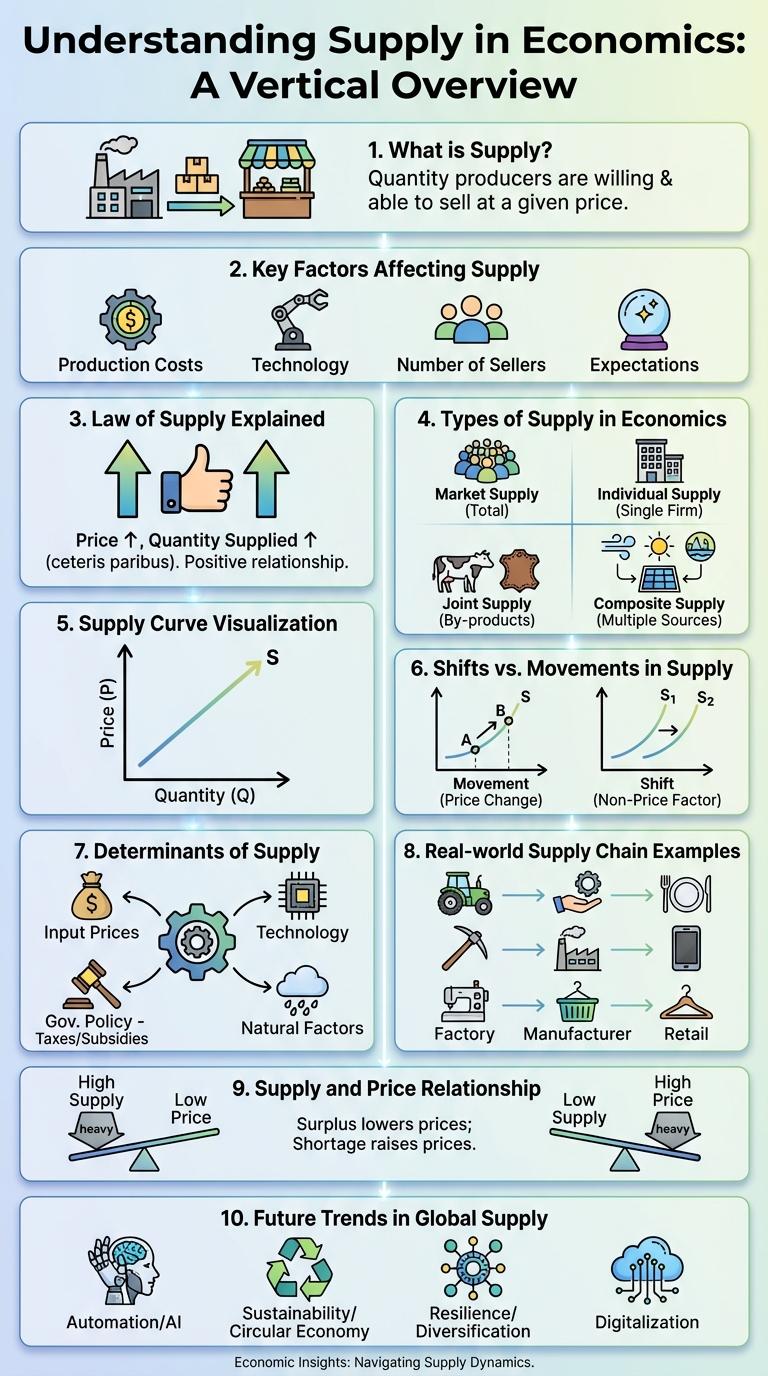
A well-designed supply infographic visually breaks down complex data related to supply chains and inventory management. It highlights key metrics such as demand forecasts, stock levels, and distribution routes to enhance decision-making efficiency. Clear visuals and concise information help businesses optimize their supply processes and improve overall operational performance.
What is Supply?
Supply refers to the total quantity of a good or service that producers are willing and able to offer to the market at various prices. It reflects the relationship between price levels and the amount available for sale.
Factors influencing supply include production costs, technology, and seller expectations. Understanding supply helps businesses and economists predict market behavior and price changes.
Key Factors Affecting Supply
Supply levels in any market are influenced by multiple key factors that determine the quantity of goods producers are willing and able to sell. Understanding these factors helps businesses anticipate changes and plan production efficiently.
Input costs, such as raw materials and labor, directly impact a producer's ability to supply products at various price points. Technological advancements can reduce production costs, thereby increasing supply by enabling higher output at lower expenses.
Law of Supply Explained
The Law of Supply states that as the price of a good or service increases, producers are willing to supply more of it. This fundamental economic principle explains the positive relationship between price and quantity supplied.
Higher prices provide an incentive for producers to increase production to maximize profits. Conversely, when prices fall, the quantity supplied typically decreases. Factors influencing supply include production costs, technology, and the number of sellers in the market.
Types of Supply in Economics
Supply in economics refers to the quantity of a good or service that producers are willing and able to offer for sale at different prices. Types of supply include individual supply, which is the supply from a single producer, and market supply, which aggregates all individual supplies in a market. Other types include short-run supply, influenced by fixed production capacity, and long-run supply, where producers can adjust all inputs.
Supply Curve Visualization
The supply curve graphically represents the relationship between price and quantity supplied by producers. It typically slopes upward, indicating that higher prices incentivize increased production. This visualization helps businesses and economists predict market behavior and optimize supply strategies.
Shifts vs. Movements in Supply
What distinguishes shifts from movements in supply? Movements in supply occur when the price of the good itself changes, causing the quantity supplied to increase or decrease along the same supply curve. Shifts in supply happen when factors other than price, such as technology or input costs, change, resulting in the entire supply curve moving left or right.
Determinants of Supply
Supply represents the quantity of a product or service that producers are willing and able to sell at various prices over a period. Several key factors influence supply levels in the market.
- Input Prices - Changes in the cost of raw materials or labor affect the overall production cost, impacting supply.
- Technology - Advancements improve production efficiency, often increasing supply by reducing costs.
- Number of Sellers - An increase in producers in the market generally raises total supply available to consumers.
Real-world Supply Chain Examples
Supply and Price Relationship
Supply directly influences market prices by dictating the quantity of goods available. Understanding the supply and price relationship helps predict consumer behavior and market trends.
- Law of Supply - Higher prices incentivize producers to increase the quantity supplied.
- Supply Curve - Typically slopes upward, illustrating that supply rises as price increases.
- Market Equilibrium - The price where quantity supplied equals quantity demanded, stabilizing the market.
Shifts in supply, caused by factors like production costs or technology, lead to changes in market prices.