
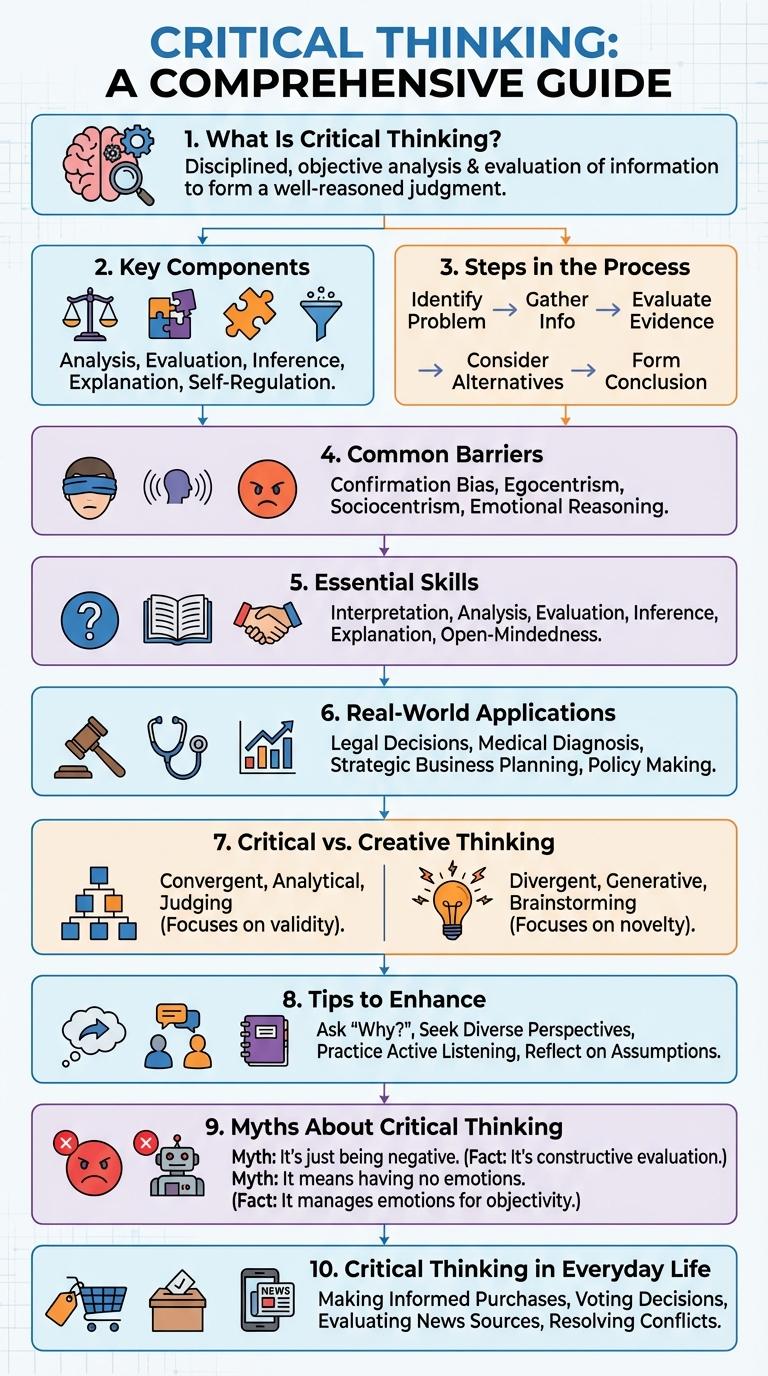
Critical thinking involves analyzing information objectively to make reasoned judgments. It enhances problem-solving skills by encouraging the evaluation of evidence and consideration of alternative perspectives. Mastering critical thinking empowers individuals to make informed decisions in complex situations.
What Is Critical Thinking?
| Aspect | Description |
|---|---|
| Definition | Critical thinking is the ability to analyze, evaluate, and synthesize information objectively. |
| Purpose | To make reasoned judgments and solve problems effectively. |
| Key Skills | Analysis, evaluation, inference, explanation, and self-regulation. |
| Importance | Enhances decision-making, improves problem-solving, and promotes independent thinking. |
| Application | Used across all disciplines including education, business, and daily life situations. |
Key Components of Critical Thinking
Critical thinking involves analyzing information objectively to make reasoned judgments. It is essential for problem-solving and decision-making in various fields.
- Analysis - Examining information carefully to understand its components and relationships.
- Evaluation - Assessing the credibility and relevance of information and arguments.
- Inference - Drawing logical conclusions based on evidence and reasoning.
- Explanation - Clearly and concisely articulating the reasoning behind conclusions.
- Self-Regulation - Reflecting on one's own beliefs and adjusting them when necessary.
Mastering these components strengthens overall critical thinking skills and enhances decision-making quality.
Steps in the Critical Thinking Process
Critical thinking involves systematic steps to analyze information and make reasoned decisions. The process includes identifying the problem, gathering relevant data, evaluating evidence, and drawing logical conclusions. Mastering these steps enhances problem-solving skills and promotes clear, objective thinking.
| Step | Description |
|---|---|
| Identify the Problem | Recognize the issue or question that requires attention. |
| Gather Information | Collect data, evidence, and perspectives related to the problem. |
| Evaluate Evidence | Analyze the credibility and relevance of collected information. |
| Draw Conclusions | Make informed decisions based on logical reasoning. |
| Reflect and Review | Assess the outcomes and refine the thinking process if needed. |
Common Barriers to Critical Thinking
Critical thinking is essential for making informed decisions and solving problems effectively. Many individuals face obstacles that hinder their ability to think critically.
Common barriers to critical thinking include cognitive biases, such as confirmation bias and anchoring. Emotional influences can cloud judgment, leading to irrational conclusions. Lack of knowledge or misinformation also prevents objective analysis of information.
Essential Critical Thinking Skills
Critical thinking involves analyzing information objectively to make reasoned judgments. Essential skills include interpretation, analysis, evaluation, inference, explanation, and self-regulation.
Interpretation requires understanding and clarifying facts or meanings. Analysis focuses on examining arguments and identifying relationships between ideas.
Real-World Applications of Critical Thinking
Critical thinking is essential for solving complex problems and making informed decisions in everyday life. It enables individuals to analyze information objectively and assess various perspectives.
- Problem Solving - Critical thinking helps identify solutions by evaluating evidence and potential outcomes logically.
- Decision Making - It supports making well-informed choices by weighing pros and cons without bias.
- Effective Communication - Critical thinking improves clarity and coherence in presenting ideas and arguments.
Critical Thinking vs. Creative Thinking
What distinguishes critical thinking from creative thinking? Critical thinking involves analyzing and evaluating information to form a reasoned judgment. Creative thinking focuses on generating innovative ideas and original solutions.
| Critical Thinking | Creative Thinking |
|---|---|
| Logical analysis of facts | Imaginative and divergent thinking |
| Evaluates arguments and evidence | Explores new possibilities |
| Seeks clarity and accuracy | Encourages originality and innovation |
| Based on structured reasoning | Embraces open-ended exploration |
| Focus on problem-solving accuracy | Focus on idea generation |
Tips to Enhance Critical Thinking
Critical thinking is essential for making informed decisions and solving complex problems effectively. Enhancing this skill involves consistent practice and adopting strategic approaches.
Question assumptions and seek evidence before forming conclusions. Engage in reflective thinking to evaluate your own reasoning process.
Myths About Critical Thinking
Critical thinking is often misunderstood, leading to common myths that can hinder its effective practice. Clarifying these misconceptions helps people develop stronger analytical skills.
- Critical thinking is just criticizing - It involves evaluating information objectively, not simply finding faults.
- Only experts can think critically - Everyone can develop critical thinking skills with practice and guidance.
- Critical thinking means being skeptical about everything - It requires open-mindedness and fair evaluation of evidence, not outright doubt.