
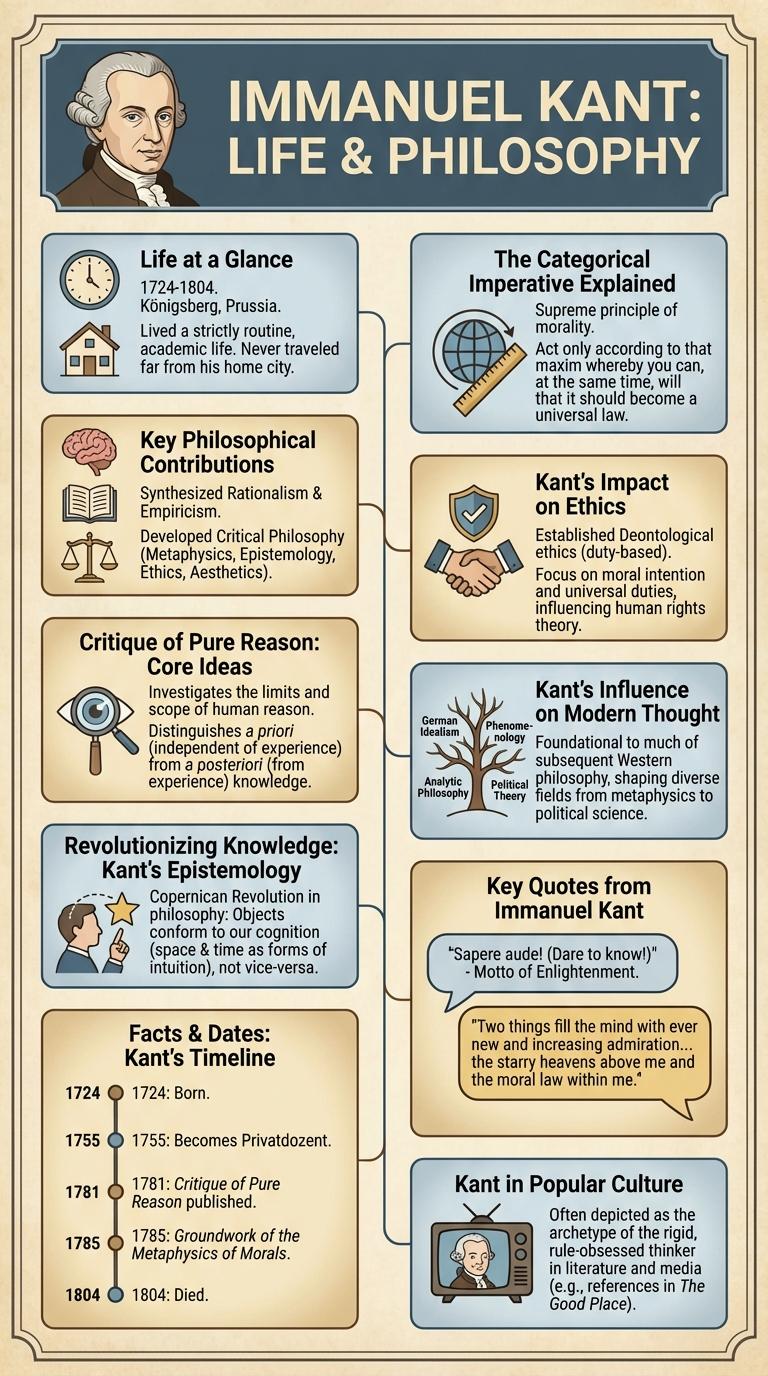
Immanuel Kant revolutionized philosophy with his critical examination of reason and morality, laying the groundwork for modern epistemology and ethics. His profound ideas on the nature of knowledge and the categorical imperative continue to influence contemporary thought. This infographic presents key concepts and milestones from Kant's life and work.
Immanuel Kant: Life at a Glance
Immanuel Kant (1724-1804) was a German philosopher born in Konigsberg, Prussia, now Kaliningrad, Russia. He is best known for his work in epistemology and ethics, particularly the "Critique of Pure Reason." Kant's philosophy laid the groundwork for modern Western thought with his ideas on autonomy, morality, and the nature of knowledge.
Key Philosophical Contributions
Immanuel Kant was a German philosopher who revolutionized modern philosophy with his critical approach to knowledge and ethics. His ideas continue to influence various fields including metaphysics, epistemology, and moral philosophy.
- Critique of Pure Reason - Kant established the framework for understanding how human cognition shapes experience through a priori concepts.
- Categorical Imperative - He formulated a universal moral law that demands actions be performed according to maxims that can be universally applied.
- Phenomena and Noumena - Kant distinguished between things as they appear to us and things as they are in themselves, highlighting limits of human perception.
The Categorical Imperative Explained
Immanuel Kant's Categorical Imperative is a foundational concept in his moral philosophy, emphasizing that actions must be universally applicable. It requires individuals to act only according to maxims that can be consistently willed as universal laws. This principle promotes moral duty and respect for humanity as an end in itself, rather than a means to an end.
Kant's Impact on Ethics
Immanuel Kant revolutionized modern ethics with his deontological approach, emphasizing duty and moral law over consequences. His philosophy centers on the idea that actions are morally right if they are motivated by a sense of duty derived from universal principles.
Kant's concept of the categorical imperative serves as the foundation for assessing moral actions, requiring that one act only according to maxims that can be universally willed. This framework shifted ethical evaluation from outcomes to intentions, promoting autonomy and rationality. His impact extends across philosophy, influencing contemporary debates in moral theory, human rights, and law.
Critique of Pure Reason: Core Ideas
Immanuel Kant's Critique of Pure Reason revolutionized philosophy by examining the limits and scope of human knowledge. It addresses how experience and reason interact to shape our understanding of reality.
The core ideas challenge previous metaphysical assumptions and establish a framework for modern epistemology.
- Phenomena vs. Noumena - Humans can know only phenomena, which are things as they appear, not noumena, the things-in-themselves.
- Categories of Understanding - The mind imposes intrinsic categories like causality and substance to organize sensory input.
- Transcendental Idealism - Space and time are forms of intuition shaped by our perception, not independently existing entities.
Revolutionizing Knowledge: Kant's Epistemology
Immanuel Kant revolutionized philosophy by bridging rationalism and empiricism, emphasizing how knowledge arises from the interaction between sensory experience and innate cognitive structures. His epistemology challenges traditional views, proposing that the mind actively shapes our understanding of reality through a priori concepts.
Kant introduced the concept of synthetic a priori judgments, which are essential for acquiring new knowledge beyond mere experience. His "Critique of Pure Reason" remains a foundational work, reshaping modern approaches to metaphysics, science, and epistemology.
Facts & Dates: Kant's Timeline
Immanuel Kant was a German philosopher renowned for his critical philosophy and contributions to epistemology and ethics. His work laid the groundwork for modern philosophy and influenced various fields, including metaphysics and political theory.
- 1724: Birth - Immanuel Kant was born in Konigsberg, Prussia, on April 22, 1724.
- 1746: University Graduation - Kant graduated from the University of Konigsberg, where he later became a professor.
- 1781: Publication of Critique of Pure Reason - This seminal work established his critical philosophy, revolutionizing how knowledge and experience are understood.
- 1797: Metaphysics of Morals - Kant published key ethical writings outlining his deontological moral philosophy.
- 1804: Death - Kant died on February 12, 1804, in Konigsberg, leaving a profound philosophical legacy.
Kant's timeline highlights significant milestones that shaped the trajectory of Western philosophy and continue to inspire contemporary thought.
Kant's Influence on Modern Thought
How did Immanuel Kant shape modern philosophy and thought? Kant revolutionized epistemology by proposing that knowledge arises from the interaction between sensory experience and innate concepts. His ideas laid the foundation for critical philosophy, influencing diverse fields such as ethics, metaphysics, and political theory.
| Key Concept | Impact |
|---|---|
| Copernican Revolution in Philosophy | Shifted focus from the external world to the mind's role in shaping experience. |
| Categorical Imperative | Established a universal moral law guiding ethical decision-making. |
| Transcendental Idealism | Distinguished between phenomena (observable) and noumena (things-in-themselves). |
| Influence on Enlightenment | Encouraged autonomy, reason, and human dignity, shaping modern democratic values. |
| Legacy in Contemporary Thought | Inspired modern debates in philosophy, cognitive science, and political philosophy. |
Key Quotes from Immanuel Kant
Immanuel Kant, a central figure in modern philosophy, profoundly influenced epistemology and ethics. His critical philosophy emphasizes the limits of human understanding and the importance of moral law.
"Sapere aude! Have courage to use your own understanding." This famous quote from Kant encourages intellectual independence and enlightenment. Another key phrase, "Act only according to that maxim whereby you can at the same time will that it should become a universal law," highlights his principle of the categorical imperative.