
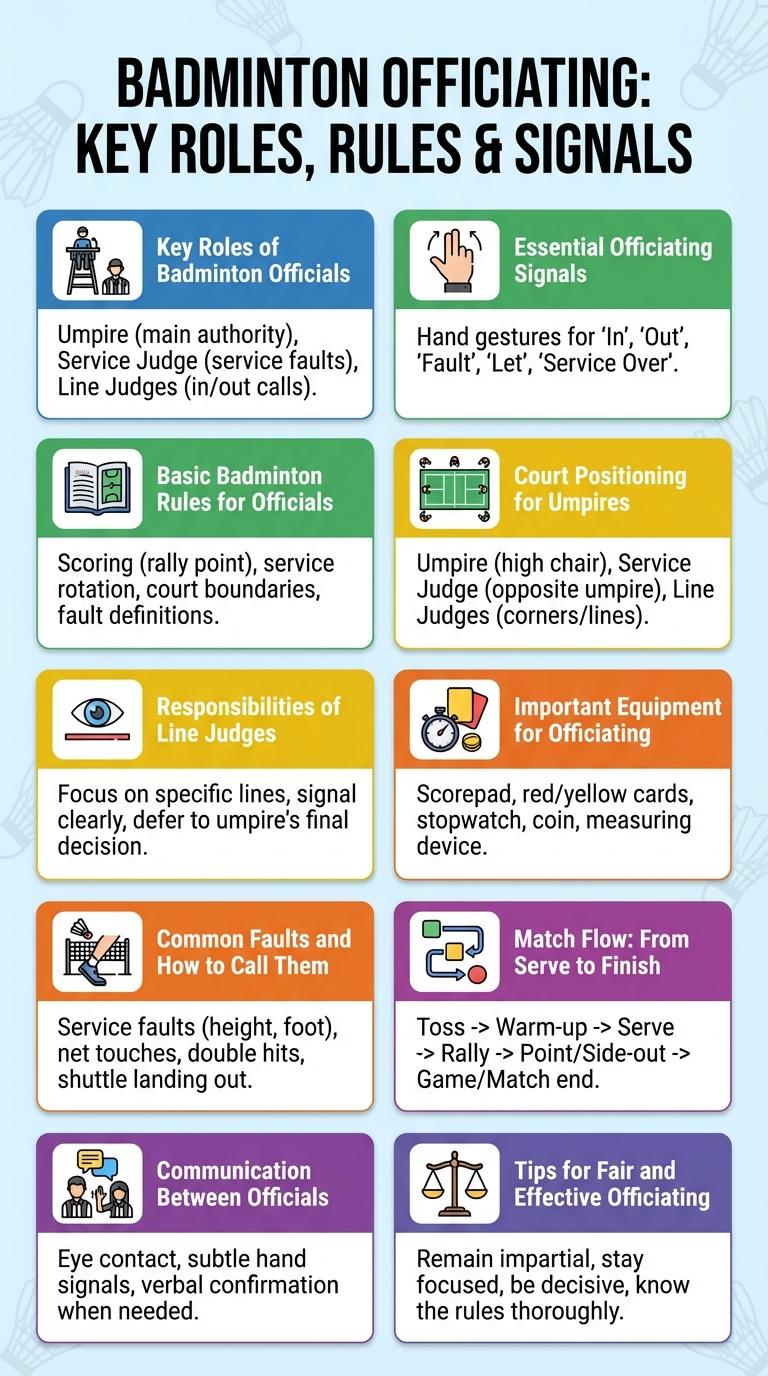
Officiating badminton requires a deep understanding of the rules, sharp observation skills, and quick decision-making to maintain fair play. Accurate judgment on serves, faults, and line calls ensures the flow and integrity of the game. This infographic highlights key responsibilities, common signals, and essential techniques that every badminton official should master.
Key Roles of Badminton Officials
Badminton officials play crucial roles in ensuring fair play and maintaining the flow of the game. Key officials include the umpire, who enforces rules and makes final decisions, and the service judge, who monitors serve legality. Line judges assist by calling shot accuracy, while the referee oversees the entire match environment and resolves disputes.
Essential Officiating Signals
Officiating badminton requires clear and standardized signals to maintain fair play and communication on the court. Essential signals guide players, coaches, and spectators throughout the match.
- Service Fault Signal - The umpire raises their arm vertically with an open hand to indicate a service fault.
- Let Signal - Both hands are raised above the head with open palms to signal a replay of the rally.
- Out Signal - The umpire extends their arm horizontally and points towards the court side where the shuttle landed out of bounds.
Mastering these essential signals ensures clear communication and smooth conduct of badminton matches.
Basic Badminton Rules for Officials
Officiating badminton requires a thorough understanding of the sport's rules to ensure fair play. Officials must observe matches closely and enforce regulations consistently throughout the game.
- Service Rules - The shuttle must be hit below the server's waist and travel diagonally to the opponent's service court.
- Scoring System - Matches are played best of three games, with each game played to 21 points using rally scoring.
- Faults and Lets - Officials call faults for rule infractions and lets to replay points in case of distractions or unforeseen incidents.
Court Positioning for Umpires
Where should umpires position themselves during a badminton match? Umpires stand on a high chair near the center of one side of the court to maintain an unobstructed view. This vantage point allows clear observation of service faults and boundary lines.
Why is court positioning crucial for badminton umpires? Proper positioning ensures umpires make accurate decisions on line calls and player conduct. It minimizes errors and helps maintain fairness throughout the match.
How do umpires adjust their position during doubles games? Umpires remain seated in the same area but frequently shift gaze and head angle to monitor both sides of the court. This technique aids in tracking rapid exchanges and court coverage.
What challenges do umpires face regarding court positioning? Limited mobility confines umpires to their chair, requiring excellent focus and anticipation. Effective positioning compensates for restricted movement and fast-paced rallies.
How does court design influence umpire positioning? Standard badminton courts measure 13.4 meters by 6.1 meters for doubles and 5.18 meters wide for singles. Umpires position their chair slightly behind the doubles long service line on the side to oversee all key areas.
Responsibilities of Line Judges
Line Judges in badminton play a crucial role in ensuring the accuracy of calls related to shuttlecock landings. They observe the boundaries and quickly signal whether the shuttle lands in or out.
Each Line Judge is assigned specific lines to monitor, maintaining focus throughout the match. Their decisions contribute significantly to fair play, supporting the umpire's authority on the court.
Important Equipment for Officiating
Officiating badminton requires specific equipment to ensure accurate and fair gameplay. Proper tools help referees maintain control and make precise decisions during matches.
- Scoreboard - Displays the current scores for both players or teams clearly to players and spectators.
- Whistle - Used by the umpire to signal the start, stop, and any faults during the game.
- Shuttlecock - Essential for testing and verifying shuttlecock quality and playability during matches.
Common Faults and How to Call Them
Officiating in badminton requires keen observation to identify faults that affect fair play. Umpires and line judges play vital roles in ensuring the game adheres to established rules.
Common faults include service errors, such as serving above the waist or stepping outside the service court. Faults also occur when the shuttlecock lands outside the court boundaries or passes through the net improperly. To call these faults, officials use clear hand signals and verbal announcements to maintain the game's flow and fairness.
Match Flow: From Serve to Finish
Officiating a badminton match requires close attention to each stage, from the initial serve to the final rally. The referee and line judges collaborate to ensure fair play and adherence to rules throughout the match.
The match begins with the server delivering the shuttlecock within the designated service courts. Officials monitor for service faults, shuttlecock in/out decisions, and foot faults during this critical phase.
During rallies, line judges watch shuttle landings while the umpire keeps score and enforces the best-of-three-games format. The match concludes when a player secures 21 points with at least a 2-point lead, or in extended rallies, a 30-point cap.
Post-match, officials confirm the results and oversee the players' conduct until the handshake, emphasizing sportsmanship. Consistent officiating maintains the integrity and pace of badminton competitions worldwide.
Communication Between Officials
Effective communication between badminton officials is crucial for maintaining fair play and ensuring smooth match progression. Officials use clear signals and concise verbal cues to coordinate decisions and resolve disputes swiftly. Consistent communication fosters trust, accuracy, and efficiency during the game.