
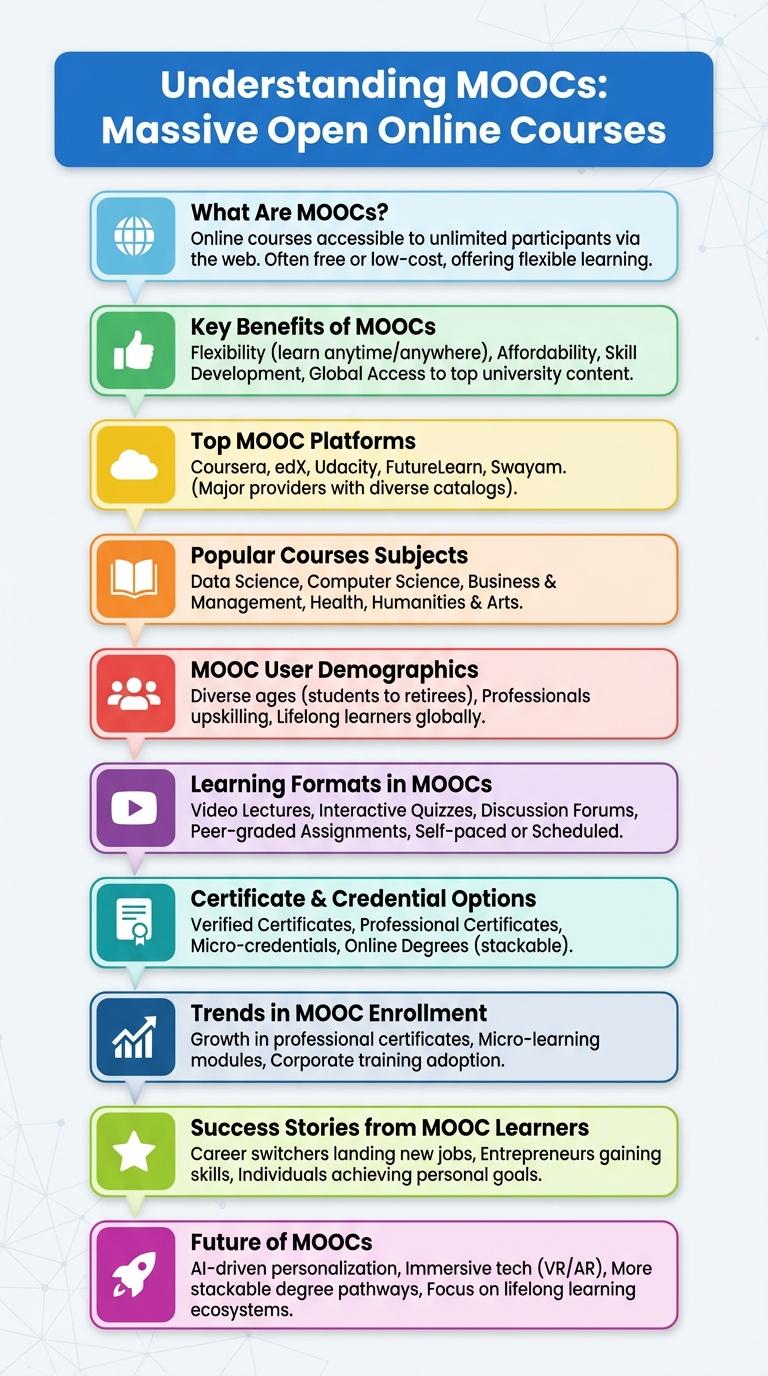
Massive Open Online Courses (MOOCs) revolutionize education by providing accessible, flexible learning opportunities to millions worldwide. Infographics about MOOCs highlight key trends, popular platforms, and course completion rates through engaging visuals. These insights help learners and educators understand the impact and future potential of online education.
What Are MOOCs?
What are MOOCs? MOOCs, or Massive Open Online Courses, are free or low-cost online classes available to anyone with internet access. They cover a wide range of subjects, allowing learners worldwide to gain new skills and knowledge at their own pace.
Key Benefits of MOOCs
Massive Open Online Courses (MOOCs) offer accessible and flexible learning opportunities to a global audience. They provide high-quality education from top institutions without geographical or financial barriers.
- Accessibility - MOOCs enable learners worldwide to access courses anytime and anywhere with an internet connection.
- Affordability - Many MOOCs are free or low-cost, reducing the expense barrier for quality education.
- Variety of Subjects - MOOCs offer a wide range of courses covering diverse fields, catering to different interests and career goals.
Top MOOC Platforms
Massive Open Online Courses (MOOCs) have revolutionized access to education worldwide. They provide flexible learning opportunities across various subjects, catering to millions of students.
Top MOOC platforms include Coursera, edX, Udacity, FutureLearn, and Khan Academy. Coursera partners with leading universities to offer professionally recognized certificates. edX provides high-quality courses from institutions like Harvard and MIT, emphasizing academic rigor and research.
Popular Courses Subjects
Massive Open Online Courses (MOOCs) cover a wide range of popular course subjects that attract millions of learners worldwide. Technology and programming, business and management, data science, personal development, and health and wellness stand out as top categories. These subjects offer flexible learning opportunities to upskill, reskill, and explore new interests from leading universities and organizations.
MOOC User Demographics
Massive Open Online Courses (MOOCs) attract a diverse global audience. Learners span various age groups, educational backgrounds, and professional sectors.
Data shows that 60% of MOOC users are between 18 and 35 years old, seeking skill development or higher education credentials. Approximately 45% hold at least a bachelor's degree, reflecting strong engagement from educated professionals aiming to enhance their expertise.
Learning Formats in MOOCs
| Learning Format | Description |
|---|---|
| Video Lectures | Pre-recorded sessions presenting course content with visuals, enabling self-paced learning. |
| Interactive Quizzes | Embedded assessments to reinforce knowledge and provide instant feedback during the course. |
| Discussion Forums | Online platforms facilitating peer interaction, knowledge exchange, and instructor engagement. |
| Assignments and Projects | Practical activities designed to apply concepts and develop skills through real-world scenarios. |
| Live Webinars | Scheduled sessions with instructors or experts allowing real-time Q&A and deeper insights. |
Certificate & Credential Options
Massive Open Online Courses (MOOCs) offer a variety of certificate and credential options tailored to learners' goals. These certificates can enhance resumes, showcase skills, and provide proof of completion for both professional and personal development.
Most MOOCs provide verified certificates upon course completion, often requiring a fee and identity verification. Some platforms collaborate with universities and industry leaders to offer accredited credentials, including professional certifications and micro-credentials.
Trends in MOOC Enrollment
Massive Open Online Courses (MOOCs) continue to reshape the landscape of digital education. Enrollment trends highlight diverse learner demographics and growing global reach.
- Rapid Growth - MOOC enrollment surged by over 20% annually from 2018 to 2023, reflecting expanding access to online learning platforms.
- Geographic Diversity - Learners from Asia and Africa constitute nearly 50% of total MOOC participants, emphasizing global inclusivity.
- Professional Development - More than 60% of enrollments focus on career advancement courses such as IT, business, and data science.
MOOCs remain a pivotal tool for accessible, flexible education worldwide.
Success Stories from MOOC Learners
Massive Open Online Courses (MOOCs) have transformed global education by providing accessible learning opportunities. Success stories from MOOC learners highlight the platform's impact on career advancement and skill development.
These learners demonstrate how MOOCs enable professional growth and lifelong learning.
- Career Transition Success - Professionals have successfully shifted industries by completing specialized MOOC programs.
- Skill Enhancement - Learners improved job-relevant skills, leading to promotions and salary increases.
- Entrepreneurial Growth - Entrepreneurs used MOOCs to acquire knowledge critical for launching and scaling businesses.
- Global Access to Education - Students from remote or underserved areas gained high-quality education through MOOCs.
- Academic Progression - MOOC completions supported learners in gaining admission to advanced degree programs.