
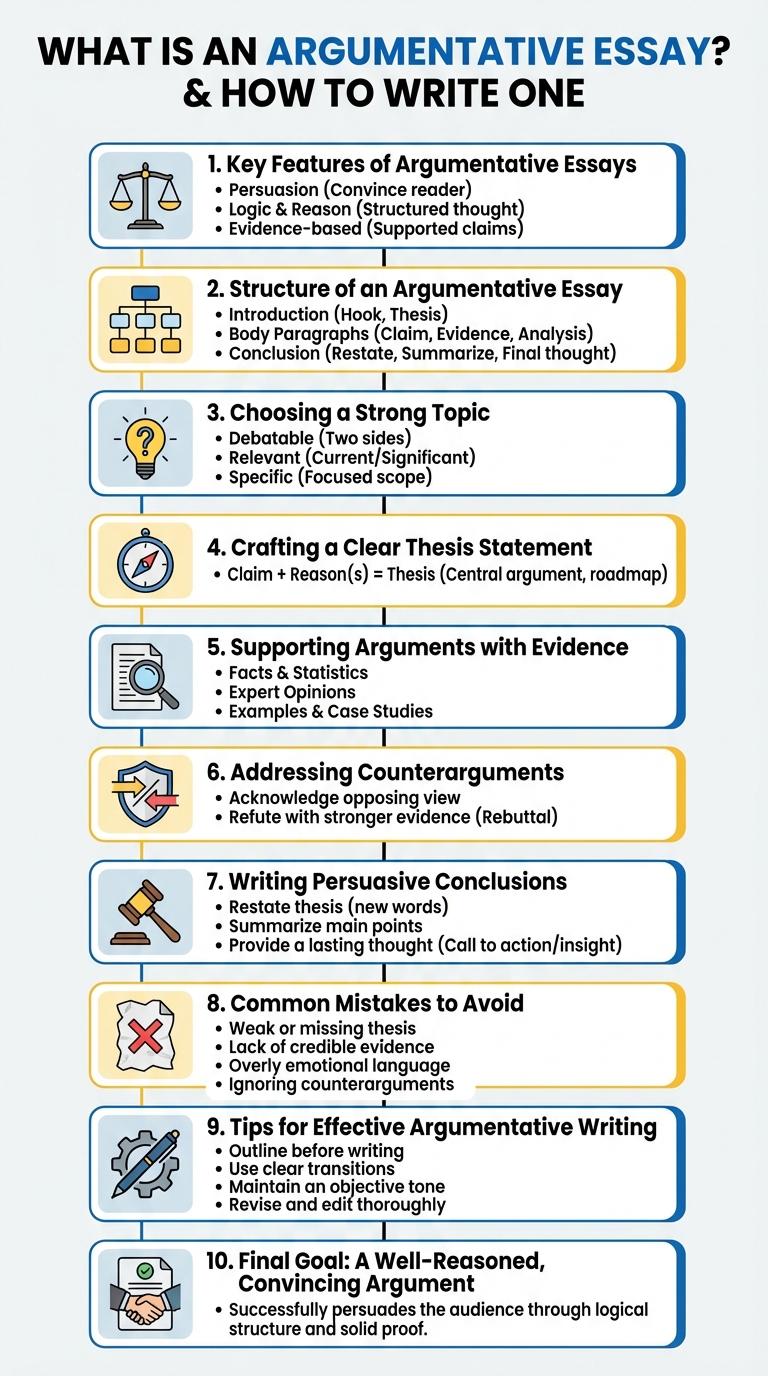
An infographic about argumentative essays visually breaks down the essential components for crafting a compelling and persuasive argument. It highlights key elements such as thesis statements, supporting evidence, counterarguments, and effective conclusion strategies. This visual guide helps students and writers understand the structure and techniques needed to develop a strong argumentative essay.
What Is an Argumentative Essay?
An argumentative essay presents a clear position on a specific topic and supports it with evidence and reasoning. Its primary goal is to persuade the reader to accept the writer's viewpoint.
This type of essay requires thorough research to gather credible facts, statistics, and examples. Writers must address opposing arguments to strengthen their position. A strong thesis statement guides the overall structure and focus of the essay.
Key Features of Argumentative Essays
An argumentative essay presents a clear claim supported by evidence and logical reasoning. It addresses counterarguments to strengthen the writer's position. The essay concludes by reinforcing the thesis and summarizing key points.
Structure of an Argumentative Essay
An argumentative essay presents a clear position on a topic and supports it with evidence and reasoning. The structure is essential to effectively persuade the reader.
The essay typically includes an introduction, body paragraphs, and a conclusion. Each section has a specific role in building a coherent argument.
| Section | Purpose |
|---|---|
| Introduction | Introduces the topic and states the thesis or main argument. |
| Body Paragraphs | Provide evidence, examples, and reasoning to support the thesis. |
| Counterarguments | Address opposing viewpoints to strengthen the essay's credibility. |
| Conclusion | Restates the thesis and summarizes key points to reinforce the argument. |
Choosing a Strong Topic
Choosing a strong topic is essential for a compelling argumentative essay. Focus on issues that are relevant, debatable, and have ample evidence available. A well-defined topic helps structure your argument and engage your audience effectively.
Crafting a Clear Thesis Statement
Supporting Arguments with Evidence
Supporting arguments with strong evidence is crucial in an argumentative essay to convince readers of your viewpoint. Evidence includes facts, statistics, examples, and expert opinions that validate your claims.
Use credible sources to back up each argument and explain how the evidence connects to your thesis. Properly integrating evidence strengthens the overall persuasiveness of your essay.
Addressing Counterarguments
How can addressing counterarguments strengthen an argumentative essay? Addressing counterarguments demonstrates critical thinking and enhances the credibility of your argument. It shows that you have considered multiple perspectives and can defend your position effectively.
| Step | Description |
|---|---|
| Identify Counterarguments | Research opposing viewpoints relevant to your thesis. |
| Present Counterarguments | Clearly explain opposing views to acknowledge different perspectives. |
| Refute Counterarguments | Use evidence and reasoning to challenge and discredit opposing views. |
| Strengthen Your Position | Reinforce your thesis by showing why your argument stands stronger. |
Incorporating counterarguments improves the logical flow and balance of the essay. It increases the essay's persuasive power by anticipating and answering doubts from the audience.
Writing Persuasive Conclusions
Effective persuasive conclusions reinforce the essay's main argument and leave a lasting impact on the reader. Crafting a compelling conclusion involves summarizing key points and inspiring the audience to take action or reconsider their perspective.
- Restate the Thesis - Reaffirm your main argument succinctly to remind readers of your essay's purpose.
- Summarize Key Points - Highlight the strongest evidence supporting your position without repeating details.
- Call to Action - Encourage readers to think, feel, or act differently based on your persuasive argument.
Common Mistakes to Avoid
Writing an argumentative essay requires clarity and precision to persuade readers effectively. Avoiding common mistakes enhances the strength of your argument and overall essay quality.
- Weak Thesis Statement - Failing to present a clear, arguable thesis weakens the essay's direction and purpose.
- Ignoring Counterarguments - Neglecting opposing viewpoints reduces credibility and one-sided arguments seem biased.
- Insufficient Evidence - Using vague or unsupported claims diminishes the essay's persuasiveness and authority.
- Poor Organization - Disorganized ideas confuse readers and disrupt logical flow within the essay.
- Overuse of Emotional Appeals - Relying too much on emotions rather than facts undermines the essay's rational appeal.
Avoiding these pitfalls improves argumentative essays by ensuring clear reasoning and credible support throughout.