
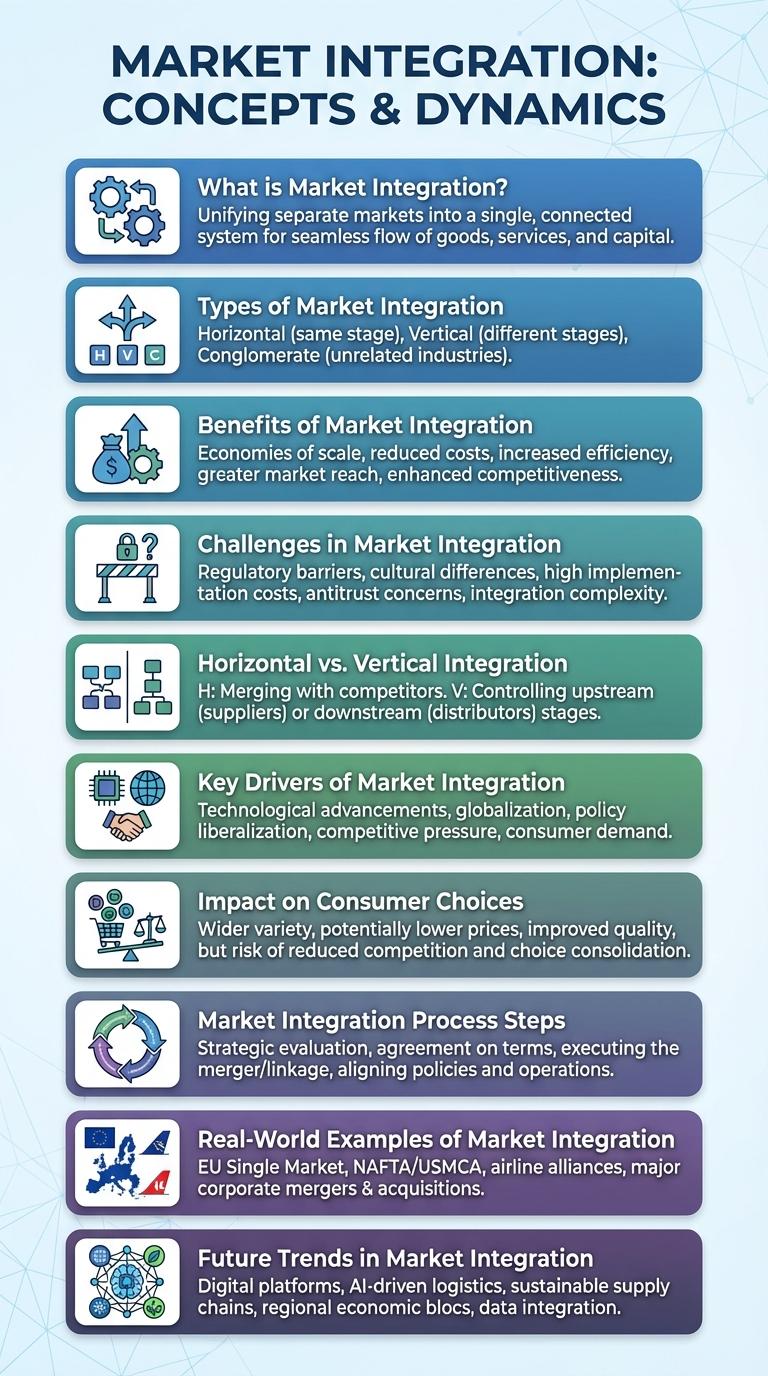
Market integration enhances economic efficiency by connecting different regional markets, promoting seamless trade and resource allocation. Improved market integration reduces price disparities, facilitates competition, and supports economic growth by enabling businesses to access broader consumer bases. Infographics illustrate these dynamics clearly, making complex market interactions easier to understand.
What is Market Integration?
Market integration refers to the process where separate markets for the same goods or services become interconnected, allowing prices to converge. It leads to a unified market where supply and demand balance across regions.
Market integration improves efficiency by reducing price disparities and transaction costs. It fosters competition, enhances resource allocation, and promotes economic growth. Examples include integrated financial markets, trade zones, and digital platforms connecting global buyers and sellers.
Types of Market Integration
Market integration enhances economic efficiency by reducing trade barriers and increasing competition. It involves various types that connect markets across different levels and regions.
- Horizontal Integration - Merges companies operating in the same industry to increase market share and reduce competition.
- Vertical Integration - Combines firms at different stages of production to control the supply chain and lower costs.
- Diagonal Integration - Involves a partnership between companies in unrelated industries for diversification and risk management.
Benefits of Market Integration
| Benefit | Description |
|---|---|
| Increased Trade Efficiency | Eliminates trade barriers, lowers costs, and enhances the speed of transactions between markets. |
| Expanded Market Access | Allows businesses to reach larger consumer bases, facilitating growth and diversification. |
| Enhanced Competition | Promotes innovation and quality improvement by encouraging competitive business environments. |
| Resource Optimization | Facilitates better allocation of resources by connecting markets with complementary supply and demand. |
| Economic Growth | Supports overall economic development through increased investment, productivity, and employment opportunities. |
Challenges in Market Integration
What are the main challenges in market integration? Market integration faces obstacles such as regulatory differences and infrastructure gaps that hinder seamless trade. These challenges impact efficiency and limit the full benefits of unified markets.
Horizontal vs. Vertical Integration
Market integration enhances business efficiency by combining operations to increase market share and reduce competition. Horizontal integration involves merging companies at the same production stage, expanding market reach and reducing competition. Vertical integration combines firms across different supply chain stages, improving control over production, costs, and distribution.
Key Drivers of Market Integration
Market integration refers to the process of unifying separate markets to function as a cohesive system, enhancing efficiency and competitiveness. Key drivers of this integration include technological advancements, trade liberalization, and improved infrastructure.
- Technological Advancements - Innovations in communication and information technology enable faster and more efficient market transactions across regions.
- Trade Liberalization - Reduction of tariffs and trade barriers promotes the flow of goods and services between markets globally.
- Improved Infrastructure - Development of transportation and logistics networks facilitates seamless connectivity between markets.
Impact on Consumer Choices
Market integration enhances consumer choices by connecting diverse suppliers and products across regions. This expanded access often reduces prices and increases the variety of goods available to consumers. Greater market integration promotes competitive quality improvements and innovation, benefiting end-users significantly.
Market Integration Process Steps
Market integration is the process of unifying separate markets to enable free flow of goods, services, and capital. It enhances economic efficiency and expands opportunities for businesses and consumers.
- Market Assessment - Analyze existing market structures and identify barriers to integration.
- Policy Alignment - Harmonize regulations, standards, and tariffs among involved markets.
- Infrastructure Development - Improve transportation, communication, and financial systems to support integration.
- Stakeholder Engagement - Involve governments, businesses, and consumers to ensure smooth implementation.
- Monitoring and Evaluation - Continuously assess integration progress and make necessary adjustments.
Successful market integration leads to improved competitiveness, increased trade, and stronger economic growth across regions.
Real-World Examples of Market Integration
Market integration connects different regional or national markets, enabling goods, services, and capital to flow seamlessly. This process reduces trade barriers and promotes economic cooperation.
Real-world examples of market integration include the European Union's Single Market and the ASEAN Economic Community. Both initiatives aim to create unified markets by harmonizing regulations and facilitating cross-border trade.