
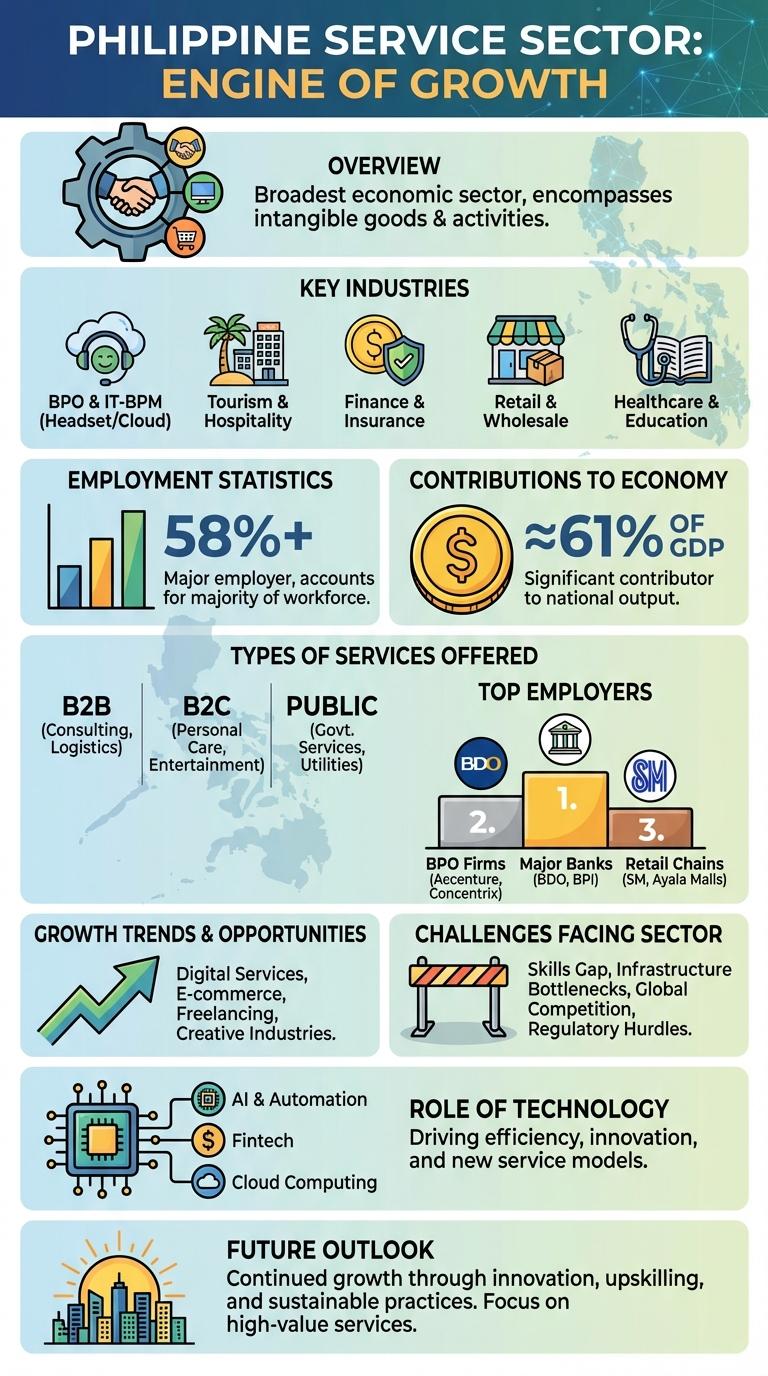
The sektor ng paglilingkod plays a crucial role in driving economic growth and improving quality of life by providing essential services across various industries. This infographic highlights key statistics, trends, and impacts of the service sector, emphasizing its contribution to employment and GDP. Understanding these insights helps in recognizing the sector's significance in both local and global markets.
Overview of the Service Sector
The service sector plays a vital role in the global economy by providing intangible goods and services. It encompasses a wide range of industries that cater to consumer and business needs.
- Economic Contribution - The service sector accounts for over 60% of GDP in many developed countries.
- Employment Generator - It employs the largest portion of the workforce worldwide, including jobs in healthcare, education, and retail.
- Diverse Industries - Key areas include finance, hospitality, information technology, and professional services.
Key Industries in the Service Sector
The service sector plays a vital role in economic growth, encompassing industries that provide intangible goods and services. Key industries within this sector drive employment and innovation, catering to various consumer and business needs.
Prominent industries include healthcare, finance, education, hospitality, and information technology. These sectors contribute significantly to GDP and offer diverse career opportunities worldwide.
Employment Statistics in the Service Sector
The service sector constitutes over 55% of total employment in many developing economies, highlighting its critical role in job creation. Key industries include retail, healthcare, education, and financial services, each contributing significantly to workforce distribution. Employment growth in this sector often correlates with urbanization and increased consumer demand for professional services.
Contributions to the Philippine Economy
How does the sektor ng paglilingkod contribute to the Philippine economy? The service sector accounts for over 55% of the country's GDP, highlighting its critical role in economic growth. Employment in this sector reaches more than 50% of the workforce, fueling consumer spending and development.
| Service Sector Component | Economic Contribution |
|---|---|
| Information Technology and BPO | Generates $38 billion in revenue yearly |
| Tourism | Contributes approximately 12% to GDP |
| Financial Services | Accounts for 8% of GDP |
| Healthcare | Employs over 2 million Filipinos nationwide |
Types of Services Offered
The sektor ng paglilingkod ay mahalagang bahagi ng ekonomiya na nakatuon sa pagbibigay ng iba't ibang uri ng serbisyo sa mga tao at negosyo. Ito ay sumasaklaw sa maraming larangan na nagpapabuti sa kalidad ng buhay at nagpapaunlad ng komunidad.
- Serbisyong Pangkalusugan - Nagbibigay ng medikal na pangangalaga at suporta para sa kalusugan ng publiko.
- Serbisyong Pang-edukasyon - Naglalaan ng edukasyon at pagsasanay sa mga mag-aaral sa iba't ibang antas.
- Serbisyong Pinansyal - Tumutulong sa pamamahala ng pera, pautang, at mga investment para sa mga indibidwal at negosyo.
- Serbisyong Pangkomunikasyon - Nagpapadali ng palitan ng impormasyon sa pamamagitan ng telepono, internet, at iba pang teknolohiya.
- Serbisyong Pangkultura at Libangan - Nagbibigay ng mga aktibidad at programa para sa kasiyahan at pagpapalago ng kultura.
Ang iba't ibang uri ng serbisyong ito ay kritikal sa pagpapaunlad ng ekonomiya at kaligayahan ng lipunan.
Top Employers within the Service Sector
The service sector is a vital part of the economy, encompassing industries such as healthcare, education, finance, and hospitality. Top employers in this sector are known for extensive workforce opportunities, competitive salaries, and career growth. Leading companies include hospitals, banks, educational institutions, and major hotel chains.
| Top Employers | Industry |
|---|---|
| Makati Medical Center | Healthcare |
| BPI (Bank of the Philippine Islands) | Finance |
| Ateneo de Manila University | Education |
| Shangri-La Hotels and Resorts | Hospitality |
Growth Trends and Opportunities
The Sektor ng Paglilingkod or Service Sector plays a critical role in the Philippine economy, accounting for over 55% of the country's GDP. Growth trends reveal a steady annual increase of approximately 6%, driven by ICT, tourism, and financial services.
Key opportunities include digital transformation, which boosts demand for IT and communication services, and the rise of e-commerce supporting logistics and customer support roles. Expanding tourism continues to create jobs in hospitality and transportation, fueling sectoral growth.
Challenges Facing the Service Sector
The service sector plays a crucial role in economic growth and employment. It faces several challenges that impact efficiency and quality of service delivery.
Understanding these challenges helps businesses and policymakers develop better strategies for improvement.
- Labor Shortages - Difficulty in recruiting skilled workers affects service quality and operational capacity.
- Technological Disruption - Rapid advancements require continuous adaptation and investment in new technologies.
- Customer Expectations - Increasing demand for personalized and immediate service puts pressure on providers.
Role of Technology in Services
| Aspect | Role of Technology in the Service Sector |
|---|---|
| Customer Interaction | Technology enables 24/7 customer support via chatbots, AI assistants, and call centers enhancing user experience and satisfaction. |
| Operational Efficiency | Automation of routine tasks, such as scheduling and billing, reduces human error and operational costs, increasing service delivery speed. |
| Data Management | Advanced data analytics systems provide valuable insights into customer behavior and preferences, improving decision-making and personalization. |
| Accessibility | Mobile apps and cloud-based platforms enable services to be delivered remotely, broadening reach for sectors like healthcare, education, and finance. |
| Innovation | Emerging technologies such as artificial intelligence, Internet of Things (IoT), and blockchain drive new service models and improve transparency and security. |