
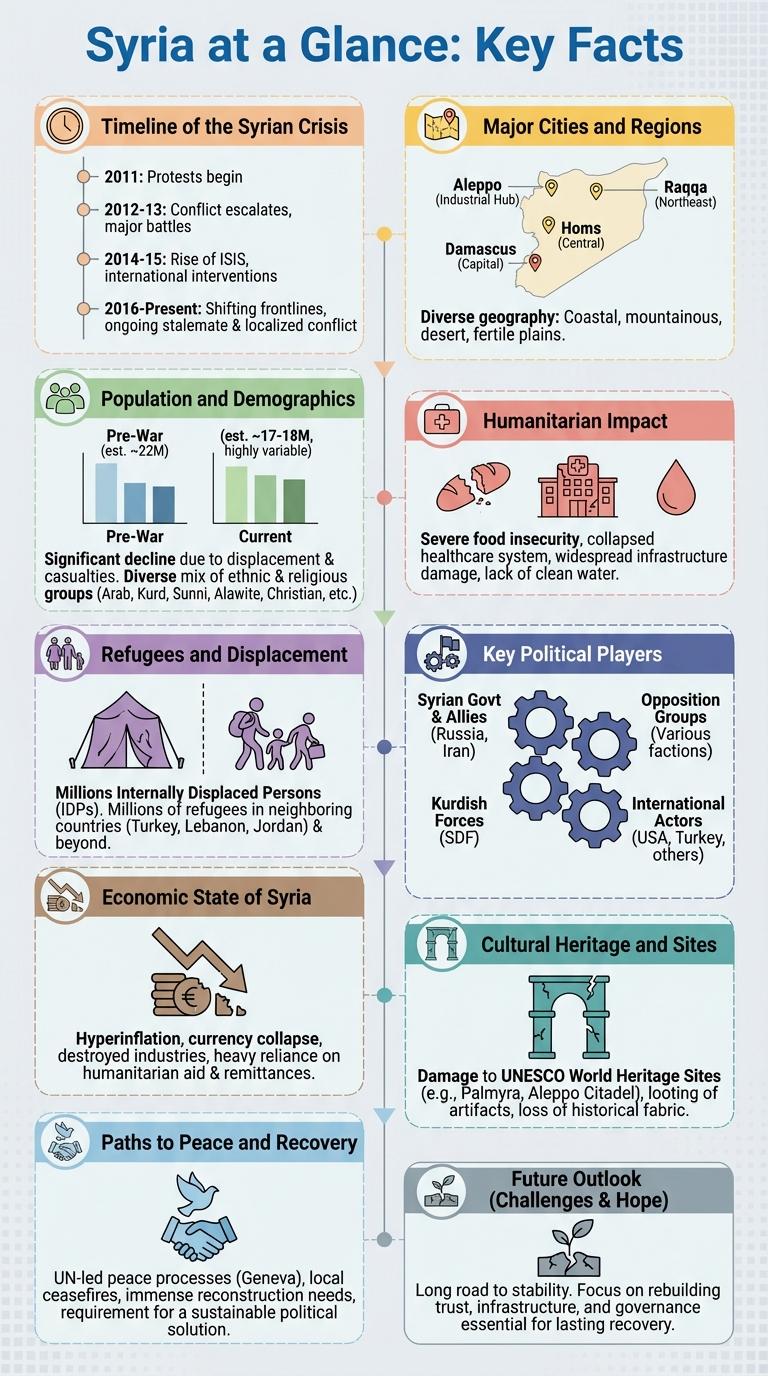
Syria's rich cultural heritage and complex history are vividly illustrated through this infographic, highlighting key historical events and demographic data. It presents a clear overview of Syria's geographical features, population distribution, and economic sectors. This visual summary offers valuable insights into the country's current challenges and development opportunities.
Syria at a Glance: Key Facts
Syria is a country located in the Middle East, bordered by Turkey, Iraq, Jordan, Israel, and Lebanon. Its capital city is Damascus, one of the oldest continuously inhabited cities in the world.
Syria has a population of approximately 21 million people. The official language is Arabic, and Islam is the predominant religion. The country's economy depends largely on agriculture, oil, and remittances from abroad.
Timeline of the Syrian Crisis
The Syrian crisis began in 2011 with nationwide protests demanding political reform. The conflict quickly escalated into a complex civil war involving multiple domestic and international actors.
Key events include the 2012 rise of extremist groups and the 2015 Russian military intervention. The ongoing crisis has led to millions of displaced people and significant regional instability.
Major Cities and Regions
Syria is a country with diverse cities and distinct regions that contribute to its cultural and economic landscape. Major urban centers are spread across key geographic zones, each playing a vital role in national development.
The country is divided into several governorates, with cities serving as their administrative capitals and hubs for trade and culture.
- Damascus - The capital city, known as one of the oldest continuously inhabited cities in the world and an important political and cultural center.
- Aleppo - Syria's largest city by population, historically a major commercial hub located in the northern region.
- Homs - A central city known for its industrial significance and strategic location connecting the coast to the interior.
- Latakia - A key port city on the Mediterranean coast, vital for maritime trade and access.
- Deir ez-Zor - A city along the Euphrates River in eastern Syria, important for oil production and regional agriculture.
Population and Demographics
Syria has a population of approximately 20 million people as of 2024. The country features a diverse ethnic composition, including Arabs, Kurds, Armenians, and Assyrians.
The majority of Syrians are Sunni Muslims, with significant communities of Alawites, Christians, and Druze. Urban areas like Damascus and Aleppo are densely populated compared to rural regions.
Humanitarian Impact
Syria has experienced a severe humanitarian crisis due to prolonged conflict, leading to widespread displacement and suffering. Millions of people require urgent assistance to meet basic needs such as food, shelter, and healthcare.
- Displacement Crisis - Over 6.7 million Syrians are internally displaced, making it one of the largest displacement crises worldwide.
- Food Insecurity - More than 12 million people face food insecurity, with many lacking consistent access to sufficient nutrition.
- Healthcare Access - Approximately 70% of health facilities are fully or partially functional, limiting medical services for millions.
Refugees and Displacement
Syria has experienced one of the world's largest refugee crises since 2011, with over 6.8 million Syrians displaced internally and more than 5.7 million registered as refugees globally. Neighboring countries like Turkey, Lebanon, and Jordan host the majority of Syrian refugees, accounting for approximately 80% of the total refugee population. The ongoing conflict continues to drive instability, leading to prolonged displacement and urgent humanitarian needs for millions of affected Syrians.
Key Political Players
Who are the key political players in Syria? The Syrian government is primarily led by President Bashar al-Assad, who has remained in power since 2000. Various opposition groups and foreign actors also influence the country's political landscape.
| Key Player | Role |
|---|---|
| Bashar al-Assad | President of Syria and head of the Syrian Arab Republic government. |
| Syrian Opposition | Includes multiple groups opposing Assad's regime, seeking political change. |
| Russia | Supports Assad's government militarily and politically. |
| Iran | Provides military and financial support to the Syrian government. |
| Turkey | Supports certain opposition factions and plays a strategic role near its border. |
Economic State of Syria
Syria's economy has been severely impacted by years of conflict, resulting in a significant decline in GDP and widespread infrastructure damage. Key sectors such as agriculture, oil production, and manufacturing have experienced major disruptions, leading to high unemployment and inflation rates. International sanctions and limited access to financial resources continue to challenge Syria's economic recovery and development efforts.
Cultural Heritage and Sites
| Cultural Heritage Site | Significance & Description |
|---|---|
| Ancient City of Palmyra | A UNESCO World Heritage Site since 1980, Palmyra is a vital archaeological site featuring Greco-Roman temples, colonnaded streets, and monumental tombs, showcasing Syria's role in ancient trade routes. |
| Umayyad Mosque (Great Mosque of Damascus) | One of the oldest and largest mosques in the world, built in the 8th century, this religious monument embodies Islamic architecture and houses important relics including the shrine of John the Baptist. |
| Crac des Chevaliers | This Crusader castle is one of the best-preserved medieval castles globally, symbolizing military architecture and Christian presence in the region during the 12th and 13th centuries. |
| Dead Cities | A group of abandoned ancient settlements in northwest Syria, revealing insights into rural life during the Byzantine period with unique stone-built houses and churches. |
| Apamea | Known for its extensive Roman colonnade, Apamea was a major city on the Silk Road, illustrating Syria's historical importance in commerce and cultural exchanges between East and West. |