
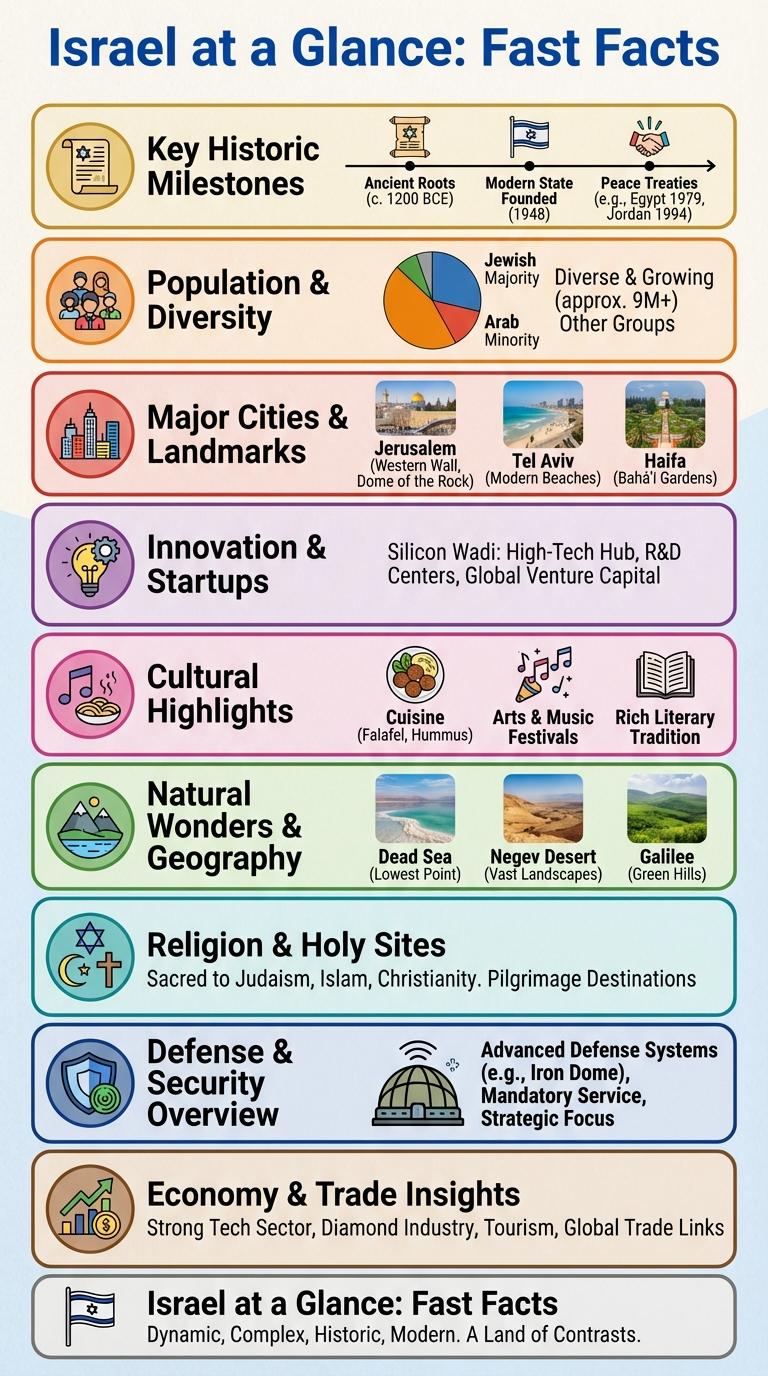
Israel's unique blend of ancient history and modern innovation makes it a fascinating subject for exploration. Its diverse culture, technological advancements, and significant historical landmarks offer rich insights captured through visual data. This infographic highlights key facts and statistics that reveal Israel's dynamic identity and global impact.
Israel at a Glance: Fast Facts
Israel is a Middle Eastern country located on the southeastern shore of the Mediterranean Sea. Known for its rich history and technological innovation, Israel offers a unique blend of ancient culture and modern advancement.
- Population - Over 9 million people live in Israel, with diverse ethnic and religious backgrounds.
- Capital City - Jerusalem serves as Israel's capital and holds significant religious importance.
- Technology Hub - Israel is recognized globally as a leader in innovation and startup technology.
Key Historic Milestones
Israel, established in 1948, marks a pivotal moment in modern Middle Eastern history. The declaration of independence followed decades of Zionist efforts and international mandates.
The Six-Day War in 1967 significantly reshaped Israel's borders and geopolitics. Peace treaties with Egypt (1979) and Jordan (1994) solidified regional diplomacy.
The Oslo Accords (1993) initiated steps toward Israeli-Palestinian peace negotiations. Technological innovation and cultural development have since positioned Israel as a global leader.
Population & Diversity
Israel is a vibrant country with a diverse population of approximately 9.7 million people as of 2024. The nation is characterized by a rich blend of ethnic and religious communities contributing to its unique social fabric.
- Population Size - Israel's population reached around 9.7 million, reflecting steady growth driven by both natural increase and immigration.
- Ethnic Diversity - The population includes Jews (75%), Arabs (21%), and other minorities, each with distinct cultural identities.
- Religious Composition - Major religions in Israel include Judaism, Islam, Christianity, and Druze, shaping the country's cultural landscape.
Major Cities & Landmarks
Israel is home to key cities such as Jerusalem, Tel Aviv, and Haifa, each offering unique cultural and historical experiences. Jerusalem stands as a spiritual center, hosting landmarks like the Western Wall and the Church of the Holy Sepulchre.
Tel Aviv is known for its vibrant nightlife, beaches, and modern architecture, including the Bauhaus buildings of the White City. Haifa features the scenic Baha'i Gardens, a UNESCO World Heritage site overlooking the Mediterranean Sea.
Innovation & Startups
Israel is renowned as the "Startup Nation," leading global innovation with the highest number of startups per capita. The country excels in technology sectors including cybersecurity, AI, and biotech.
Over 6,000 startups operate across Israel, supported by a strong venture capital ecosystem exceeding $24 billion in annual investments. Tel Aviv ranks among the top global tech hubs, fostering collaboration between universities, corporations, and entrepreneurs. Government initiatives boost R&D, fueling breakthroughs and attracting multinational companies to establish innovation centers.
Cultural Highlights
| Aspect | Description |
|---|---|
| Languages | Hebrew and Arabic are the official languages; English widely spoken |
| Religious Sites | Jerusalem's Western Wall, Dome of the Rock, and Church of the Holy Sepulchre |
| Festivals | Passover, Yom Kippur, Hanukkah, and the secular Independence Day |
| Music and Dance | Traditional klezmer music, Mizrahi tunes, and the Hora dance popular |
| Cuisine | Influences from Middle Eastern, Mediterranean, and Jewish traditions; staples include falafel, hummus, and shakshuka |
Natural Wonders & Geography
Israel hosts diverse natural wonders, including the Dead Sea, the lowest point on Earth at 430 meters below sea level. The country features varied geography, from the mountainous regions of the Galilee in the north to the Negev Desert in the south. The Sea of Galilee, Israel's largest freshwater lake, supports rich ecosystems and is a key water resource.
Religion & Holy Sites
Israel is a unique country where three major religions--Judaism, Christianity, and Islam--converge. It holds some of the world's most revered holy sites that attract millions of pilgrims annually.
- Western Wall - Located in Jerusalem, it is the holiest place where Jews can pray, being the last remnant of the Second Temple.
- Church of the Holy Sepulchre - This site in Jerusalem is believed to be the location of Jesus Christ's crucifixion and resurrection, making it central for Christians worldwide.
- Dome of the Rock - A significant Islamic shrine on the Temple Mount, it is considered the third holiest site in Islam after Mecca and Medina.
These sites reflect Israel's deep spiritual heritage and ongoing religious significance globally.
Defense & Security Overview
Israel maintains one of the most advanced defense systems globally, combining cutting-edge technology with compulsory military service for citizens. The Israel Defense Forces (IDF) encompass the Army, Navy, and Air Force, specializing in rapid response and intelligence operations. National security also includes advanced missile defense systems like Iron Dome, David's Sling, and Arrow to protect against aerial threats.