
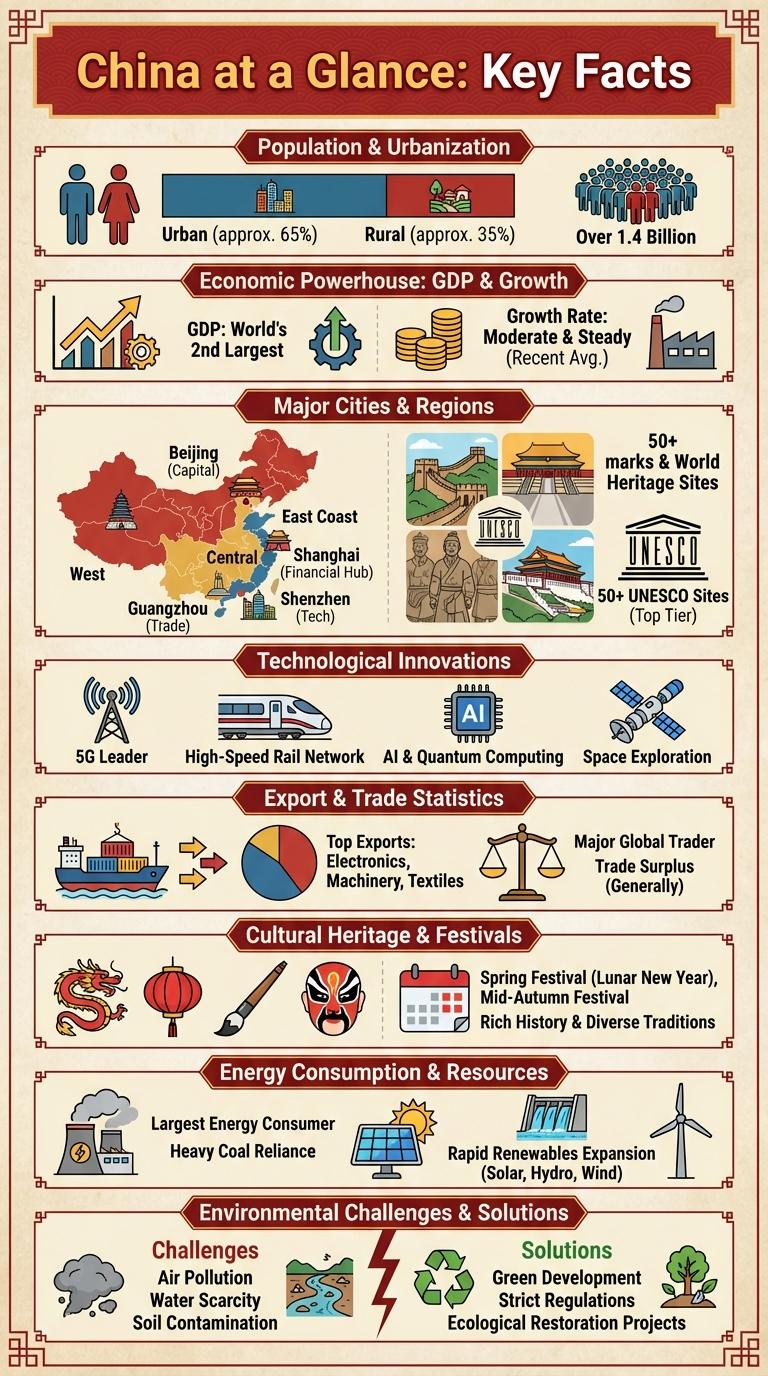
China stands as a global powerhouse with its rich history, vast population, and rapid economic growth. The infographic highlights key aspects including its cultural heritage, technological advancements, and environmental initiatives. Understanding these elements offers insights into China's significant role on the world stage.
China at a Glance: Key Facts
| Category | Key Facts |
|---|---|
| Official Name | People's Republic of China |
| Capital | Beijing |
| Population | Over 1.4 billion (2024 estimate) |
| Area | Approximately 9.6 million square kilometers |
| Official Language | Mandarin Chinese |
Population & Urbanization
China is the most populous country in the world, hosting over 1.4 billion people. Rapid urbanization has transformed its social and economic landscape in recent decades.
- Population Size - China's population exceeds 1.4 billion, accounting for about 18% of the global population.
- Urbanization Rate - Over 60% of China's population lives in urban areas, a significant increase from previous decades.
- City Growth - Megacities like Shanghai and Beijing each have populations surpassing 20 million residents.
Economic Powerhouse: GDP & Growth
China stands as one of the world's leading economic powerhouses, boasting the second-largest GDP globally. Its rapid expansion over recent decades has transformed the nation into a critical player in international markets.
In 2023, China's GDP reached approximately $19.4 trillion, reflecting a growth rate of around 5.2%. This consistent expansion is driven by robust manufacturing, export sectors, and increasing domestic consumption. The government's focus on innovation and infrastructure continues to fuel economic resilience and long-term development.
Major Cities & Regions
China is home to several major cities that serve as economic, cultural, and political hubs. Beijing, Shanghai, Guangzhou, Shenzhen, and Chengdu are among the most prominent urban centers driving the country's growth.
Regions like the Yangtze River Delta, Pearl River Delta, and Beijing-Tianjin-Hebei area are key economic zones with high population density and industrial output. These regions integrate advanced infrastructure, technology industries, and international trade ports.
Landmarks & World Heritage Sites
China is home to numerous iconic landmarks and UNESCO World Heritage Sites that showcase its rich history and cultural heritage. These sites attract millions of tourists annually, highlighting China's significance on the global cultural map.
The Great Wall of China, the Forbidden City, and the Terracotta Army are among the most famous landmarks reflecting ancient Chinese civilization. Other notable World Heritage Sites include the Potala Palace in Tibet and the classical gardens of Suzhou.
Technological Innovations
What are some of the key technological innovations emerging from China? China leads in advancements such as 5G technology, artificial intelligence (AI), and renewable energy solutions. These innovations drive global digital transformation and sustainability efforts.
| Innovation | Impact |
|---|---|
| 5G Technology | Enables faster mobile communication and IoT connectivity. |
| Artificial Intelligence (AI) | Enhances automation and data analysis across industries. |
| Electric Vehicles (EVs) | Reduces carbon emissions through mass adoption. |
| Quantum Computing | Accelerates complex problem solving and cryptography. |
| Renewable Energy | Promotes solar and wind power for sustainable growth. |
Export & Trade Statistics
China is the world's largest exporter, with total exports valued at approximately $3.6 trillion in 2023. Key export goods include electronics, machinery, textiles, and furniture. Major trade partners are the United States, the European Union, and ASEAN countries, driving over 60% of China's total trade volume.
Cultural Heritage & Festivals
China's cultural heritage is rich and diverse, reflecting thousands of years of history, art, and traditions. Iconic landmarks such as the Great Wall, Forbidden City, and Terracotta Army highlight the nation's ancient architectural and artistic achievements. Traditional festivals like Chinese New Year, Mid-Autumn Festival, and Dragon Boat Festival showcase vibrant customs, family reunions, and symbolic rituals that continue to unite communities.
Energy Consumption & Resources
China is the world's largest energy consumer, heavily relying on coal for electricity generation. The country is rapidly expanding renewable energy sources to reduce carbon emissions and enhance sustainability.
- Coal Dominance - Coal accounts for approximately 57% of China's total energy consumption as of 2023.
- Renewable Growth - China leads globally in solar and wind energy capacity, with over 1,200 GW installed.
- Energy Import Dependence - China imports about 20% of its oil to meet growing industrial and transportation demands.
Efforts to improve energy efficiency and invest in clean technologies are central to China's long-term energy strategy.