
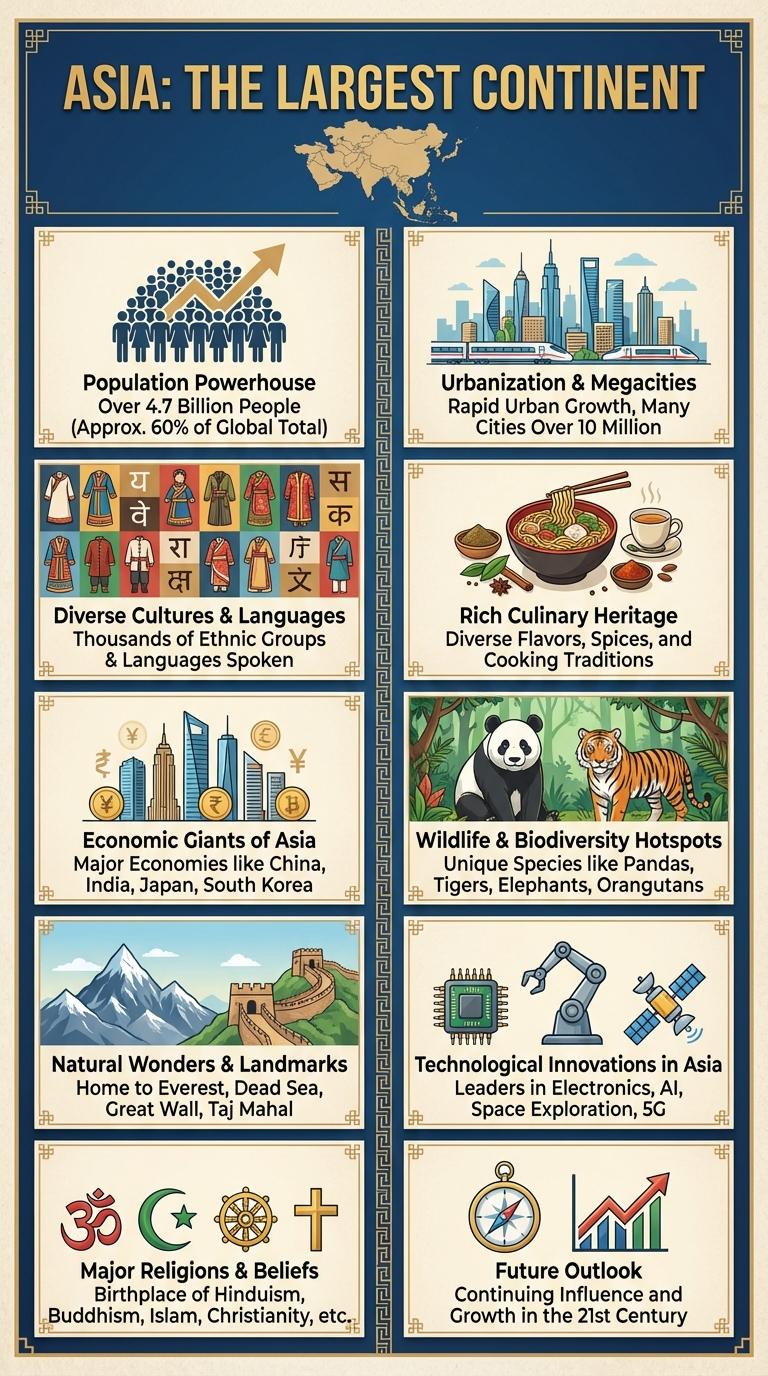
Asia, the largest continent, boasts a rich tapestry of cultures, languages, and landscapes. It is home to over 4.5 billion people, representing diverse economies and ancient civilizations. This infographic highlights key facts and statistics, showcasing Asia's dynamic growth and cultural heritage.
Asia: The Largest Continent
What makes Asia the largest continent on Earth? Asia covers approximately 44.58 million square kilometers, making it the biggest continent by land area. It contains 49 countries, contributing significantly to the world's cultural and geographical diversity.
How is Asia's population distributed compared to other continents? Asia is home to over 4.6 billion people, accounting for nearly 60% of the global population. Countries like China and India alone have more than 2.7 billion residents combined.
| Fact | Detail |
|---|---|
| Land Area | 44.58 million km2 |
| Number of Countries | 49 |
| Population | 4.6+ billion |
| Major Mountains | Himalayas (Mount Everest 8,848m) |
| Major Rivers | Yangtze, Ganges, Mekong |
Population Powerhouse
Asia is the most populous continent, home to over 4.7 billion people, representing nearly 60% of the global population. China and India alone account for more than 2.8 billion people, making them the two largest countries by population worldwide.
Rapid urbanization and economic growth fuel Asia's demographic expansion, driving demand for resources and infrastructure development. The continent's diverse cultures and languages contribute to its dynamic social landscape and global influence.
Diverse Cultures & Languages
Asia is home to over 4.5 billion people, representing a vast mosaic of cultures and traditions. With more than 2,300 languages spoken across its regions, Asia holds the highest linguistic diversity in the world. This rich cultural and linguistic variety shapes Asia's social fabric, influencing art, cuisine, and daily life uniquely in every country.
Economic Giants of Asia
Asia hosts some of the world's largest and fastest-growing economies, driving global economic trends. Key players in this region significantly influence international trade and investment flows.
- China - The largest economy in Asia and the second-largest globally, China dominates manufacturing and exports.
- Japan - Known for its advanced technology and automotive industries, Japan ranks as Asia's third-largest economy.
- India - With rapid growth in technology and services, India is emerging as a major economic powerhouse in Asia.
These economic giants shape Asia's strategic importance in the global market.
Natural Wonders & Landmarks
| Natural Wonders | Landmarks |
|---|---|
| Mount Everest - Highest peak in the world (8,848m), located in the Himalayas, Nepal-China border. | Great Wall of China - Ancient fortification stretching over 13,000 miles, Northern China. |
| Ha Long Bay - UNESCO World Heritage site with limestone karsts and emerald waters, Vietnam. | Taj Mahal - White marble mausoleum and symbol of love, Agra, India. |
| Jeju Island - Volcanic island with lava tubes and Hallasan mountain, South Korea. | Angkor Wat - Largest religious monument in the world, Khmer architecture, Cambodia. |
| Lake Baikal - Deepest freshwater lake in the world, Siberia, Russia. | Petra - Ancient rock-cut city famous for its rose-red facade, Jordan. |
| Sundarbans - Largest mangrove forest and tiger habitat, Bangladesh and India. | Tokyo Tower - Iconic communications and observation tower, Tokyo, Japan. |
Major Religions & Beliefs
Asia is home to the world's largest and most diverse population, with major religions including Buddhism, Islam, Hinduism, and Christianity. Hinduism dominates India and Nepal, while Islam is prevalent in countries like Indonesia, Pakistan, and Bangladesh. Buddhism originated in Asia and remains widely practiced in countries such as China, Thailand, and Japan.
Urbanization & Megacities
Asia is home to some of the world's fastest-growing urban areas and numerous megacities with populations exceeding 10 million. Rapid urbanization in Asia is transforming economic landscapes and social structures across the continent.
Tokyo, Jakarta, Delhi, Shanghai, and Mumbai rank among Asia's largest megacities by population. Over 50% of Asia's population now lives in urban areas, driving demand for housing, infrastructure, and services. The region's urban growth presents opportunities for innovation but also challenges related to sustainability and congestion.
Rich Culinary Heritage
Asia boasts one of the richest culinary heritages in the world, with a diverse range of flavors and cooking techniques unique to each country. From the spicy curries of India to the delicate sushi of Japan, Asian cuisine offers an unparalleled gastronomic experience.
Staple ingredients like rice, soy, ginger, and various spices form the foundation of many traditional dishes across the continent. Street food culture thrives in Asia, showcasing authentic recipes passed down through generations, adding to its vibrant food landscape.
Wildlife & Biodiversity Hotspots
Asia is home to some of the world's richest wildlife and diverse ecosystems, hosting numerous biodiversity hotspots. These regions support an extraordinary variety of endemic species and critical habitats.
- The Sundaland Biodiversity Hotspot - Encompasses the tropical rainforests of Indonesia, Malaysia, and surrounding islands, harboring unique species like orangutans and Sumatran tigers.
- Himalayan Biodiversity Hotspot - Spanning the mountain range from Afghanistan to Myanmar, it contains rare flora and fauna including snow leopards and red pandas.
- The Indo-Burma Hotspot - Covers parts of Myanmar, Thailand, and Vietnam, recognized for its high levels of amphibian and plant endemism threatened by habitat loss.