
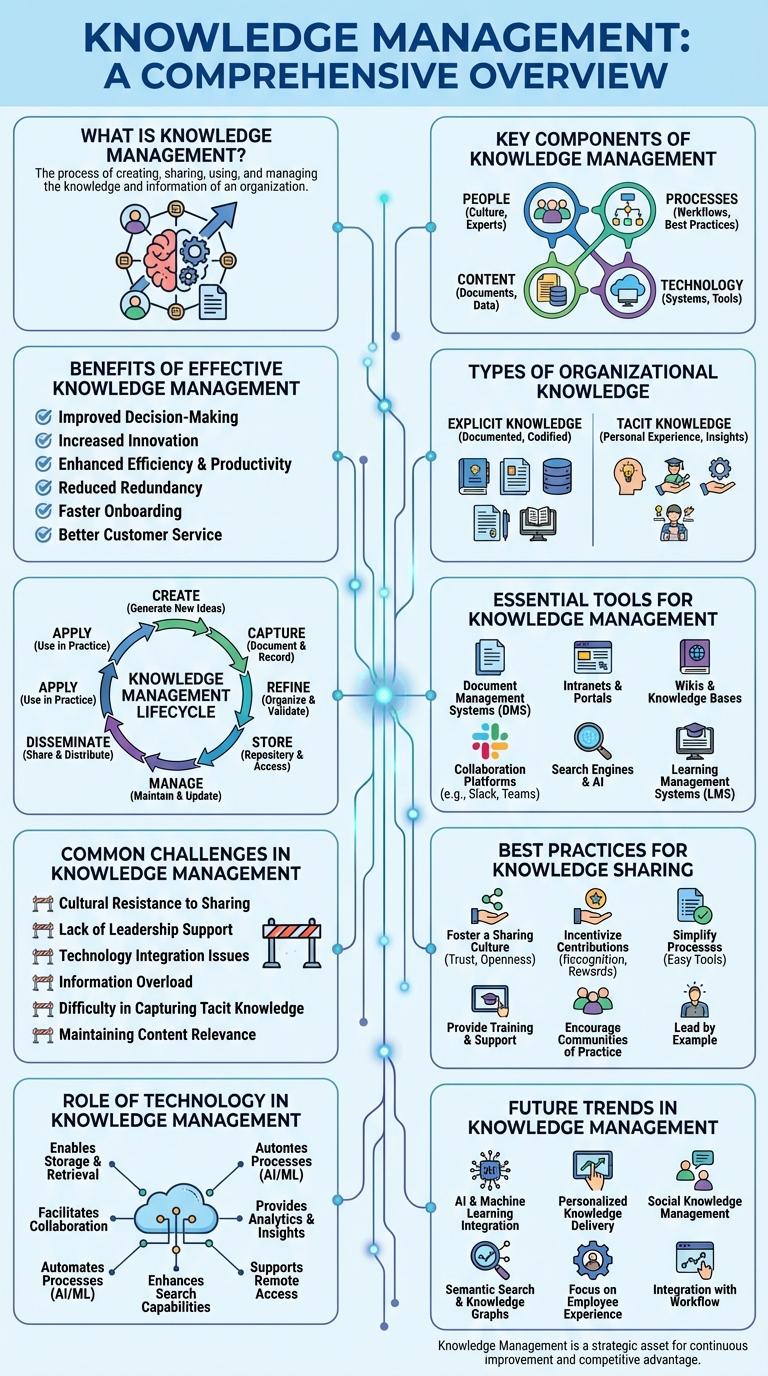
Knowledge management enhances organizational efficiency by systematically capturing, organizing, and sharing information. Visualizing these processes through an infographic highlights the critical components and benefits, making complex concepts easily digestible. This approach aids businesses in improving decision-making, collaboration, and innovation.
What is Knowledge Management?
Knowledge Management (KM) is the systematic process of capturing, distributing, and effectively using knowledge within an organization. It integrates people, processes, and technology to enhance organizational learning and decision-making.
KM aims to improve productivity by turning individual knowledge into shared assets. It includes practices like knowledge creation, storage, retrieval, and transfer to support innovation and competitive advantage.
Key Components of Knowledge Management
Knowledge management involves systematically capturing, distributing, and effectively using organizational knowledge. It enhances decision-making, innovation, and competitive advantage through structured processes.
- Knowledge Creation - Refers to generating new insights, ideas, or routines within the organization.
- Knowledge Storage - Involves organizing and preserving knowledge in databases, documents, or repositories.
- Knowledge Sharing - Facilitates the exchange of information and expertise among employees to improve collaboration.
- Knowledge Application - Focuses on using knowledge strategically to support business processes and problem-solving.
- Knowledge Evaluation - Involves assessing the effectiveness and relevance of knowledge for continuous improvement.
Benefits of Effective Knowledge Management
Effective knowledge management streamlines access to critical information, enhancing decision-making and fostering innovation within organizations. It reduces redundancy and errors by ensuring accurate knowledge sharing across teams. Improved collaboration and knowledge retention lead to increased productivity and sustained competitive advantage.
Types of Organizational Knowledge
Organizational knowledge consists of various types that drive business success and innovation. Understanding these types helps in effectively capturing, sharing, and utilizing knowledge within an organization.
Tacit knowledge is personal, experience-based, and difficult to formalize, often residing in employees' minds. Explicit knowledge is documented, easily shared, and includes manuals, procedures, and databases.
Knowledge Management Lifecycle
Knowledge Management (KM) is crucial for capturing, sharing, and utilizing organizational knowledge effectively. The Knowledge Management Lifecycle outlines the stages through which knowledge is created, stored, and leveraged to improve business processes.
The KM Lifecycle consists of four key phases: knowledge creation, storage, sharing, and application. During creation, new insights and information are generated or discovered. Storage involves organizing knowledge in accessible repositories, enabling efficient retrieval. Sharing promotes collaboration and dissemination across teams, while application focuses on using knowledge to solve problems and drive innovation.
Essential Tools for Knowledge Management
| Tool | Function |
|---|---|
| Document Management Systems (DMS) | Store, organize, and control access to digital documents, enabling easy retrieval and collaboration. |
| Knowledge Bases | Central repositories for FAQs, manuals, and best practices to facilitate self-service and quick problem resolution. |
| Collaboration Platforms | Support team communication, project management, and knowledge sharing through integrated messaging and document sharing. |
| Content Management Systems (CMS) | Create, edit, and publish digital content efficiently while managing version control and user access. |
| Learning Management Systems (LMS) | Deliver training, track learner progress, and manage educational resources to enhance workforce knowledge. |
Common Challenges in Knowledge Management
What are the common challenges faced in knowledge management? Organizations often struggle with capturing and organizing vast amounts of information efficiently. Ensuring knowledge is easily accessible and up-to-date remains a significant obstacle.
How does knowledge sharing impact management effectiveness? Resistance to sharing expertise and information silos reduce collaboration and innovation. Overcoming cultural barriers is essential to foster a knowledge-sharing environment.
Why is maintaining data accuracy difficult in knowledge management? Information rapidly becomes outdated, leading to inaccuracies and mistrust in the system. Continuous validation and updates require dedicated resources and commitment.
What role does technology play in knowledge management challenges? Inadequate or complex systems hinder user adoption and reduce efficiency. Integration of tools with existing workflows is critical for successful knowledge management.
How does leadership influence knowledge management success? Lack of executive support often results in insufficient policies and resource allocation. Strong leadership drives a culture that values continuous learning and knowledge retention.
Best Practices for Knowledge Sharing
Effective knowledge sharing enhances organizational efficiency by promoting collaboration and innovation. Best practices include creating accessible knowledge repositories, encouraging open communication, and recognizing contributors. Implementing these strategies fosters a culture of continuous learning and drives business success.
Role of Technology in Knowledge Management
Technology serves as a critical enabler in knowledge management by facilitating the creation, storage, and sharing of information across organizations. It improves access to expertise and accelerates decision-making processes through advanced tools and platforms.
- Knowledge Repositories - Digital databases store vast amounts of organizational knowledge for easy retrieval and updating.
- Collaboration Platforms - Tools like intranets and social networks foster real-time communication and knowledge exchange among employees.
- Advanced Analytics - AI and machine learning analyze data patterns to generate actionable insights and improve knowledge utilization.