
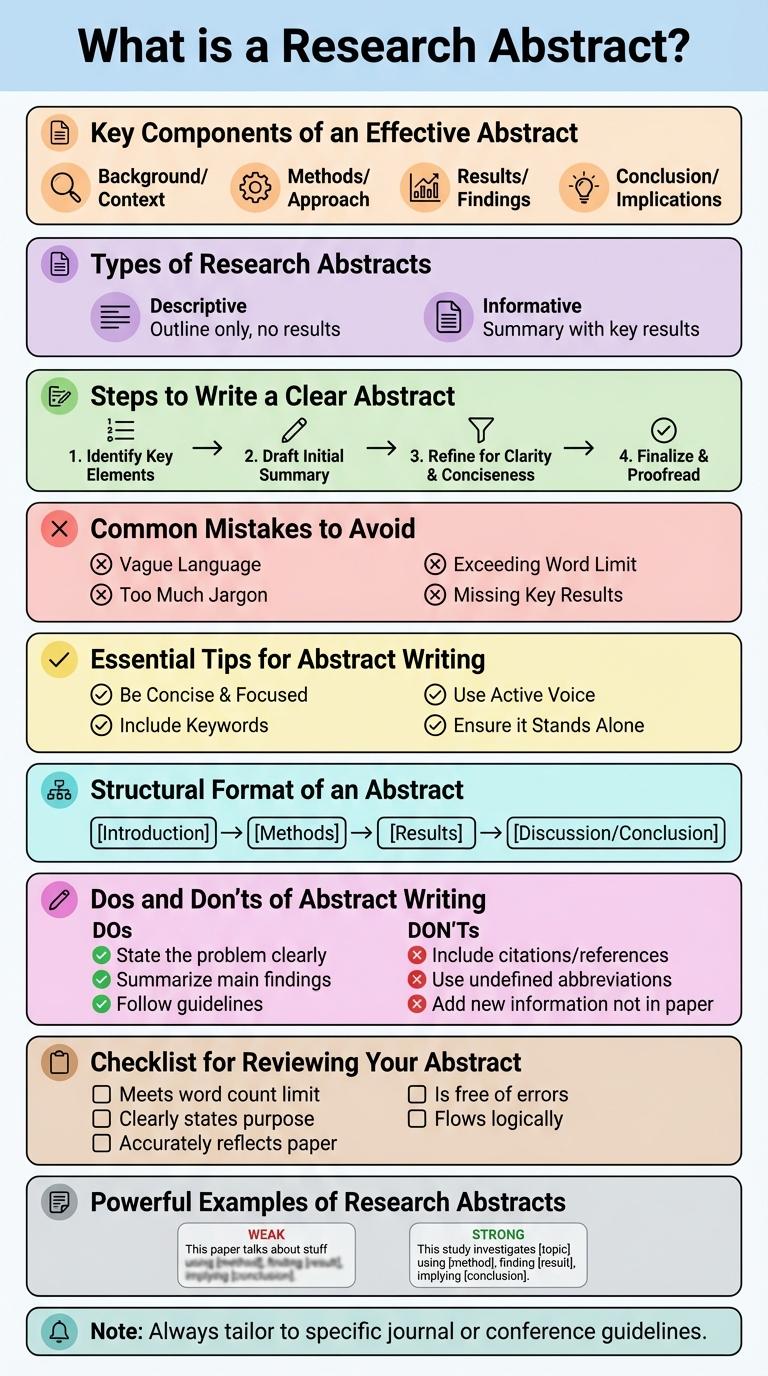
A research abstract summarizes the key points of a study, providing readers with a concise overview of the purpose, methods, results, and conclusions. Crafting an effective abstract requires clarity, brevity, and precision to highlight essential information. An infographic poster visually presents these guidelines, helping researchers create impactful abstracts that capture attention and communicate findings efficiently.
What is a Research Abstract?
A research abstract is a concise summary of a study's key points and findings. It provides readers with a quick overview of the research purpose, methods, results, and conclusions.
The abstract helps readers determine the relevance of the research to their interests. It typically ranges from 150 to 250 words, depending on publication guidelines. Clear, precise language is essential for effective communication in an abstract.
Key Components of an Effective Abstract
Writing a clear and concise research abstract is essential for communicating your study's purpose and findings. An effective abstract highlights the most important elements of your research in a brief format.
- Purpose - Clearly state the main objective or research question addressed in the study.
- Methods - Summarize the approach, design, and key techniques used to conduct the research.
- Results - Present the principal findings or data outcomes without detailed explanations.
- Conclusions - Provide the significance and implications of the results in context.
- Keywords - Include relevant terms that enhance discoverability and indexing of the abstract.
An impactful research abstract serves as a concise summary that guides readers and researchers efficiently to your work.
Types of Research Abstracts
An infographic poster about writing a research abstract highlights three main types: descriptive, informative, and structured abstracts. Descriptive abstracts provide a brief overview without detailed results, while informative abstracts summarize key findings and conclusions. Structured abstracts organize content into sections such as background, methods, results, and conclusions for clarity and ease of reading.
Steps to Write a Clear Abstract
Writing a clear research abstract involves summarizing the main objectives, methods, results, and conclusions concisely. Start by identifying the purpose and significance of your study, then briefly describe the methodology and key findings. Ensure the abstract is concise, uses precise language, and highlights the core contributions of the research.
Common Mistakes to Avoid
What are the most common mistakes to avoid when writing a research abstract? Avoid including unnecessary details that belong in the main paper. Focus on clear, concise language that accurately summarizes your research.
Why should you avoid vague or overly broad statements in an abstract? Vague writing confuses readers and reduces the impact of your research. Use specific data and precise terminology to convey key findings effectively.
How can failing to highlight the research purpose affect your abstract? Without a clear purpose, readers won't understand the study's significance. Explicitly state the problem and objective within the first few sentences.
What happens when you include citations or references in an abstract? Abstracts should be standalone summaries and not contain citations. Save references for the main document to keep the abstract brief and focused.
Why is it important to avoid grammatical errors and jargon in an abstract? Errors and jargon can distract or alienate readers unfamiliar with the topic. Use simple, correct language to ensure accessibility across diverse audiences.
Essential Tips for Abstract Writing
Crafting a clear and concise research abstract is vital for engaging your audience and summarizing your study effectively. An abstract should provide a snapshot of your research, highlighting the purpose, methods, and key findings.
Start with a strong opening that defines the research problem and objectives. Use precise language and avoid jargon to ensure accessibility for a broad academic audience.
Structural Format of an Abstract
Writing a research abstract requires clarity and precision to summarize the key points effectively. Its structural format guides readers through the essential elements of the research.
- Background - Introduce the research topic and provide context in one concise sentence.
- Objectives - Clearly state the main purpose or research questions addressed by the study.
- Methods - Summarize the approach, design, or techniques used to conduct the research.
- Results - Highlight the primary findings or data outcomes obtained from the research.
- Conclusion - Present the implications, significance, or recommendations derived from the study.
Dos and Don'ts of Abstract Writing
Writing a clear and concise research abstract is essential for effectively summarizing your study. Knowing the dos and don'ts helps enhance readability and impact.
- Do Be Concise - Use precise language to summarize key points without unnecessary details.
- Do Highlight Objectives - Clearly state the research purpose and major findings.
- Do Use Keywords - Incorporate relevant terms to improve searchability and relevance.
- Don't Include Jargon - Avoid technical terms that may confuse a general audience.
- Don't Exceed Word Limit - Keep the abstract within required length to maintain focus and clarity.
Checklist for Reviewing Your Abstract
| Checklist Item | Key Points |
|---|---|
| Clarity | Ensure the abstract clearly states the research problem and objectives |
| Conciseness | Keep the abstract brief, typically 150-250 words |
| Structure | Include background, methods, results, and conclusion in a logical order |
| Relevance | Focus on key findings and their importance to the field |
| Accuracy | Check for factual correctness and avoid unsupported claims |