
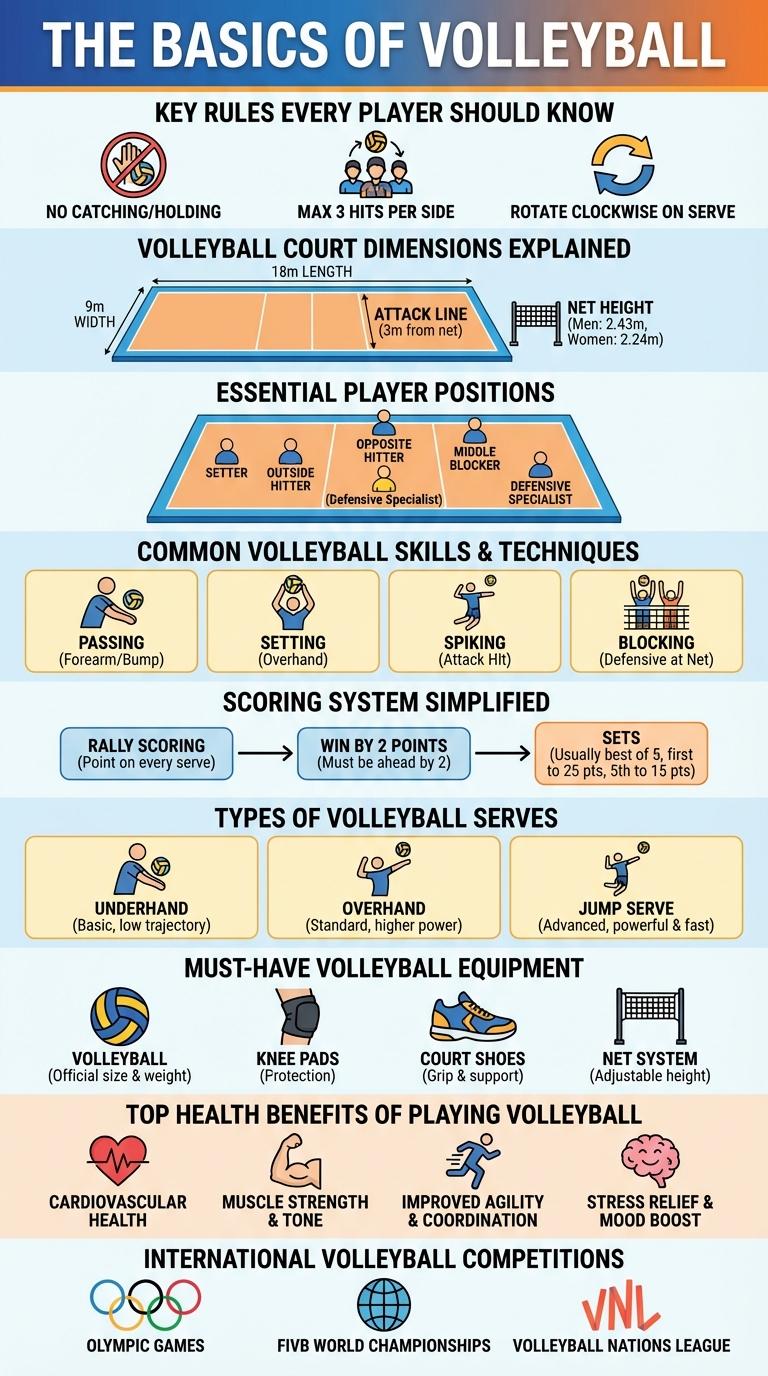
Volleyball combines agility, teamwork, and strategy to create an exciting and fast-paced sport enjoyed worldwide. This infographic highlights key aspects such as rules, player positions, and scoring methods that define volleyball. Understanding these elements enhances appreciation for the game's dynamic nature and competitive spirit.
The Basics of Volleyball
Volleyball is a dynamic team sport played by two teams of six players each on a rectangular court divided by a net. The primary objective is to send the ball over the net and ground it on the opponent's court while preventing the opposing team from doing the same.
Each team has three successive touches to return the ball over the net. The game begins with a serve from behind the end line. Points are awarded when the ball touches the ground on the opponent's side or when the opposing team commits a fault.
Key Rules Every Player Should Know
Volleyball is a dynamic sport that combines skill, strategy, and teamwork. Understanding the key rules enhances both playing and watching experiences.
- Three Touches Per Side - Each team is allowed a maximum of three successive touches to return the ball over the net.
- No Double Hit - A player cannot hit the ball twice consecutively; control and precision are crucial.
- Rotation Rules - Players must rotate positions clockwise each time their team wins the serve from the opponents.
- Net Violations - Players must not touch the net during play, as it results in a fault.
- Scoring System - Matches use rally scoring, where a point is scored on every serve regardless of which team served.
Mastering these fundamental rules creates a fair and competitive volleyball game for all participants.
Volleyball Court Dimensions Explained
Volleyball courts measure 18 meters long and 9 meters wide, divided into two equal halves by a net. Each side includes a 3-meter attack line parallel to the net, separating the front and back zones. The court features clearly marked boundary lines ensuring fair play and accurate calls during matches.
Essential Player Positions
Volleyball involves specific player positions critical for team strategy and performance. Each position has unique responsibilities contributing to offense and defense.
- Setter - Coordinates the offense by delivering accurate sets to attackers.
- Outside Hitter - Primary attacker who also plays a key role in passing and defense.
- Middle Blocker - Focuses on blocking opponent attacks and quick middle hits.
- Libero - Defensive specialist who excels in reception and digs but cannot attack.
- Opposite Hitter - Positioned opposite the setter, responsible for scoring and blocking.
Common Volleyball Skills & Techniques
Volleyball requires a variety of fundamental skills to play effectively. Mastering these techniques enhances teamwork and overall game performance.
- Serving - The act of putting the ball into play by striking it over the net from behind the baseline.
- Passing - Using forearms or hands to control and direct the ball to a teammate, commonly done with a bump or dig.
- Setting - A precise overhead technique used to position the ball for an attacker to spike.
- Spiking - Hitting the ball forcefully over the net to score points or disrupt the opponent's defense.
- Blocking - Jumping near the net to prevent or deflect an opponent's spike from crossing into one's court.
Scoring System Simplified
The volleyball scoring system is based on a rally point format, where a point is awarded on every serve, regardless of which team served. Matches are typically played as best-of-five sets, with each set played to 25 points, except the deciding set which is played to 15 points.
A team must win a set by at least two points, so the score can go beyond 25 if both teams are closely matched. The first team to win three sets wins the match, making strategy and stamina crucial in every rally.
Types of Volleyball Serves
What are the main types of volleyball serves? Volleyball features several serve types that vary in technique and difficulty. Each serve aims to challenge the opposing team's reception and create scoring opportunities.
| Serve Type | Description |
|---|---|
| Float Serve | Characterized by a no-spin ball, making it move unpredictably in the air. |
| Topspin Serve | Features forward spin, causing the ball to drop quickly and bounce high. |
| Jump Serve | Combines a jumping approach with a powerful topspin delivery for added speed. |
| Underhand Serve | A basic serve where the ball is hit from below the waist, ideal for beginners. |
| Jump Float Serve | Combines a jump approach with a floating ball, creating both power and unpredictability. |
Must-Have Volleyball Equipment
Volleyball requires specific equipment to ensure safety and enhance performance. Essential gear includes the volleyball ball, proper footwear, knee pads, and appropriate attire.
A quality volleyball ball is designed for grip and control, while shoes provide ankle support and traction on court surfaces. Knee pads protect players from impact during dives and falls.
Top Health Benefits of Playing Volleyball
| Health Benefit | Description |
|---|---|
| Cardiovascular Fitness | Playing volleyball improves heart health by increasing aerobic endurance and promoting better circulation. |
| Muscle Strength | Engages major muscle groups including legs, arms, core, and shoulders, enhancing overall muscle tone and strength. |
| Coordination and Balance | Boosts hand-eye coordination and balance through quick reflexes, jumps, and precise ball handling. |
| Bone Health | High-impact movements like jumping help increase bone density, reducing the risk of osteoporosis. |
| Mental Well-being | Encourages teamwork and social interaction, reducing stress and improving mood and cognitive function. |