
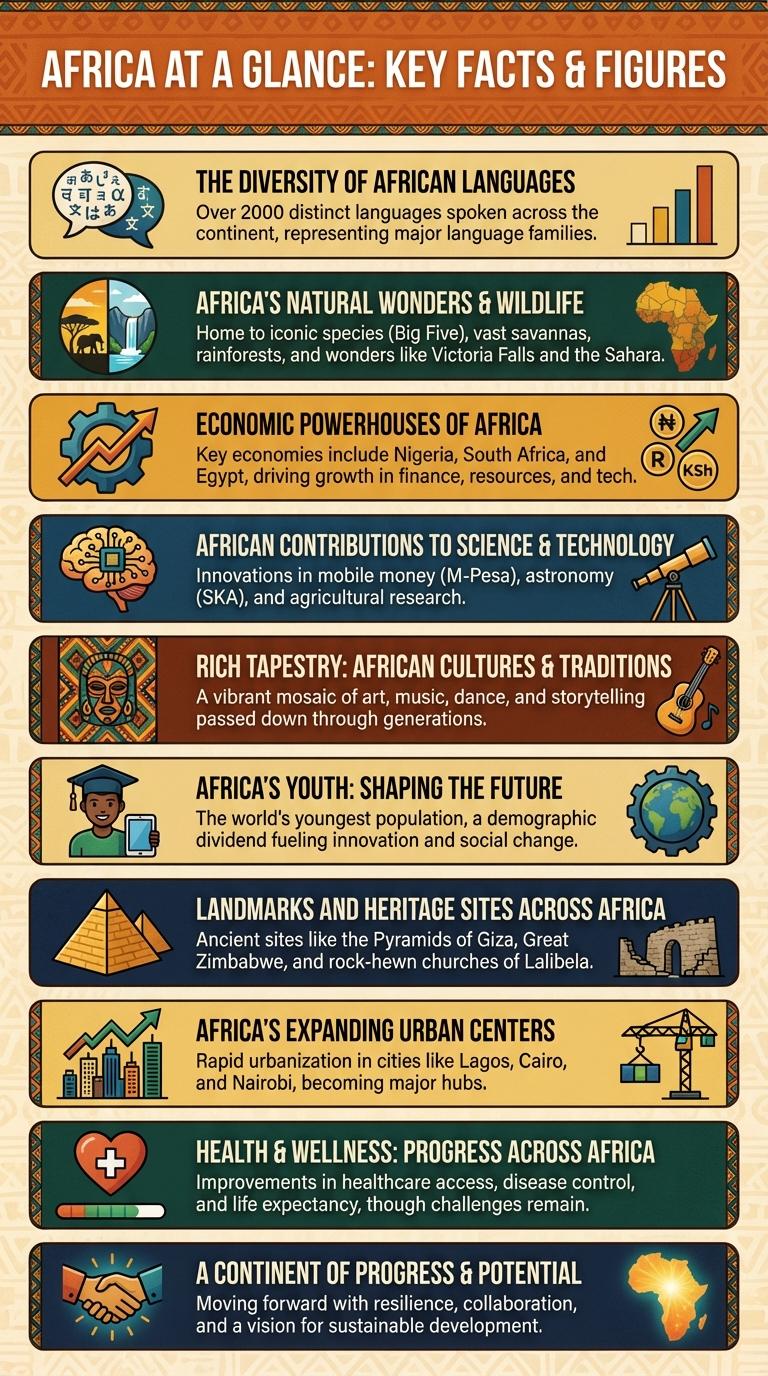
African infographics visually highlight the continent's rich cultural diversity, vibrant wildlife, and dynamic economies. They effectively present complex data about demographics, natural resources, and historical landmarks in an engaging and easily digestible format. These visuals are essential tools for educators, businesses, and travelers aiming to deepen their understanding of Africa's unique attributes.
Africa at a Glance: Key Facts & Figures
Africa is the second-largest continent, covering over 30 million square kilometers and home to more than 1.4 billion people. It comprises 54 countries with diverse cultures, languages, and ecosystems.
The continent holds 17% of the world's population and features a young demographic, with a median age under 20 years. Africa's economy is rich in natural resources, including vast reserves of minerals, oil, and agricultural land.
The Diversity of African Languages
African languages represent one of the most diverse linguistic landscapes in the world, with over 2,000 distinct languages spoken across the continent. These languages belong to several major language families, including Afroasiatic, Nilo-Saharan, Niger-Congo, and Khoisan.
Swahili, Hausa, Amharic, and Yoruba are among the most widely spoken African languages, serving as lingua francas in various regions. Language diversity reflects Africa's rich cultural heritage, influencing literature, music, and social communication.
Africa's Natural Wonders & Wildlife
Africa is home to some of the world's most remarkable natural wonders and diverse wildlife. From vast deserts to lush rainforests, the continent offers unique ecosystems that support an incredible variety of species.
The Sahara Desert, the largest hot desert on Earth, spans over 9 million square kilometers. The Serengeti National Park hosts the Great Migration, where over 1.5 million wildebeest, zebras, and gazelles travel annually. Africa's rich biodiversity includes iconic animals like elephants, lions, rhinoceroses, and gorillas, many found within its numerous national parks and reserves.
Economic Powerhouses of Africa
Which African countries lead as economic powerhouses? Nigeria, South Africa, and Egypt dominate Africa's economy with their diverse industries and large markets. These nations contribute significantly to the continent's GDP and attract substantial foreign investment.
| Country | Key Economic Sectors |
|---|---|
| Nigeria | Oil & Gas, Telecommunications, Agriculture |
| South Africa | Mining, Manufacturing, Financial Services |
| Egypt | Tourism, Construction, Energy |
| Kenya | Agriculture, Technology, Financial Services |
| Morocco | Automotive, Aerospace, Tourism |
African Contributions to Science & Technology
Africa has made significant contributions to science and technology throughout history, including early advancements in mathematics, metallurgy, and medicine. Ancient Egyptian innovations in engineering and astronomy laid foundational knowledge influencing later civilizations globally. Contemporary African scientists and engineers continue to drive progress in fields such as renewable energy, health technology, and information systems.
Rich Tapestry: African Cultures & Traditions
Africa hosts a vast array of cultures and traditions, each contributing to its vibrant social fabric. Understanding these unique elements reveals the continent's rich heritage and diverse identity.
- Ethnic Diversity - Over 3,000 distinct ethnic groups populate Africa, each with unique languages, customs, and histories.
- Traditional Music and Dance - Music and dance serve as vital expressions of community life and spiritual beliefs across African societies.
- Handicrafts and Art - Africa is renowned for its intricate textiles, beadwork, and sculptures that symbolize cultural heritage and social status.
Africa's Youth: Shaping the Future
Africa's youth represent over 60% of the continent's population, driving innovation and economic growth. Empowering young people through education and technology is crucial for sustainable development. Youth-led initiatives in entrepreneurship and social activism are shaping Africa's future landscape.
Landmarks and Heritage Sites Across Africa
| Landmark / Heritage Site | Location & Significance |
|---|---|
| Great Pyramids of Giza | Egypt; Oldest of the Seven Wonders, monumental tombs from Ancient Egypt |
| Victoria Falls | Border of Zambia and Zimbabwe; One of the largest and most famous waterfalls in the world |
| Rock-Hewn Churches of Lalibela | Ethiopia; Eleven 12th-century monolithic churches carved from rock, pilgrimage site |
| Table Mountain | South Africa; Flat-topped mountain overlooking Cape Town, biodiversity hotspot |
| Timbuktu | Mali; Historic center of Islamic culture and learning, UNESCO World Heritage Site |
Africa's Expanding Urban Centers
Africa is experiencing rapid urbanization, with cities growing faster than anywhere else in the world. This expansion is reshaping economic activities, infrastructure demands, and population distribution across the continent.
- Urban Population Growth - Africa's urban population is expected to double by 2050, reaching over 1.2 billion people.
- Megacity Emergence - Cities like Lagos, Cairo, and Kinshasa are becoming megacities, hosting more than 10 million residents each.
- Infrastructure Development - Expanding urban centers drive investments in housing, transportation, and energy networks to meet rising demands.