
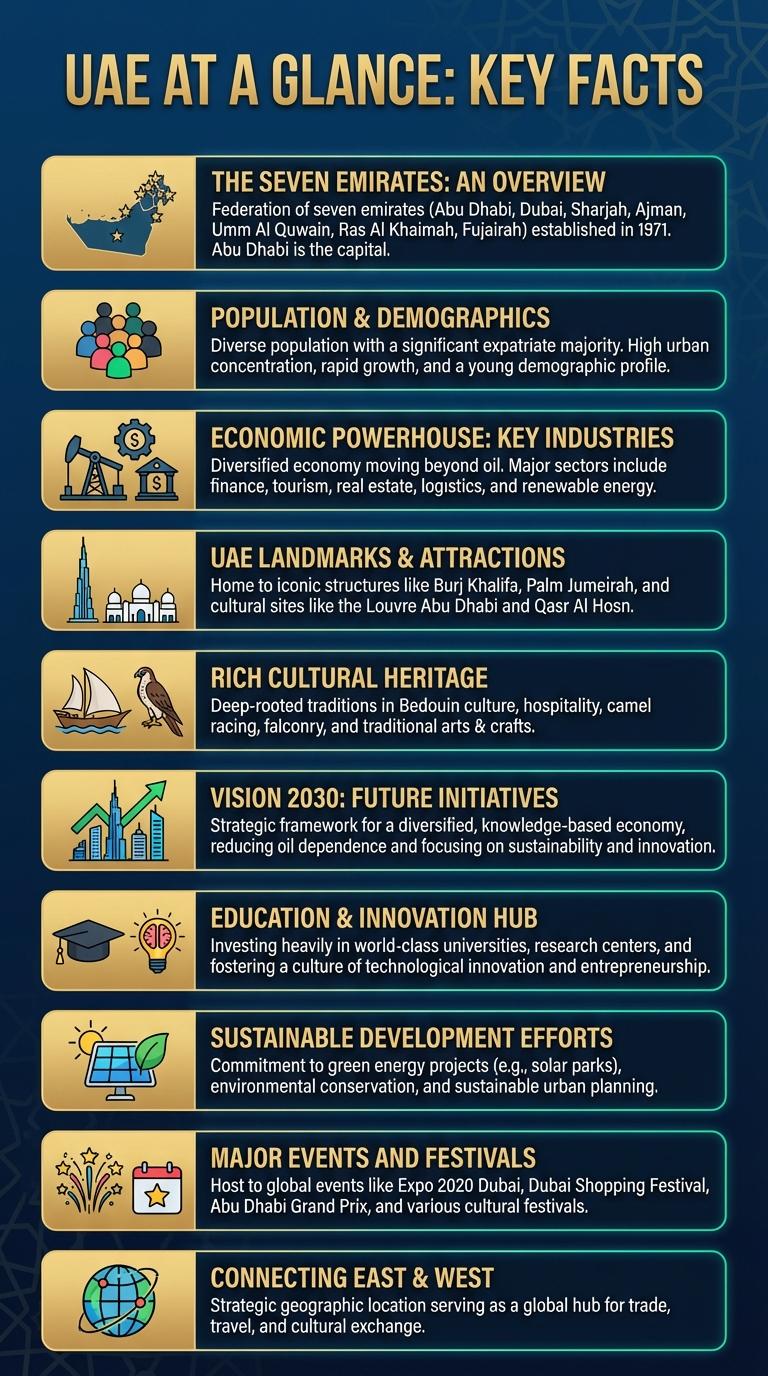
The infographic highlights key facts and figures about the UAE's economic growth, cultural diversity, and technological advancements. It showcases data on population demographics, major industries, and infrastructure developments. Visual elements provide a clear overview of the nation's dynamic progress and global significance.
UAE at a Glance: Key Facts
| Key Fact | Details |
|---|---|
| Official Name | United Arab Emirates (UAE) |
| Capital City | Abu Dhabi |
| Population | Approximately 10 million (2024 estimate) |
| Official Language | Arabic |
| Government Type | Federal Absolute Monarchy |
The Seven Emirates: An Overview
The United Arab Emirates (UAE) is a federation of seven emirates located on the southeastern coast of the Arabian Peninsula. Each emirate has its own unique identity and plays a specific role in the country's economy and culture.
Abu Dhabi is the capital and largest emirate, known for its vast oil reserves and modern infrastructure. Dubai is a global city and major business hub, famous for its skyscrapers and luxury tourism.
Sharjah is recognized as the cultural capital, emphasizing art and heritage preservation. Ajman, the smallest emirate, offers a quieter lifestyle with growing industrial and real estate sectors.
Fujairah, the only emirate on the Gulf of Oman, focuses on shipping and port activities. Ras Al Khaimah is rich in natural landscapes and mining industries. Umm Al Quwain is the most tranquil emirate, known for its natural mangroves and traditional fishing.
Population & Demographics
What is the current population of the UAE? The United Arab Emirates has a population of approximately 10 million people as of 2024. The population is highly diverse, with expatriates making up about 89% of residents.
How is the UAE's population distributed by nationality? Emirati citizens represent roughly 11% of the total population. The remaining 89% consists of expatriates from South Asia, the Middle East, and Western countries.
What are the key demographic characteristics of the UAE? The population is predominantly young, with a median age of around 32 years. Males outnumber females significantly due to the high number of male migrant workers.
What is the urbanization rate in the UAE? Over 85% of the UAE's population lives in urban areas, primarily in Dubai and Abu Dhabi. These cities serve as major economic and cultural hubs attracting global talent and business.
How does the UAE's population growth impact its society? Rapid population growth drives demand for housing, infrastructure, and public services. It also fosters a multicultural society with diverse languages, cultures, and traditions.
Economic Powerhouse: Key Industries
The United Arab Emirates (UAE) stands as a formidable economic powerhouse in the Middle East, driven by diversified industries. Its strategic location and business-friendly environment attract global investment and foster innovation.
Key industries include oil and gas, which remain the backbone of the economy, contributing significantly to GDP. The UAE has also invested heavily in tourism, real estate, and finance, positioning itself as a global hub. Emerging sectors like renewable energy and technology are gaining momentum, further strengthening economic resilience.
UAE Landmarks & Attractions
The United Arab Emirates is home to some of the world's most iconic landmarks and attractions. These sites showcase the country's blend of modern architecture and rich cultural heritage.
- Burj Khalifa - The tallest building in the world, standing at 828 meters, located in Dubai.
- Sheikh Zayed Grand Mosque - A stunning architectural marvel in Abu Dhabi, known for its white marble and intricate designs.
- Dubai Mall - One of the largest shopping centers globally, featuring an aquarium, ice rink, and over 1,200 retail stores.
Rich Cultural Heritage
The United Arab Emirates boasts a rich cultural heritage rooted in Bedouin traditions and Islamic values. Its history reflects a blend of Arabian, Persian, and South Asian influences, shaping a unique cultural identity.
Traditional music, dance, and handicrafts remain integral to Emirati culture, preserving ancient customs. Museums and heritage villages across the UAE showcase artifacts that celebrate its vibrant past and evolving modernity.
Vision 2030: Future Initiatives
The UAE's Vision 2030 outlines ambitious plans to transform the nation's economy and infrastructure. These future initiatives focus on sustainability, innovation, and global competitiveness.
- Renewable Energy Expansion - The UAE aims to increase its renewable energy capacity to 50% by 2030, reducing reliance on fossil fuels.
- Smart City Development - Integrating advanced technologies to enhance urban living and government services across major cities.
- Space Exploration Programs - Investing in space missions and research to position the UAE as a leader in space science.
- Education and Talent Growth - Enhancing education systems to nurture a highly skilled workforce aligned with future market needs.
- Economic Diversification - Expanding sectors like tourism, technology, and manufacturing to reduce oil dependency.
Education & Innovation Hub
The United Arab Emirates has rapidly emerged as a leading education and innovation hub in the Middle East, investing heavily in state-of-the-art universities and research centers. Abu Dhabi and Dubai host numerous international campuses, innovation labs, and technology parks fostering cutting-edge research and entrepreneurship. Government initiatives like the UAE Innovation Month and Mohammed bin Rashid Innovation Fund accelerate knowledge economy growth and nurture future-focused talent.
Sustainable Development Efforts
The United Arab Emirates (UAE) is a global leader in sustainable development, investing heavily in renewable energy and innovative environmental policies. The country's commitment supports both economic growth and environmental preservation.
- Renewable Energy Expansion - The UAE has launched the Mohammed bin Rashid Al Maktoum Solar Park, aiming for 5,000 MW capacity by 2030.
- Green Buildings Initiative - Sustainable architectural regulations promote energy efficiency and reduce water consumption nationwide.
- Waste Management Programs - Comprehensive recycling and waste reduction strategies are implemented across major cities to minimize landfill use.
The UAE continues to develop initiatives that balance rapid development with environmental sustainability.