
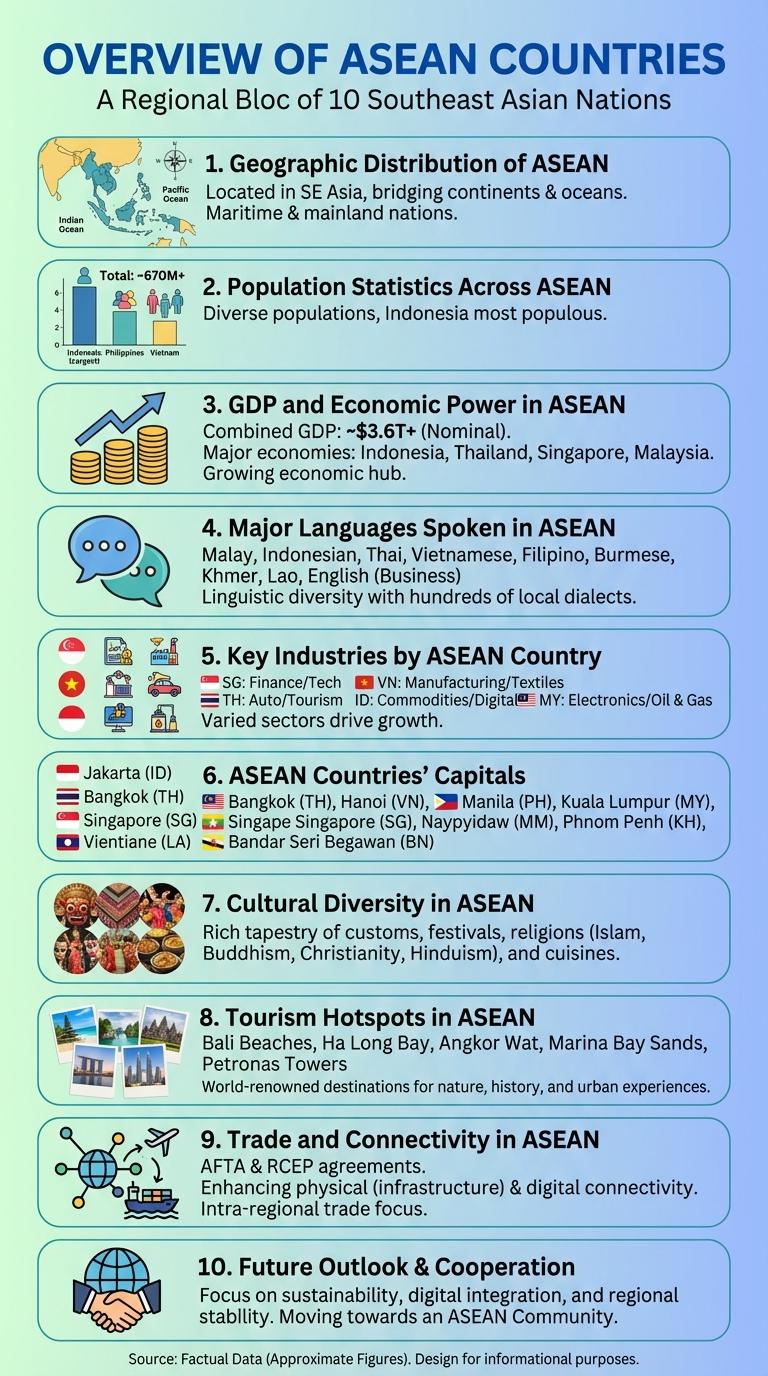
ASEAN countries comprise a diverse group of nations in Southeast Asia, each contributing unique cultural, economic, and political characteristics. This infographic highlights key data points such as population, GDP, and trade relations that shape the region's dynamic landscape. Understanding these statistics offers valuable insights into ASEAN's role in global affairs and regional development.
Overview of ASEAN Countries
The Association of Southeast Asian Nations (ASEAN) comprises 10 countries: Indonesia, Malaysia, Philippines, Singapore, Thailand, Brunei, Vietnam, Laos, Myanmar, and Cambodia. This regional organization promotes economic growth, cultural development, and political stability among its member states. ASEAN countries collectively represent a diverse population exceeding 660 million people and a combined GDP of over $3 trillion.
Geographic Distribution of ASEAN
The Association of Southeast Asian Nations (ASEAN) is a regional intergovernmental organization comprising ten countries located in Southeast Asia. These nations collectively cover a vast geographic area with diverse landscapes including islands, peninsulas, and mainland territories.
ASEAN countries are geographically distributed across two main regions: mainland Southeast Asia and maritime Southeast Asia. Mainland countries include Myanmar, Thailand, Laos, Cambodia, and Vietnam, all situated on the Indochinese Peninsula. Maritime countries such as Indonesia, the Philippines, Brunei, Malaysia, and Singapore consist mainly of archipelagos and coastal territories spread across the South China Sea and the surrounding oceans.
Population Statistics Across ASEAN
| Country | Population (2024 Estimate) |
|---|---|
| Indonesia | 277 million |
| Philippines | 117 million |
| Vietnam | 100 million |
| Thailand | 70 million |
| Myanmar | 56 million |
GDP and Economic Power in ASEAN
The ASEAN region comprises ten member countries, boasting a combined GDP exceeding $3.6 trillion as of 2023, making it one of the world's fastest-growing economic blocs. Indonesia leads with the largest GDP, followed by Thailand, Malaysia, and Singapore, reflecting diverse economic strengths across the bloc.
Economic power in ASEAN is driven by manufacturing, services, and natural resources, with exports playing a critical role in regional growth. Singapore stands out as a financial hub, while Vietnam and the Philippines show rapid industrial expansion, enhancing ASEAN's influence in the global economy.
Major Languages Spoken in ASEAN
ASEAN countries are linguistically diverse, with numerous major languages spoken across the region. These languages reflect the rich cultural heritage and communication patterns among the 10 member states.
The infographic highlights the primary languages used in each ASEAN country, emphasizing their significance in daily life and official functions.
- Indonesian (Bahasa Indonesia) - The official language of Indonesia, spoken by over 230 million people, serving as a unifying medium across the archipelago.
- Thai - Thailand's official language, used by approximately 70 million speakers, crucial for government, media, and education.
- Vietnamese - The predominant language in Vietnam, with over 85 million speakers, key to national identity and communication.
- Filipino and English - In the Philippines, both languages are official, with Filipino widely spoken and English used extensively in government and business.
- Malay - Official in Malaysia, Brunei, and Singapore, Malay is important for cultural ties and inter-country communication within ASEAN.
Key Industries by ASEAN Country
The ASEAN region comprises ten diverse countries, each excelling in unique key industries that drive their economies. Indonesia leads in palm oil and mining, while Thailand is renowned for automotive manufacturing and tourism. Singapore excels in finance and electronics, Malaysia focuses on electronics and petroleum, and Vietnam is a major player in textiles and agribusiness.
ASEAN Countries' Capitals
Which cities serve as the capitals of ASEAN countries? ASEAN consists of 10 member states, each with a unique capital city that plays a central role in its governance and culture. These capitals are hubs for political, economic, and social activities within the region.
| ASEAN Country | Capital City |
|---|---|
| Brunei | Bandar Seri Begawan |
| Cambodia | Phnom Penh |
| Indonesia | Jakarta |
| Laos | Vientiane |
| Malaysia | Kuala Lumpur |
Cultural Diversity in ASEAN
ASEAN countries are renowned for their rich cultural diversity, shaped by numerous ethnic groups, languages, and traditions. This diversity fosters unique cultural identities and promotes cross-cultural understanding throughout the region.
- Ethnic Diversity - ASEAN is home to over 300 distinct ethnic groups, highlighting the region's multi-ethnic societies.
- Language Variety - More than 100 languages are spoken across ASEAN countries, reflecting diverse linguistic heritage.
- Religious Pluralism - The region embraces multiple religions, including Buddhism, Islam, Christianity, and Hinduism, shaping different cultural practices.
Cultural festivals in ASEAN celebrate this diversity and strengthen regional unity.
Tourism Hotspots in ASEAN
ASEAN countries boast diverse tourism hotspots rich in natural beauty and cultural heritage. These destinations attract millions of travelers seeking unique experiences annually.
- Bali, Indonesia - Famous for its stunning beaches, vibrant nightlife, and rich Hindu culture, Bali remains Indonesia's top tourist destination.
- Halong Bay, Vietnam - Known for its emerald waters and thousands of limestone islands, Halong Bay is a UNESCO World Heritage site drawing adventure seekers.
- Angkor Wat, Cambodia - The largest religious monument in the world, Angkor Wat offers visitors a glimpse into the Khmer Empire's history and architecture.