
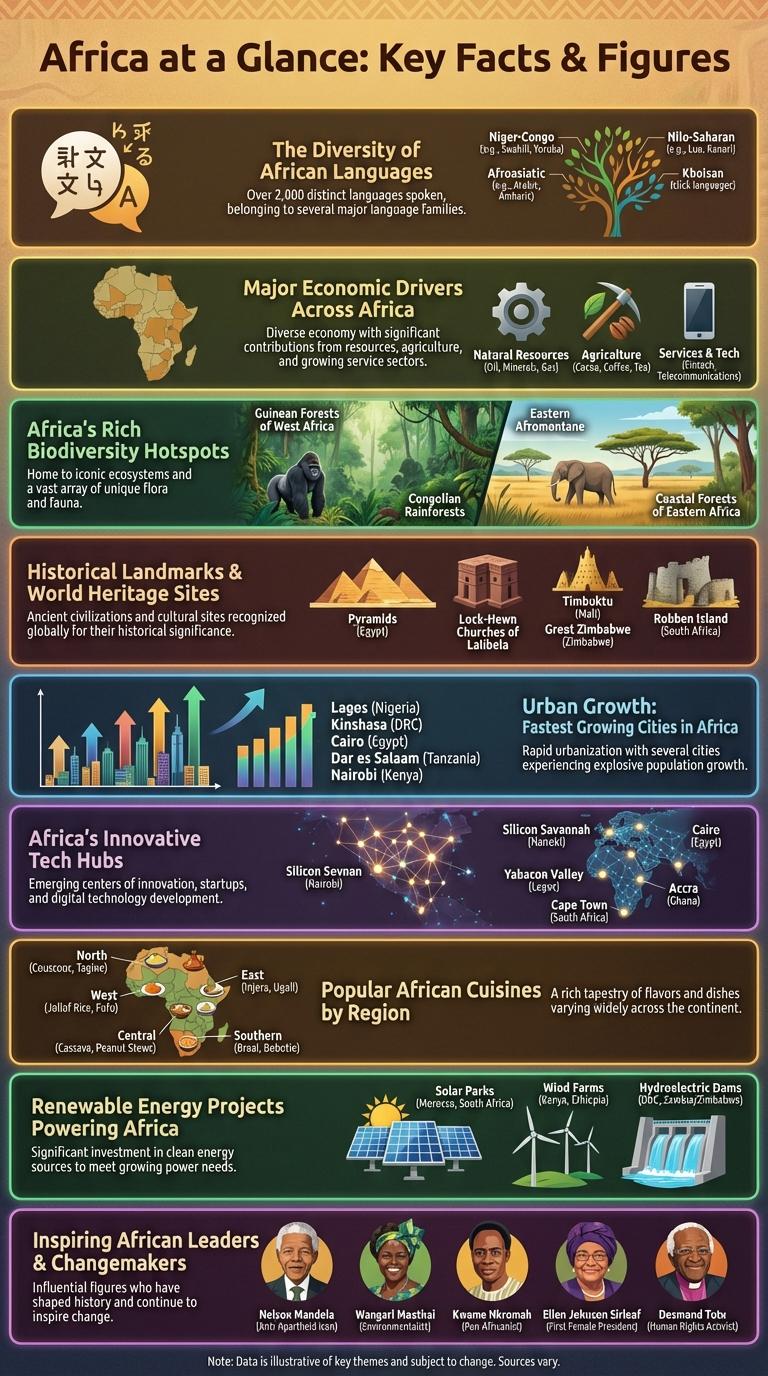
Africa's rich cultural heritage and diverse ecosystems are vividly showcased through detailed infographics. Data visualization highlights the continent's population growth, natural resources, and economic development trends. These graphical representations provide clear insights into Africa's expanding role on the global stage.
Africa at a Glance: Key Facts & Figures
Africa is the second largest continent, covering about 30.2 million square kilometers. It is home to over 1.4 billion people, making it the second most populous continent in the world.
The continent comprises 54 countries with diverse cultures and languages. Africa holds vast natural resources, including 60% of the world's uncultivated arable land and significant mineral reserves.
The Diversity of African Languages
| Aspect | Details |
|---|---|
| Number of Languages | Over 2,000 distinct languages spoken across Africa |
| Major Language Families | Niger-Congo, Afroasiatic, Nilo-Saharan, Khoisan |
| Most Widely Spoken Language | Swahili with over 75 million speakers |
| Official Languages | English, French, Arabic, Portuguese, and Spanish used in various countries |
| Cultural Significance | Languages reflect ethnic identities, oral traditions, and local histories |
Major Economic Drivers Across Africa
Africa's major economic drivers include natural resources, agriculture, and technology sectors. Countries like Nigeria and South Africa lead in oil production and mining, while Kenya and Ethiopia excel in agriculture and digital innovation. The continent's diverse economy presents numerous investment opportunities and growth potential.
Africa's Rich Biodiversity Hotspots
Africa is home to some of the world's richest biodiversity hotspots, harboring a vast array of unique plant and animal species. These regions are critical for global ecological health and conservation efforts.
The Congo Basin, one of the largest tropical rainforests, supports thousands of species, including endangered gorillas and forest elephants. The Cape Floristic Region in South Africa features a remarkable diversity of endemic plant species, many found nowhere else on Earth. East Africa's savannas provide habitat for iconic wildlife such as lions, elephants, and cheetahs, playing a key role in maintaining ecological balance.
Historical Landmarks & World Heritage Sites
Africa is home to a rich array of historical landmarks and UNESCO World Heritage Sites that showcase its diverse cultures and ancient civilizations. These sites attract millions of visitors annually and reflect the continent's significant contributions to world history and heritage.
- The Great Pyramid of Giza - This ancient Egyptian pyramid in Cairo is the oldest of the Seven Wonders of the Ancient World and represents remarkable architectural achievement.
- Rock-Hewn Churches of Lalibela - Located in Ethiopia, these 12th-century monolithic churches were carved directly into rock and serve as a major pilgrimage site.
- Victoria Falls - Straddling the border of Zambia and Zimbabwe, this UNESCO World Heritage Site is one of the largest and most famous waterfalls on Earth.
Urban Growth: Fastest Growing Cities in Africa
Africa is experiencing rapid urban growth, with several cities emerging as the fastest growing urban centers on the continent. Lagos, Nigeria leads with a population growth rate of over 4% annually, followed by cities like Kinshasa, Nairobi, and Cairo. This urban expansion presents significant opportunities and challenges for infrastructure, housing, and sustainable development.
Africa's Innovative Tech Hubs
What makes Africa's tech hubs stand out in the global innovation landscape? Africa hosts over 600 technology hubs across 40 countries driving digital transformation and startup growth. These hubs foster innovation in fintech, agritech, healthtech, and clean energy sectors, proving critical to economic development.
| Tech Hub | Location & Key Focus |
|---|---|
| iHub | Nairobi, Kenya - Mobile and software innovation |
| CcHub | Lagos, Nigeria - Social impact and fintech |
| Konza Technopolis | Kenya - Smart city and ICT innovation |
| Hub Africa | South Africa - Digital entrepreneurship and AI |
| BongoHive | Lusaka, Zambia - Tech startup incubation |
Popular African Cuisines by Region
Africa's diverse regions boast a rich tapestry of cuisines that reflect unique cultural traditions and local ingredients. Each area offers signature dishes known worldwide for their distinctive flavors and preparation methods.
- North Africa: Tagine and couscous highlight the blend of Mediterranean and Arab influences, utilizing spices like cumin and saffron.
- West Africa: Jollof rice and fufu are staples, emphasizing hearty grains and root vegetables with spicy stews.
- East Africa: Ugali and injera serve as essential carbohydrate bases, paired with flavorful meat and vegetable dishes.
Renewable Energy Projects Powering Africa
Africa's renewable energy sector is experiencing significant growth with several large-scale projects underway. These initiatives aim to harness solar, wind, and hydropower to meet rising electricity demands sustainably.
- Grand Ethiopian Renaissance Dam - The largest hydroelectric power project in Africa, generating over 6,000 MW of clean energy.
- Noor Solar Complex, Morocco - One of the world's largest concentrated solar power plants, supplying solar power to millions of households.
- Lake Turkana Wind Power, Kenya - Africa's largest wind farm, with a capacity of 310 MW, providing about 17% of Kenya's electricity.
Renewable energy projects across Africa are accelerating the continent's transition to sustainable power and economic growth.