
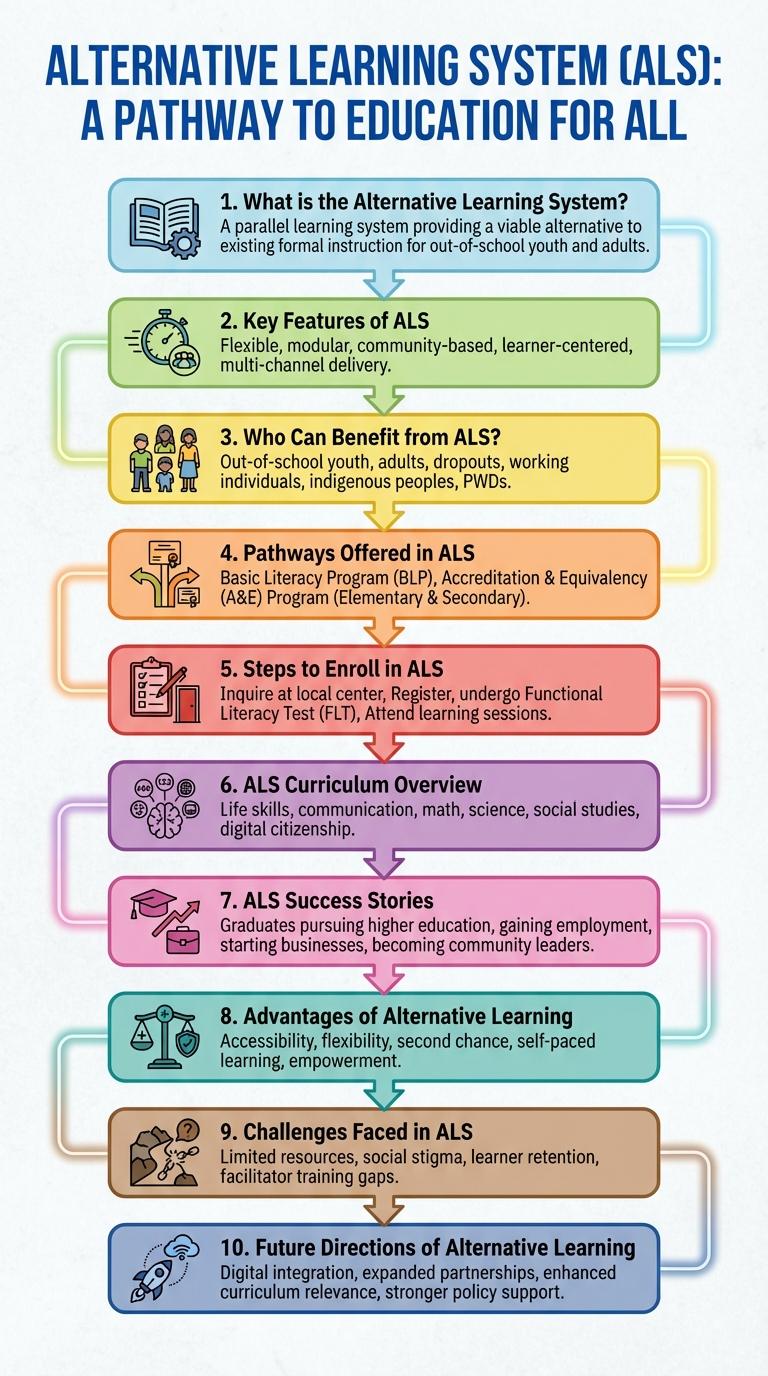
Alternative learning systems offer flexible education pathways designed to accommodate diverse learning needs and schedules, providing learners with opportunities beyond traditional classrooms. These programs emphasize self-paced study, practical skills, and community-based instruction, making education accessible to out-of-school youth and adults. Infographics visually highlight key components, benefits, and success rates of alternative learning methods to inform and inspire potential learners.
What is the Alternative Learning System?
The Alternative Learning System (ALS) is a parallel education program in the Philippines designed for out-of-school youth and adult learners. It provides a practical and flexible learning approach outside the formal school system. ALS aims to equip learners with functional literacy, livelihood skills, and the competencies required for formal education equivalency.
Key Features of ALS
The Alternative Learning System (ALS) offers a flexible education program designed for out-of-school youth and adults. It provides non-formal education tailored to individual learning needs, allowing learners to acquire basic literacy, livelihood skills, and life skills. Key features include modular instruction, accreditation and equivalency, and community-based learning opportunities.
Who Can Benefit from ALS?
The Alternative Learning System (ALS) provides flexible education opportunities for various individuals who may not thrive in traditional classrooms. It caters to out-of-school youth, adults seeking to complete basic education, and people in marginalized communities.
ALS benefits learners who work or have family responsibilities, offering non-formal pathways to literacy and skills development. It also supports those preparing for the Accreditation and Equivalency exam to obtain high school diplomas and improve employment prospects.
Pathways Offered in ALS
The Alternative Learning System (ALS) provides flexible educational pathways designed to meet diverse learner needs. It offers options that enable learners to achieve equivalency with formal education levels outside traditional classroom settings.
- Basic Literacy Program - Developed for learners who are non-literate or semi-literate to acquire fundamental reading, writing, and numeracy skills.
- Accreditation and Equivalency (A&E) Program - Enables learners to earn certification equivalent to elementary or high school diplomas for career or further education opportunities.
- Livelihood Skills Training - Provides practical skills and vocational training to enhance employability and self-sufficiency for ALS learners.
Steps to Enroll in ALS
The Alternative Learning System (ALS) offers a flexible education program for out-of-school youth and adults. Enrolling in ALS involves a few simple steps designed to make learning accessible.
- Visit the Nearest ALS Center - Locate and go to the closest ALS learning center to begin the enrollment process.
- Submit Required Documents - Provide basic identification and supporting documents for verification and registration.
- Attend Orientation - Participate in an orientation session to understand the ALS program and schedule.
- Assessment and Profiling - Undergo an initial assessment to determine the appropriate learning level and modules.
- Start Learning Modules - Begin studying the ALS modules under the guidance of assigned facilitators.
ALS Curriculum Overview
The Alternative Learning System (ALS) provides a flexible education program designed for out-of-school youth and adults. It offers basic literacy, livelihood skills, and alternative secondary education.
The ALS curriculum covers foundational skills in reading, writing, and numeracy along with practical life skills. It is divided into the Basic Literacy Program, Accreditation and Equivalency Program, and the Native Language Literacy Program.
ALS Success Stories
The Alternative Learning System (ALS) offers flexible education opportunities to out-of-school youth and adults. Many learners have succeeded in achieving academic and personal goals through the ALS program.
- Empowered Graduates - ALS learners have successfully passed equivalency exams, earning certificates comparable to formal education diplomas.
- Improved Employment - ALS graduates have secured better job opportunities and increased income after completing the program.
- Community Leaders - Many ALS alumni contribute actively to their communities, inspiring others to pursue education.
Success stories from ALS demonstrate the program's vital role in transforming lives and fostering lifelong learning.
Advantages of Alternative Learning
Alternative Learning System (ALS) provides flexible education opportunities tailored to learners outside the traditional school setup. It emphasizes personalized learning, making education accessible to diverse groups including out-of-school youth and adults.
ALS is designed to accommodate varying schedules and learning paces, enhancing student engagement and retention. It promotes inclusivity by offering equivalency programs that recognize informal and non-formal educational experiences. This system bridges educational gaps and supports lifelong learning goals effectively.
Challenges Faced in ALS
What are the main challenges faced in the Alternative Learning System (ALS)? The ALS encounters significant barriers including limited resources and accessibility issues. Many learners struggle with inadequate learning materials and lack of stable internet connection.
How does geographic location impact ALS learners? Remote and rural areas often suffer from poor infrastructure, making it difficult for learners to attend classes regularly. This results in lower participation and higher dropout rates among ALS students.
What role does learner motivation play in ALS success? Maintaining motivation can be difficult due to non-traditional learning environments and personal responsibilities. Many ALS learners juggle work and family duties alongside their education, causing inconsistent engagement.
How do social stigmas affect ALS participation? Some communities perceive ALS as a lesser alternative to formal education, impacting learner confidence and support. This stigma often discourages potential learners from enrolling or continuing with the program.
What challenges do educators in ALS face? Teachers frequently deal with high learner-to-instructor ratios and lack of formal training specific to ALS. These factors limit the effectiveness of personalized instruction and student progress monitoring.