
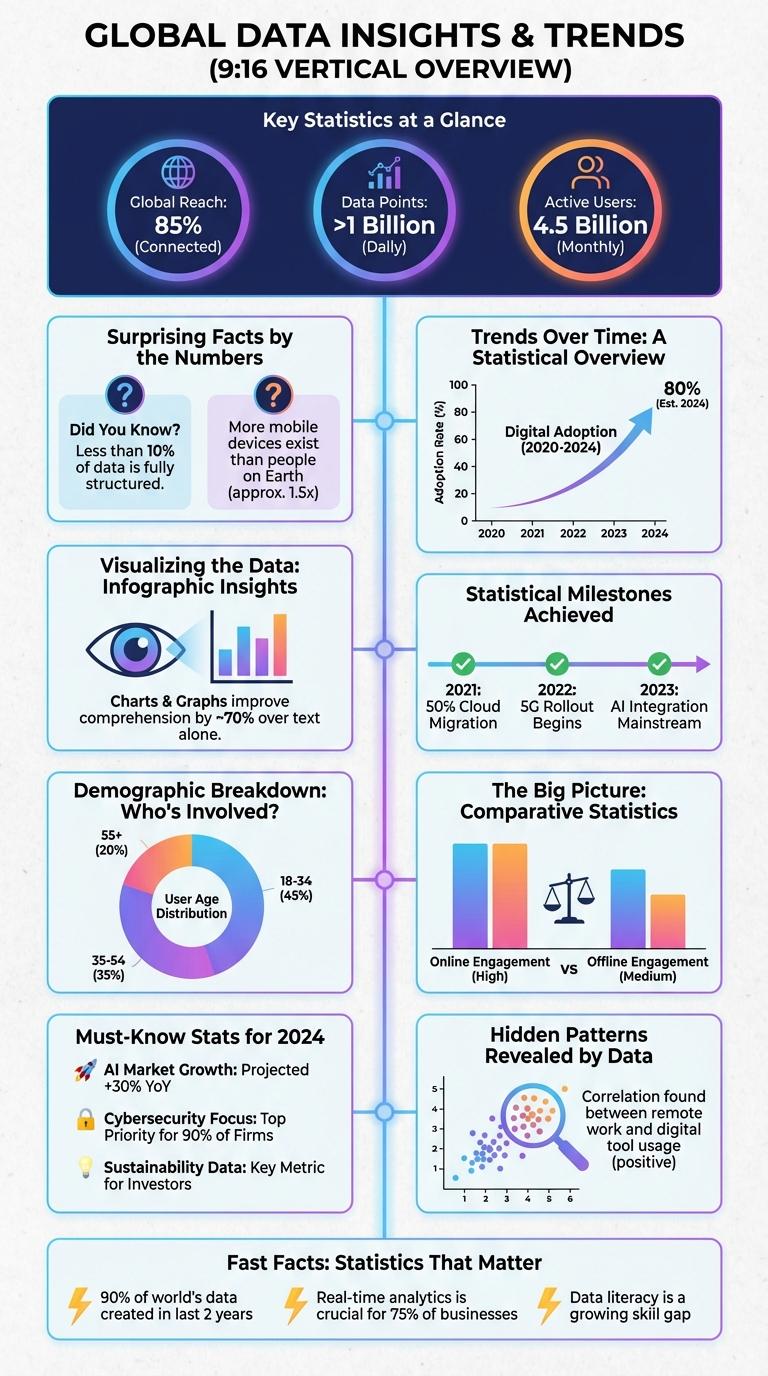
Infographics about statistics transform complex numerical data into visually engaging and easily digestible formats, enhancing comprehension and retention. They highlight key trends, patterns, and insights through charts, graphs, and icons, making statistical information accessible to diverse audiences. Effective statistical infographics combine clarity, accuracy, and aesthetic appeal to facilitate informed decision-making.
Key Statistics at a Glance
Statistics provide critical insights into data trends, helping to make informed decisions. Key statistics at a glance highlight important metrics that summarize complex information efficiently.
Understanding these key statistics can enhance analysis and improve strategic planning across various fields.
- Global Internet Usage - Over 5 billion people worldwide are active internet users as of 2024, showing continuous growth in connectivity.
- Data Generation - More than 2.5 quintillion bytes of data are created daily, reflecting the vast volume of information generated globally.
- Mobile Device Penetration - Approximately 66% of the global population uses smartphones, demonstrating the widespread adoption of mobile technology.
Surprising Facts by the Numbers
Statistics reveal unexpected insights that challenge common assumptions. Numbers often tell stories that go beyond surface-level observations.
For example, over 90% of the world's data was generated in the last two years alone. This rapid growth highlights the exponential rise of digital information globally.
Trends Over Time: A Statistical Overview
Statistical trends over time reveal critical patterns in various fields such as economics, healthcare, and technology. Analyzing these trends helps identify growth, decline, and cyclical behaviors in complex datasets.
Visualizing data through infographics enhances comprehension by highlighting key metrics like percentages, averages, and rates of change. Time-series charts and line graphs are essential tools for illustrating statistical trends over multiple periods.
Visualizing the Data: Infographic Insights
Infographics transform complex statistics into visually engaging insights, making data easier to understand. They enhance communication by highlighting key trends and patterns effectively.
- Data Clarity - Infographics simplify raw data into clear, digestible formats for quick comprehension.
- Trend Visualization - Graphical elements reveal patterns and correlations that might be missed in text-based data.
- Audience Engagement - Eye-catching design increases retention and interest in statistical information.
Statistical Milestones Achieved
Statistical milestones achieved highlight significant advancements in data analysis and interpretation, shaping modern decision-making processes. Key breakthroughs include the development of probability theory, the introduction of hypothesis testing, and the widespread adoption of machine learning models. These milestones have revolutionized fields such as healthcare, economics, and social sciences by enabling more accurate predictions and data-driven strategies.
Demographic Breakdown: Who's Involved?
Who makes up the key demographics in today's statistics? Age, gender, and geographic location play significant roles in defining demographic segments. Understanding these factors helps identify trends and target specific populations effectively.
| Demographic Factor | Key Insights |
|---|---|
| Age | Majority participation from 18-34 years, with growing interest among seniors. |
| Gender | Balanced involvement, slight predominance of females in social statistics fields. |
| Location | Urban areas contribute over 70% of data collected, rural data increasing. |
| Income Level | Middle-income groups provide the largest data sample, high-income data underrepresented. |
| Education | Higher education correlates with increased participation in statistical surveys. |
The Big Picture: Comparative Statistics
Comparative statistics provide a clear overview of differences and similarities across various data sets. They help in identifying trends, patterns, and relationships efficiently.
By comparing data from multiple sources or time periods, these statistics offer valuable insights into performance, growth, or decline. Visualization tools like charts and graphs enhance comprehension of complex data. The big picture emerges when distinct datasets are analyzed side-by-side, facilitating informed decision-making.
Must-Know Stats for 2024
Statistics reveal key trends shaping industries and societies in 2024. Understanding must-know stats empowers data-driven decisions across business, technology, and healthcare sectors. This infographic highlights critical metrics essential for strategic planning and innovation.
Hidden Patterns Revealed by Data
Infographics serve as powerful tools to visualize complex data effectively. They help uncover hidden patterns that may not be immediately obvious in raw statistics.
- Correlation Detection - Infographics highlight relationships between variables that reveal underlying trends.
- Cluster Identification - Visual groupings expose natural groupings or segments within large datasets.
- Anomaly Spotting - Unusual data points are easily noticed, signaling potential outliers or errors.
By translating numbers into visual insights, infographics make hidden data patterns accessible and understandable.