
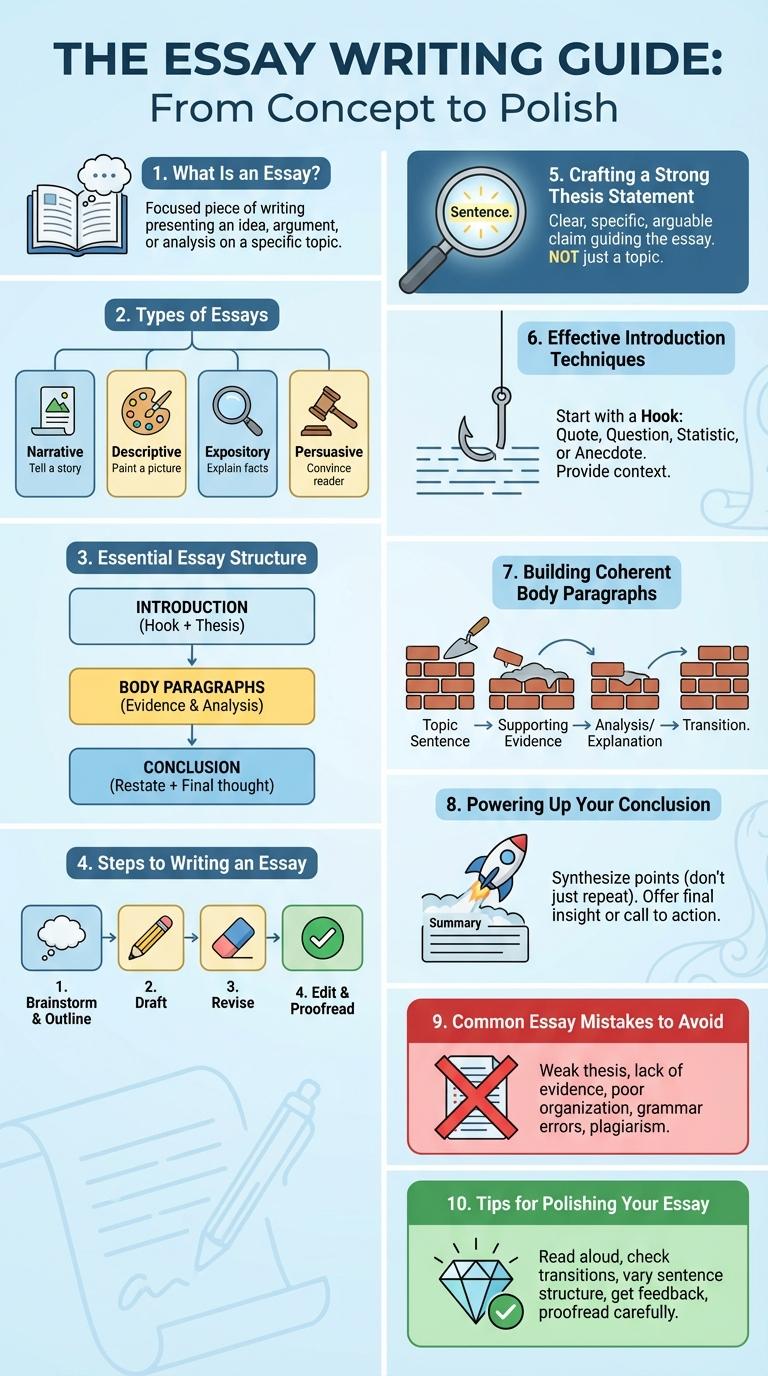
An infographic about essays visually breaks down the essential components of essay writing, making complex information easy to understand and remember. It highlights key elements such as thesis statements, paragraph structure, and writing tips to improve clarity and coherence. This visual tool serves as a quick reference guide for students and writers aiming to enhance their essay composition skills.
What Is an Essay?
What is an essay? An essay is a structured piece of writing that presents a clear argument or analysis on a specific topic. It typically includes an introduction, body paragraphs, and a conclusion to convey ideas effectively.
Types of Essays
Essays come in various types, each serving a unique purpose in writing. Understanding these types helps improve clarity and effectiveness in communication.
Common types include narrative, descriptive, expository, argumentative, and persuasive essays. Each type requires a distinct approach to structure, tone, and content to achieve its goal.
Essential Essay Structure
| Essay Component | Key Elements |
|---|---|
| Introduction | Hook, Background Information, Thesis Statement |
| Body Paragraphs | Topic Sentence, Supporting Evidence, Analysis, Transition |
| Conclusion | Restate Thesis, Summarize Main Points, Closing Thought |
Steps to Writing an Essay
Writing an essay involves organized steps to effectively communicate ideas. These steps guide the process from brainstorming to final revision.
Start with planning by choosing a topic and outlining key points. Next, draft the introduction, body, and conclusion focusing on clear arguments. Finally, revise for clarity, coherence, and grammatical accuracy to strengthen the essay.
Crafting a Strong Thesis Statement
Crafting a strong thesis statement is crucial for guiding the focus and direction of an essay. A well-defined thesis provides clarity and sets the tone for the entire writing.
An effective thesis statement clearly expresses the main argument or purpose of the essay, helping readers understand its core message.
- Specificity - A strong thesis narrows the topic to a specific claim that can be supported with evidence.
- Clarity - The statement should be clear and unambiguous, avoiding vague language.
- Argumentative - A thesis must present an argument or position that invites discussion rather than stating a fact.
Effective Introduction Techniques
An effective introduction captures the reader's attention and provides a clear overview of the essay's main topic. It sets the tone and directs the reader toward the essay's purpose.
- Hook the Reader - Use an intriguing question, fact, or quote to engage the audience immediately.
- Provide Background - Offer brief context or necessary information to understand the essay topic.
- State the Thesis - Clearly express the main argument or focus of the essay in one concise sentence.
Building Coherent Body Paragraphs
Building coherent body paragraphs is essential for crafting a clear and persuasive essay. Each paragraph should focus on a single main idea supported by evidence and explanation.
- Topic Sentence - Introduces the main idea of the paragraph and connects it to the thesis statement.
- Supporting Details - Provide facts, examples, or quotes that reinforce the topic sentence and add credibility.
- Closing Sentence - Summarizes the paragraph's point and smoothly transitions to the next idea.
Well-structured body paragraphs enhance the overall flow and clarity of the essay, making arguments easier to follow.
Powering Up Your Conclusion
Powering up your conclusion reinforces your essay's main argument and leaves a lasting impression on readers. A strong conclusion ties together key points and emphasizes the significance of your topic.
Summarize your main ideas clearly and avoid introducing new information. End with a thought-provoking statement or call to action to engage your audience further.
Common Essay Mistakes to Avoid
An essay often loses impact due to common mistakes such as unclear thesis statements, weak topic sentences, and poor organization. Avoiding grammatical errors, overgeneralizations, and redundancy improves overall readability. Careful proofreading and structured planning ensure a compelling and coherent essay.