
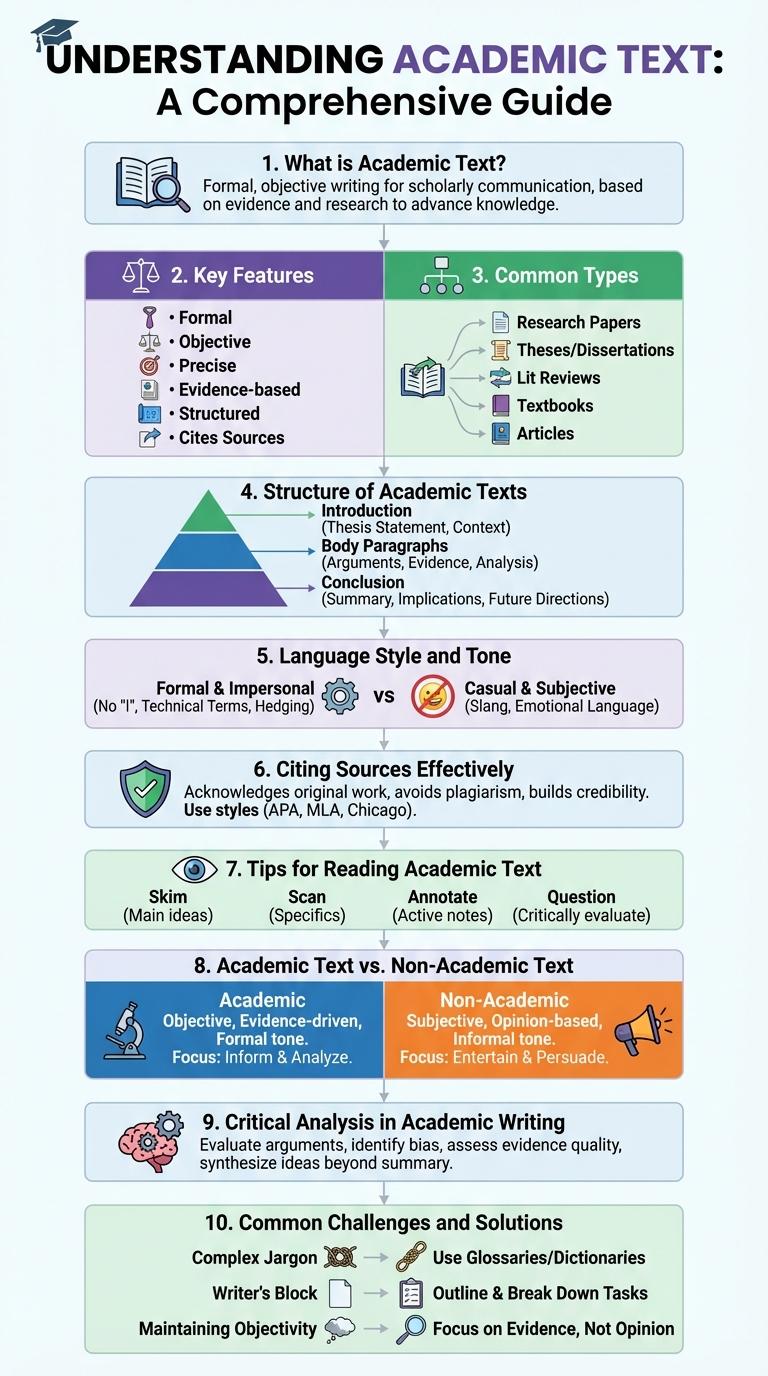
Academic texts systematically present research findings, theories, and critical analyses to advance knowledge within various disciplines. These texts follow structured formats, including clear arguments, evidence-based support, and precise language to communicate complex ideas effectively. Understanding the components and organization of academic writing enhances comprehension and improves one's ability to engage with scholarly material.
What is Academic Text?
Academic text presents ideas and research in a structured, formal style aimed at a scholarly audience. It uses clear evidence and logical reasoning to support arguments or findings.
- Formal Tone - Maintains professionalism with precise vocabulary and objective language.
- Evidence-Based - Relies on data, citations, and references to validate claims.
- Structured Format - Follows organized sections like introduction, methods, results, and conclusion.
Academic texts are essential for advancing knowledge within educational and research communities.
Key Features of Academic Text
What defines the key features of academic text? Academic texts prioritize clarity and formality to communicate complex ideas effectively. They use precise vocabulary and structured organization to support logical argumentation.
How is evidence presented in academic writing? Academic texts rely on credible sources such as peer-reviewed journals and books to substantiate claims. Proper citation and referencing are essential to maintain academic integrity.
What role does objectivity play in academic texts? Maintaining an unbiased and impersonal tone ensures arguments are presented fairly and logically. Authors avoid emotional language, focusing instead on facts and rational analysis.
How is coherence achieved in academic texts? Logical flow is maintained through clear topic sentences, paragraph transitions, and consistent terminology. This structure helps readers follow the argument from introduction to conclusion.
Why is structure important in academic writing? Academic texts typically follow a standard format including introduction, methodology, results, and discussion sections. This organized framework supports transparency and replicability in research.
Common Types of Academic Text
Academic texts serve as foundational tools for conveying knowledge, research, and arguments in educational settings. They follow structured formats to present information clearly and effectively.
Common types of academic texts include research papers, essays, book reviews, reports, and literature reviews. Research papers present original findings supported by evidence and analysis. Essays offer critical perspectives on specific topics, while book reviews evaluate academic works. Reports summarize data and conclusions from experiments or studies, and literature reviews synthesize existing research on a topic.
Structure of Academic Texts
Academic texts follow a clear and logical structure to effectively communicate ideas and research findings. This structure helps readers understand the progression of arguments and evidence.
The main components include the introduction, body, and conclusion, each serving a specific purpose in the text. Proper organization enhances clarity and supports the author's thesis throughout the paper.
Language Style and Tone
Academic texts employ a formal language style to convey information clearly and precisely. The tone remains objective and impersonal, ensuring unbiased communication.
Language style and tone are crucial in maintaining credibility and engaging scholarly audiences effectively.
- Formal Language - Uses precise vocabulary and avoids slang or colloquialisms to maintain professionalism.
- Objective Tone - Presents information without personal bias or emotional influence to ensure neutrality.
- Complex Sentence Structure - Employs well-structured sentences to express intricate ideas clearly and logically.
Citing Sources Effectively
| Aspect | Details |
|---|---|
| Definition | Citing sources involves acknowledging the original authors of information or ideas used in academic writing to avoid plagiarism and support arguments. |
| Importance | Proper citation enhances credibility, provides evidence for claims, and allows readers to locate source materials. |
| Common Styles | APA, MLA, Chicago, Harvard - each with specific rules for formatting in-text citations and reference lists. |
| Best Practices | Use consistent citation style, cite all direct quotes and paraphrases, and double-check details like author names, titles, and publication dates. |
| Tools & Resources | Reference management software like Zotero, EndNote, and Citation Machine help format and organize citations effectively. |
Tips for Reading Academic Text
Reading academic texts requires strategic approaches to enhance comprehension and retention. Effective techniques enable readers to grasp complex information efficiently.
- Preview the Text - Skim headings, abstracts, and summaries to get an overview of the main ideas before deep reading.
- Highlight Key Concepts - Mark important terms and phrases to focus on essential information and facilitate quick review.
- Take Notes - Write brief summaries or questions to engage actively with the material and improve memory retention.
Academic Text vs. Non-Academic Text
Academic texts are structured, formal, and based on research, aiming to inform or argue specific points within scholarly contexts. Non-academic texts are more informal, designed for entertainment or general information without strict adherence to research standards.
Academic texts include journals, essays, and theses, featuring citations and technical vocabulary. Non-academic texts cover blogs, news articles, and fiction, using everyday language and simpler structures.
Critical Analysis in Academic Writing
Critical analysis in academic writing involves evaluating and interpreting ideas, arguments, and evidence to develop a well-supported perspective. It requires identifying underlying assumptions, assessing the validity and relevance of information, and synthesizing diverse viewpoints. Mastery of critical analysis enhances clarity, depth, and credibility in scholarly communication.