
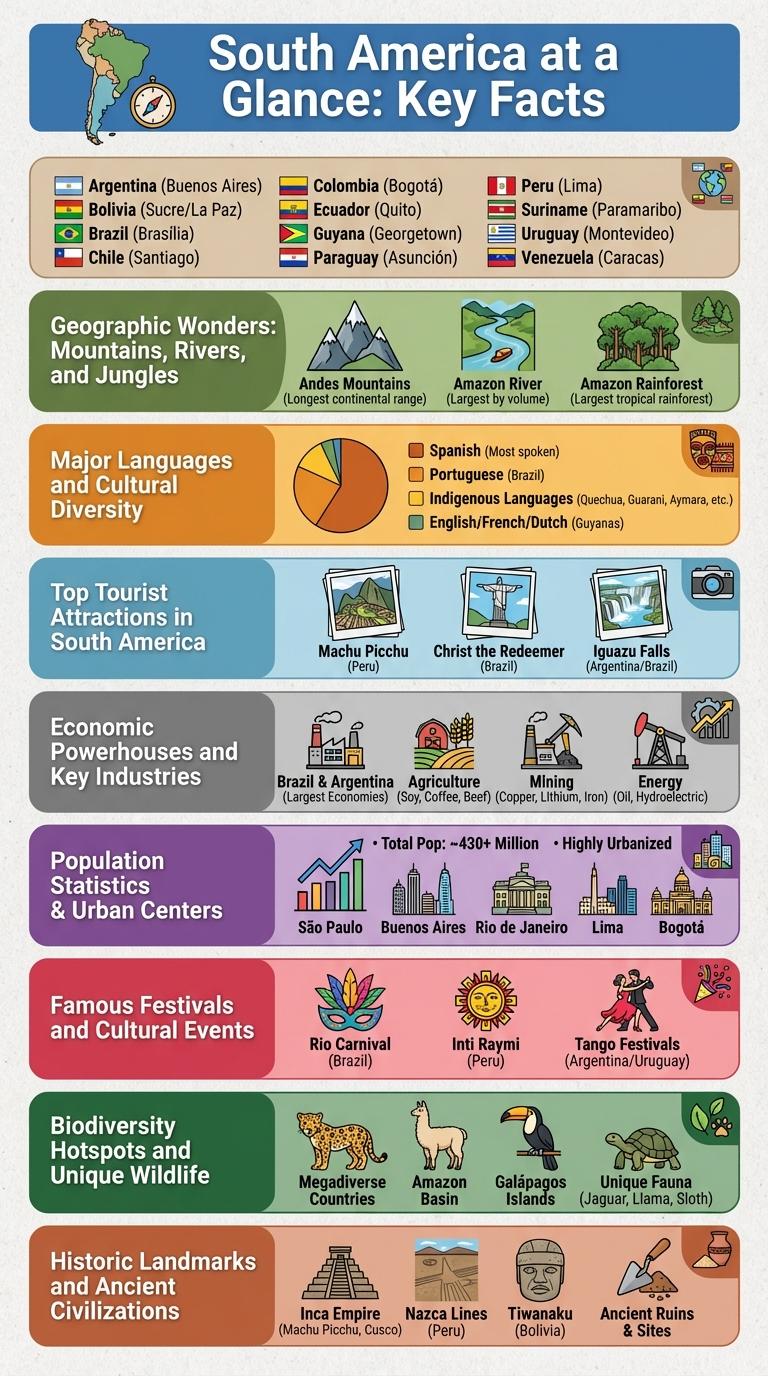
South America boasts diverse landscapes and rich cultural heritage that shape its unique identity. From the Amazon rainforest to the Andes mountains, the continent offers vast ecological and geographical variety. A detailed infographic highlights key facts, economic trends, and historical landmarks defining South America's vibrant character.
South America at a Glance: Key Facts
South America is the fourth largest continent, covering approximately 17.84 million square kilometers. It is home to over 430 million people, with Brazil being the most populous country. The continent features diverse ecosystems, including the Amazon rainforest, Andes mountains, and extensive river systems.
| Key Fact | Detail |
|---|---|
| Area | 17.84 million km2 |
| Population | 430 million (approx.) |
| Largest Country | Brazil |
| Major Ecosystems | Amazon Rainforest, Andes Mountains |
| Primary Languages | Spanish, Portuguese |
Countries and Capitals of South America
South America consists of 12 countries, each with a unique capital city representing its political and cultural center. Key capitals include Brasilia in Brazil, Buenos Aires in Argentina, and Bogota in Colombia. These cities are not only administrative hubs but also important economic and cultural destinations within the continent.
| Country | Capital |
|---|---|
| Argentina | Buenos Aires |
| Brazil | Brasilia |
| Chile | Santiago |
| Colombia | Bogota |
| Peru | Lima |
Geographic Wonders: Mountains, Rivers, and Jungles
South America boasts some of the most diverse and breathtaking geographic features on Earth. This continent is home to towering mountains, expansive rivers, and vast jungles that shape its natural landscape and ecosystems.
- The Andes Mountains - Stretching over 7,000 kilometers, the Andes are the longest continental mountain range in the world, home to several peaks soaring above 6,000 meters.
- The Amazon River - The Amazon is the largest river by discharge volume, flowing over 6,400 kilometers and supporting the richest rainforest on the planet.
- The Amazon Rainforest - Covering approximately 5.5 million square kilometers, this jungle is the largest tropical rainforest, hosting unparalleled biodiversity.
Major Languages and Cultural Diversity
| Major Languages | Cultural Diversity |
|---|---|
| Spanish - Predominant in countries like Argentina, Colombia, Peru, and Chile | Indigenous groups such as Quechua, Aymara, and Guarani contribute to unique cultural heritage |
| Portuguese - Official language of Brazil, the largest country in South America | Afro-descendant communities, especially in Brazil, influence music, cuisine, and religious practices |
| English - Spoken in Guyana and the Falkland Islands | European cultural influences from Spanish, Portuguese, British, and Italian immigrants shape traditions |
| Dutch - Official language of Suriname | Multicultural society with contributions from Indian, Javanese, and Chinese immigrant communities |
| French - Official language of French Guiana | Blending of indigenous, African, and European cultures creates vibrant festivals and art forms |
Top Tourist Attractions in South America
South America boasts diverse landscapes and rich cultural history, making it a prime destination for travelers. Top tourist attractions highlight the continent's natural beauty and ancient civilizations.
- Machu Picchu, Peru - This ancient Incan city is renowned for its breathtaking mountain views and well-preserved archaeological ruins.
- Christ the Redeemer, Brazil - The iconic statue in Rio de Janeiro offers panoramic views of the city and Atlantic coastline.
- Iguazu Falls, Argentina/Brazil - One of the largest waterfall systems in the world, famous for its immense power and surrounding rainforest.
Economic Powerhouses and Key Industries
South America hosts several economic powerhouses such as Brazil and Argentina, known for their diverse and robust economies. These countries drive regional growth through agriculture, manufacturing, and services sectors.
Brazil leads the continent with a strong industrial base including automobile production, aerospace, and steel manufacturing. Argentina excels in agriculture, particularly soybean and beef exports, contributing significantly to its GDP. Chile dominates in mining, especially copper, positioning itself as a global leader in natural resource exports.
Population Statistics & Urban Centers
South America is home to over 430 million people, making it the fourth most populous continent. Brazil leads with a population exceeding 210 million, followed by Colombia and Argentina, each with populations above 40 million.
The continent's urbanization is significant, with major cities like Sao Paulo housing over 12 million residents. Other urban centers such as Buenos Aires and Bogota exceed 7 million inhabitants, reflecting rapid urban growth and economic hubs across South America.
Famous Festivals and Cultural Events
South America hosts a variety of famous festivals that celebrate its rich cultural heritage and vibrant traditions. Events like the Rio Carnival in Brazil and Inti Raymi in Peru draw millions of visitors each year.
The Rio Carnival, known for its samba parades and colorful costumes, is the largest carnival in the world. Inti Raymi, the Festival of the Sun, honors the Inca sun god with traditional dances and ceremonies in Cusco.
Biodiversity Hotspots and Unique Wildlife
South America hosts some of the world's richest biodiversity hotspots, offering unique ecosystems. These diverse habitats support an exceptional variety of wildlife found nowhere else on Earth.
- Amazon Rainforest - Encompasses over 5.5 million square kilometers and is home to around 10% of known species globally.
- Andes Mountains - Houses endemic species such as the spectacled bear and the Andean condor, adapted to high-altitude ecosystems.
- Atlantic Forest - Contains over 20,000 plant species, with more than 8,000 endemic species due to its fragmented habitat.
Conservation efforts continue to play a critical role in preserving South America's unique biodiversity and wildlife heritage.