
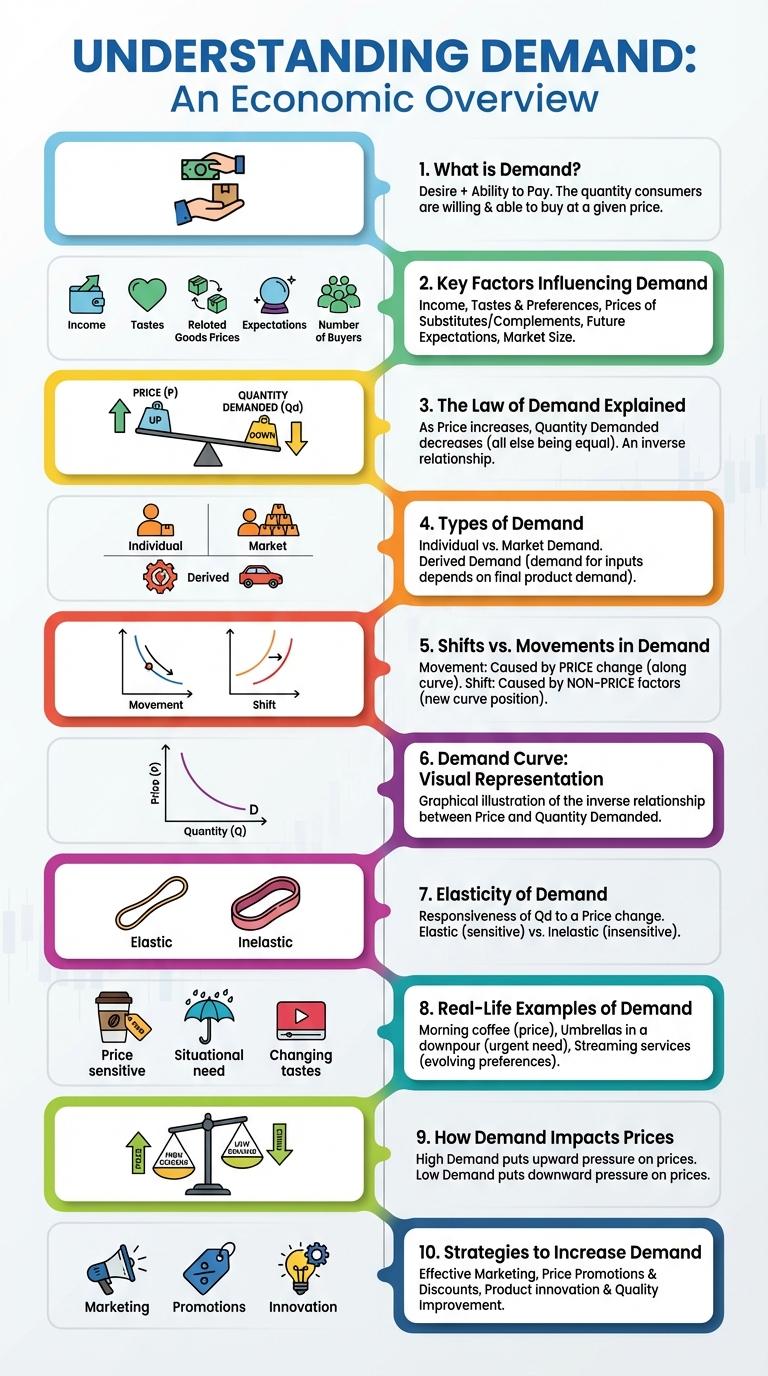
Infographics about demand visually present how consumer interest in products or services fluctuates over time. They highlight key factors influencing demand, such as pricing, seasonal trends, and market conditions. Clear data visualization helps businesses identify patterns and make informed decisions to optimize sales strategies.
What is Demand?
Demand refers to the quantity of a product or service that consumers are willing and able to purchase at various prices over a specific period. It is influenced by factors such as price, consumer income, preferences, and the prices of related goods. Understanding demand helps businesses and economists predict market behavior and make informed decisions.
Key Factors Influencing Demand
Demand in economics refers to the quantity of a product or service that consumers are willing and able to purchase at various prices. Understanding the key factors influencing demand is essential for businesses to set prices and forecast sales effectively.
Price is the primary factor affecting demand; as prices decrease, demand typically increases, following the law of demand. Consumer income impacts purchasing power, with higher income generally leading to greater demand for normal goods. Preferences, tastes, and expectations about future prices further shape consumer demand patterns.
The Law of Demand Explained
The Law of Demand describes the inverse relationship between price and quantity demanded. When prices fall, consumers typically buy more, and when prices rise, demand usually decreases.
- Price and Quantity Demanded - Demand decreases as prices increase, reflecting consumers' sensitivity to cost changes.
- Substitution Effect - Higher prices lead consumers to seek cheaper alternatives, reducing demand for the original product.
- Income Effect - A price increase effectively reduces consumer purchasing power, lowering the quantity demanded.
Types of Demand
Demand represents the quantity of a product or service that consumers are willing and able to purchase at various prices. Understanding different types of demand helps businesses tailor their strategies effectively.
Types of demand include elastic and inelastic demand, which differ based on consumers' sensitivity to price changes. Other types include joint demand, derived demand, and seasonal demand, each influencing market dynamics uniquely.
Shifts vs. Movements in Demand
| Aspect | Shifts vs. Movements in Demand |
|---|---|
| Definition | Shifts in demand refer to changes in the entire demand curve caused by factors other than price. Movements in demand happen along the demand curve due to price changes. |
| Cause | Shifts result from changes in consumer income, preferences, prices of related goods, expectations, or number of buyers. Movements occur solely because of changes in the good's own price. |
| Direction | Shifts can be to the right (increase in demand) or left (decrease in demand). Movements are upward or downward along the existing demand curve. |
| Graphical Representation | Shift: Entire demand curve moves right or left. Movement: Movement along the demand curve without changing its position. |
| Example | Shift: Increase in income leads to higher demand for luxury items. Movement: Price of coffee rises causing a decrease in quantity demanded. |
Demand Curve: Visual Representation
The demand curve graphically illustrates the relationship between the price of a good and the quantity demanded by consumers. It typically slopes downward from left to right, showing that demand decreases as price increases.
This curve is essential for understanding market behavior and consumer responsiveness to price changes.
- Downward Slope - Indicates an inverse relationship between price and quantity demanded.
- Price Axis - The vertical axis represents the price levels of the product.
- Quantity Axis - The horizontal axis shows the quantity of goods consumers are willing to buy.
Elasticity of Demand
Elasticity of demand measures how much the quantity demanded of a good changes in response to a price change. It reflects consumer sensitivity to price variations.
- Price Elasticity - Indicates the percentage change in quantity demanded relative to a one percent price change.
- Elastic Demand - When the elasticity is greater than 1, demand is highly responsive to price changes.
- Inelastic Demand - When the elasticity is less than 1, demand changes little despite price fluctuations.
Understanding elasticity helps businesses and policymakers predict consumer behavior and optimize pricing strategies.
Real-Life Examples of Demand
Demand represents consumers' willingness and ability to purchase goods or services at various prices. Real-life examples include the surge in demand for face masks during the COVID-19 pandemic, the increased desire for electric vehicles amid environmental concerns, and seasonal spikes in demand for holiday gifts. These examples illustrate how external factors and consumer preferences shape demand patterns in different markets.
How Demand Impacts Prices
Demand directly influences prices through the basic economic principle of supply and demand. When demand for a product increases, prices tend to rise due to heightened competition among buyers.
Conversely, a decrease in demand often leads to lower prices as sellers seek to attract customers. Understanding how demand fluctuations affect pricing helps businesses adjust strategies and optimize revenue.