
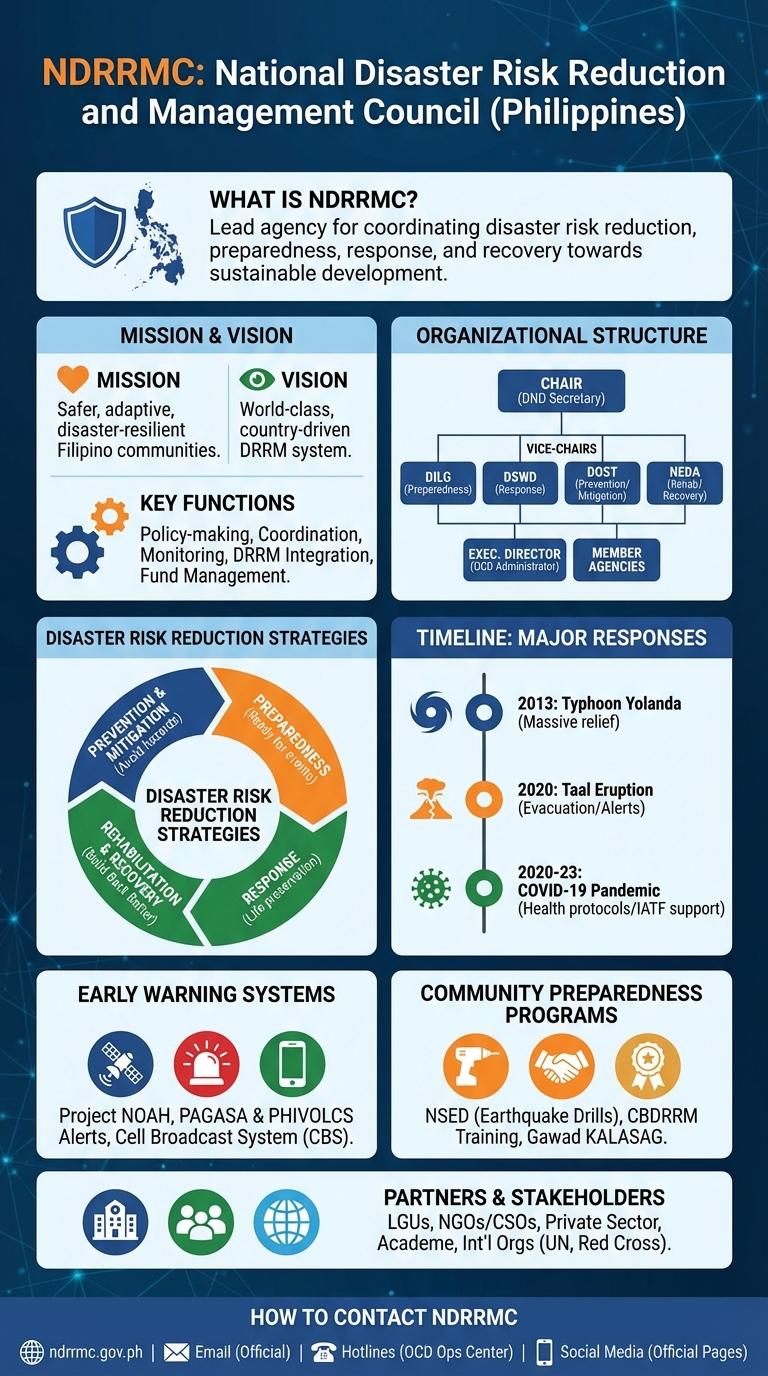
The National Disaster Risk Reduction and Management Council (NDRRMC) plays a crucial role in coordinating disaster preparedness and response across the Philippines. This infographic highlights key functions, recent initiatives, and important statistics that showcase NDRRMC's efforts in mitigating risks and enhancing resilience. Understanding these aspects can help communities better prepare for natural and man-made disasters.
What is NDRRMC?
The National Disaster Risk Reduction and Management Council (NDRRMC) is the Philippines' agency responsible for disaster preparedness, response, and mitigation. It coordinates government efforts to reduce the impact of natural and human-induced hazards. The NDRRMC ensures community resilience through effective planning and resource management.
NDRRMC's Mission & Vision
The National Disaster Risk Reduction and Management Council (NDRRMC) leads disaster preparedness, response, and recovery efforts in the Philippines. It aims to build a safer, resilient nation through effective risk reduction strategies and community empowerment.
- Mission - To ensure the protection and welfare of people and their property during disasters by coordinating risk reduction and management efforts across government agencies and stakeholders.
- Vision - A disaster-resilient Philippines where vulnerable communities are empowered and equipped to effectively manage and reduce disaster risks.
- Core Objective - To integrate disaster risk reduction into national and local development planning, promoting sustainable and inclusive risk management.
The NDRRMC continually drives policies and programs aligned with its mission to uphold public safety and disaster resilience nationwide.
Key Functions of NDRRMC
The National Disaster Risk Reduction and Management Council (NDRRMC) is the primary agency responsible for disaster preparedness and response in the Philippines. It coordinates government efforts to reduce risks and ensure efficient management during emergencies.
NDRRMC's key functions include disaster risk assessment, preparedness planning, and response coordination. The council also oversees recovery operations and promotes public awareness on disaster risk reduction strategies.
Organizational Structure
The National Disaster Risk Reduction and Management Council (NDRRMC) is the Philippines' lead agency for disaster risk reduction and management. It coordinates efforts among government agencies, local government units, and other stakeholders to ensure a unified disaster response.
The NDRRMC's organizational structure includes the Executive Council, which is composed of key government officials responsible for policy-making and strategic directives. Supporting the council is the Technical Support Services Group, providing expertise and technical assistance. Various sectoral committees handle specific areas such as preparedness, response, rehabilitation, and recovery to ensure comprehensive disaster management.
Disaster Risk Reduction Strategies
The National Disaster Risk Reduction and Management Council (NDRRMC) leads the Philippines in developing and implementing comprehensive disaster risk reduction strategies. These strategies aim to enhance community resilience and reduce vulnerabilities to natural and human-induced hazards.
NDRRMC focuses on four key components: prevention and mitigation, preparedness, response, and rehabilitation and recovery. Emphasis is placed on early warning systems, community-based disaster risk management, and capacity building for local government units.
Timeline: Major Responses
The National Disaster Risk Reduction and Management Council (NDRRMC) plays a critical role in coordinating disaster response in the Philippines. Its timeline highlights key moments where efficient action mitigated impacts.
- Typhoon Haiyan Response (2013) - NDRRMC coordinated nationwide relief operations following one of the strongest tropical cyclones recorded.
- Marawi Siege Rehabilitation (2017) - The council facilitated disaster management efforts during urban conflict and subsequent rehabilitation.
- COVID-19 Pandemic Management (2020) - NDRRMC activated emergency protocols to support public health measures and resource distribution.
NDRRMC Early Warning Systems
The National Disaster Risk Reduction and Management Council (NDRRMC) oversees the implementation of comprehensive early warning systems in the Philippines. These systems aim to provide timely alerts to reduce disaster impacts and save lives.
The NDRRMC Early Warning Systems integrate technology, community participation, and inter-agency coordination to enhance disaster preparedness.
- Philippine Atmospheric, Geophysical and Astronomical Services Administration (PAGASA) - Provides meteorological data and typhoon warnings critical for early alerts.
- PHILVOLCS Monitoring - Offers real-time volcanic activity reports to warn communities of imminent eruptions.
- Community-Based Early Warning - Empowers local stakeholders to detect hazards and disseminate warnings effectively.
Community Preparedness Programs
The National Disaster Risk Reduction and Management Council (NDRRMC) implements community preparedness programs to enhance local resilience against disasters. These programs focus on education, early warning systems, and capacity-building activities to equip communities with essential knowledge and skills. Through active participation, communities become better prepared to respond effectively during emergencies and mitigate potential risks.
Partners & Stakeholders
| Partners | Roles & Contributions |
|---|---|
| Local Government Units (LGUs) | Implement disaster response protocols, coordinate community evacuation, and manage resource distribution. |
| Philippine Red Cross | Emergency medical services, disaster relief operations, blood donation drives, and livelihood support programs. |
| Armed Forces of the Philippines (AFP) | Search and rescue operations, logistical support, and transportation during disasters. |
| Department of Health (DOH) | Provision of medical aid, disease control, and health emergency management during calamities. |
| Non-Governmental Organizations (NGOs) | Community resilience programs, humanitarian aid, and advocacy for disaster risk reduction policies. |