
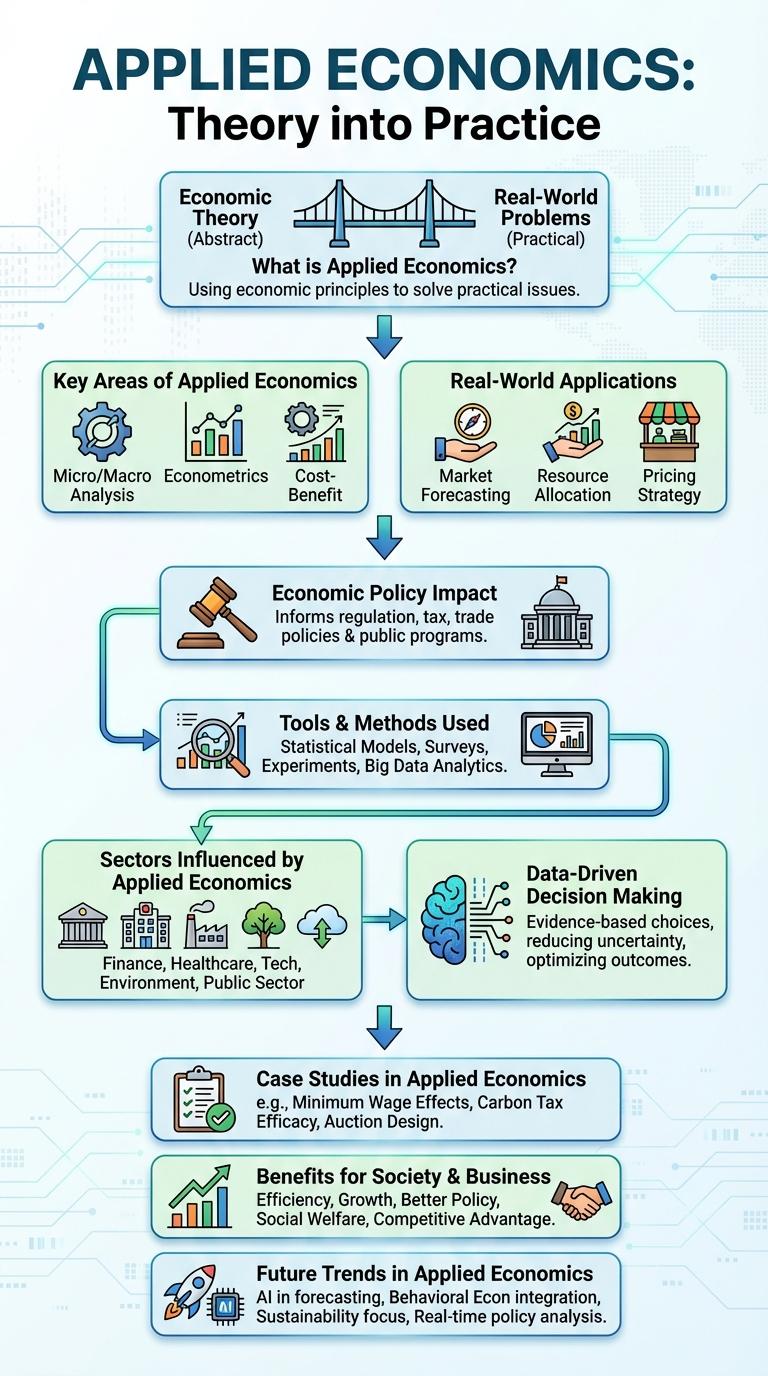
Applied economics uses real-world data and economic theories to solve practical problems in business, government, and society. This infographic highlights key concepts, methods, and case studies illustrating how applied economics informs decision-making and policy development. Understanding these applications bridges the gap between economic theory and everyday economic challenges.
What is Applied Economics?
Applied economics involves using economic theories and principles to address real-world problems and inform decision-making. It bridges the gap between abstract economic concepts and practical applications in various industries.
Professionals in applied economics analyze data to develop strategies that improve business performance, guide public policy, and optimize resource allocation. This field covers areas such as labor economics, health economics, and environmental economics. Applied economists use quantitative tools and models to provide actionable insights for governments, organizations, and individuals.
Key Areas of Applied Economics
What are the key areas of applied economics? Applied economics translates economic theory into real-world practice, addressing specific issues through empirical methods. It covers a variety of fields where economic principles are used to solve practical problems.
| Key Area | Description |
|---|---|
| Labor Economics | Analyzes workforce dynamics, employment trends, and wage determination. |
| Health Economics | Studies healthcare systems, cost-effectiveness, and policy impacts on public health. |
| Environmental Economics | Focuses on resource management, pollution control, and sustainability strategies. |
| Development Economics | Examines economic growth, poverty reduction, and structural changes in developing countries. |
| Industrial Organization | Investigates market structures, competition policies, and firm behavior. |
Real-World Applications
Applied economics uses economic theories and principles to address practical problems in various sectors. It bridges the gap between abstract economic models and real-world decision-making processes.
Real-world applications of applied economics include policy analysis, business strategy, and resource management. These applications help improve efficiency, forecast market trends, and solve social issues effectively.
Economic Policy Impact
Applied economics uses real-world data to analyze the effects of economic policies on markets and societies. Economic policy impact assessment helps policymakers design informed strategies for growth and equity.
- Fiscal Policy - Examines government spending and taxation effects on economic stability and growth.
- Monetary Policy - Studies influence of central bank actions on inflation, employment, and interest rates.
- Trade Policy - Analyzes consequences of tariffs, quotas, and trade agreements on domestic and global markets.
Evaluating economic policy impact guides effective decision-making for sustainable economic development.
Tools & Methods Used
| Tool/Method | Description |
|---|---|
| Statistical Analysis | Utilizes data collection, regression models, and hypothesis testing to interpret economic data accurately. |
| Cost-Benefit Analysis | Assesses the economic feasibility of projects by comparing expected costs against potential benefits. |
| Econometric Modeling | Applies mathematical models to economic data for forecasting and policy evaluation. |
| Input-Output Analysis | Examines relationships between different sectors of an economy to measure impacts and dependencies. |
| Computable General Equilibrium (CGE) Models | Simulates how economies respond to changes in policy, technology, or external shocks using complex economic models. |
Sectors Influenced by Applied Economics
Applied economics uses economic theories and quantitative methods to address real-world problems across various sectors. This practical approach helps optimize resource allocation, improve decision-making, and enhance economic outcomes.
Key sectors influenced by applied economics include healthcare, where it informs cost-effective treatment strategies and policy planning. In agriculture, applied economics drives efficiency improvements and market analysis for sustainable food production.
Data-Driven Decision Making
Applied economics leverages real-world data to inform strategic decisions in business, government, and finance. Data-driven decision making enhances accuracy and effectiveness in economic problem-solving and policy development.
- Data Collection - Gathering relevant economic data from diverse sources enables comprehensive analysis and insight generation.
- Quantitative Analysis - Employing statistical and econometric methods transforms raw data into meaningful economic indicators.
- Informed Policy Making - Utilizing analyzed data supports creating targeted policies that address specific economic challenges effectively.
Case Studies in Applied Economics
Applied economics uses real-world data to solve economic problems and inform policy decisions. Case studies in applied economics showcase practical applications of economic theories to various industries and social issues.
- Labor Market Analysis - Examines employment trends to shape workforce development and wage policies.
- Environmental Economics - Studies economic impacts of environmental regulations to balance growth and sustainability.
- Health Economics - Evaluates healthcare policies and their effects on cost, access, and outcomes.
- Development Economics - Investigates poverty reduction strategies and economic growth in emerging economies.
- Behavioral Economics - Analyzes decision-making processes to design better financial and social programs.
Benefits for Society & Business
Applied economics uses real-world data and economic theory to solve practical problems, driving informed decisions in policy and business. It enhances societal welfare by improving resource allocation, reducing unemployment, and promoting sustainable growth. Businesses benefit through market analysis, cost optimization, and strategic planning, which boost profitability and competitive advantage.