
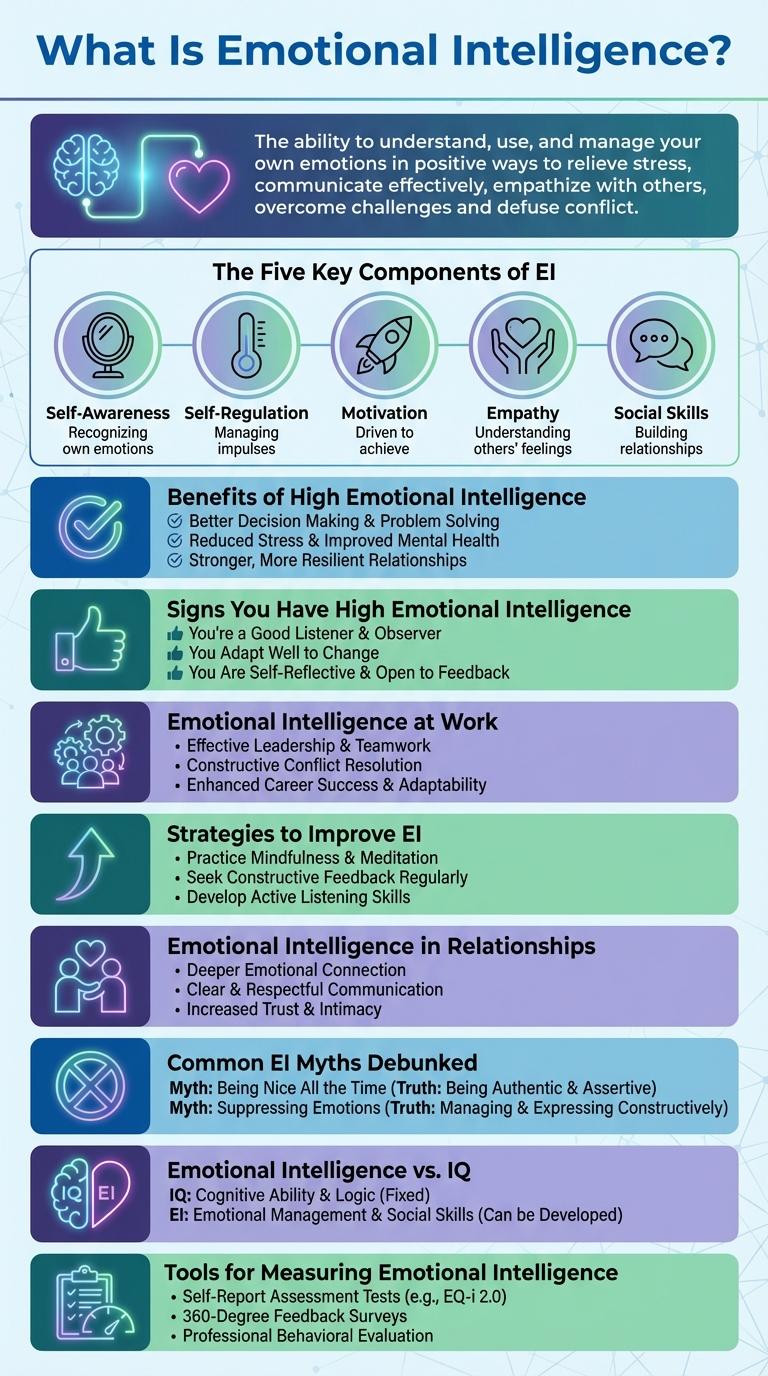
Emotional intelligence encompasses the ability to recognize, understand, and manage emotions effectively in oneself and others. Mastering this skill improves communication, enhances relationships, and supports mental well-being. This infographic visually breaks down key components and benefits of emotional intelligence for personal and professional growth.
What Is Emotional Intelligence?
Emotional intelligence is the ability to recognize, understand, and manage our own emotions while also perceiving and influencing the emotions of others. It plays a critical role in effective communication, decision-making, and relationship building.
- Self-awareness - The capacity to identify and comprehend one's own emotions and their impact on thoughts and behavior.
- Self-regulation - The skill to control or redirect disruptive emotions and impulses, maintaining emotional balance.
- Social skills - The ability to manage relationships, inspire others, and navigate social networks effectively.
The Five Key Components of EI
| Component | Description |
|---|---|
| Self-Awareness | The ability to recognize and understand your own emotions, drives, and effects on others. |
| Self-Regulation | The capacity to control or redirect disruptive emotions and impulses, maintaining composure. |
| Motivation | Inner drive to pursue goals with energy, persistence, and passion beyond external rewards. |
| Empathy | Understanding and sharing the feelings of others, fostering stronger interpersonal relationships. |
| Social Skills | Managing relationships effectively, communicating clearly, and inspiring cooperation within groups. |
Benefits of High Emotional Intelligence
High emotional intelligence enhances communication skills, fostering better personal and professional relationships. It improves stress management and decision-making by enabling individuals to understand and regulate their emotions effectively. People with high emotional intelligence often experience greater empathy, leading to stronger teamwork and leadership capabilities.
Signs You Have High Emotional Intelligence
High emotional intelligence (EI) reflects the ability to understand and manage your own emotions while recognizing and influencing the feelings of others. People with high EI exhibit self-awareness and emotional regulation even in stressful situations.
Signs of high emotional intelligence include empathy, effective communication, and strong interpersonal skills. These traits enable individuals to build meaningful relationships and navigate social complexities with ease.
Emotional Intelligence at Work
Emotional intelligence (EI) plays a crucial role in enhancing workplace interactions and productivity. Understanding and managing emotions leads to better teamwork and leadership.
- Self-awareness - Recognizing personal emotions helps employees regulate responses and make informed decisions.
- Empathy - Understanding colleagues' feelings fosters stronger relationships and collaboration.
- Emotional regulation - Controlling impulses reduces workplace conflict and increases focus.
Developing emotional intelligence skills contributes to a positive work environment and improved organizational performance.
Strategies to Improve EI
Emotional intelligence (EI) plays a crucial role in personal and professional success. Improving EI enhances self-awareness, empathy, and interpersonal skills.
Practice mindfulness to better recognize and manage your emotions. Develop active listening skills to understand others' feelings accurately. Regularly reflecting on emotional experiences helps build stronger emotional regulation.
Emotional Intelligence in Relationships
Emotional intelligence enhances communication and understanding between partners. It plays a crucial role in managing conflicts and building lasting relationships.
- Self-awareness - Recognizing your own emotions helps you respond thoughtfully rather than react impulsively.
- Empathy - Understanding your partner's feelings fosters deeper connection and trust.
- Emotional regulation - Managing emotions effectively reduces misunderstandings and promotes harmony.
Common EI Myths Debunked
Emotional intelligence (EI) is often misunderstood as just being nice or overly emotional. Common myths suggest EI means ignoring logic or avoiding conflicts, which is inaccurate. True EI involves recognizing, understanding, and managing emotions effectively in various situations.
Emotional Intelligence vs. IQ
What distinguishes Emotional Intelligence (EI) from Intelligence Quotient (IQ)? Emotional Intelligence measures the ability to understand and manage emotions effectively. IQ evaluates cognitive abilities such as reasoning, memory, and problem-solving skills.
How do EI and IQ impact personal and professional success differently? High EI enhances interpersonal relationships, empathy, and conflict resolution. High IQ generally predicts academic achievement and technical problem-solving capacity.
Which areas of life benefit more from Emotional Intelligence compared to IQ? Emotional Intelligence plays a critical role in leadership, teamwork, and emotional regulation. IQ contributes predominantly to analytical tasks and logical decision-making.
Can Emotional Intelligence be developed more easily than IQ? Emotional Intelligence can improve through practice, self-awareness, and social experience. IQ is generally considered stable throughout adulthood, with limited change.
Why do organizations value Emotional Intelligence alongside IQ in employees? Emotional Intelligence fosters effective communication, collaboration, and stress management. IQ supports innovative thinking and strategic planning abilities.