
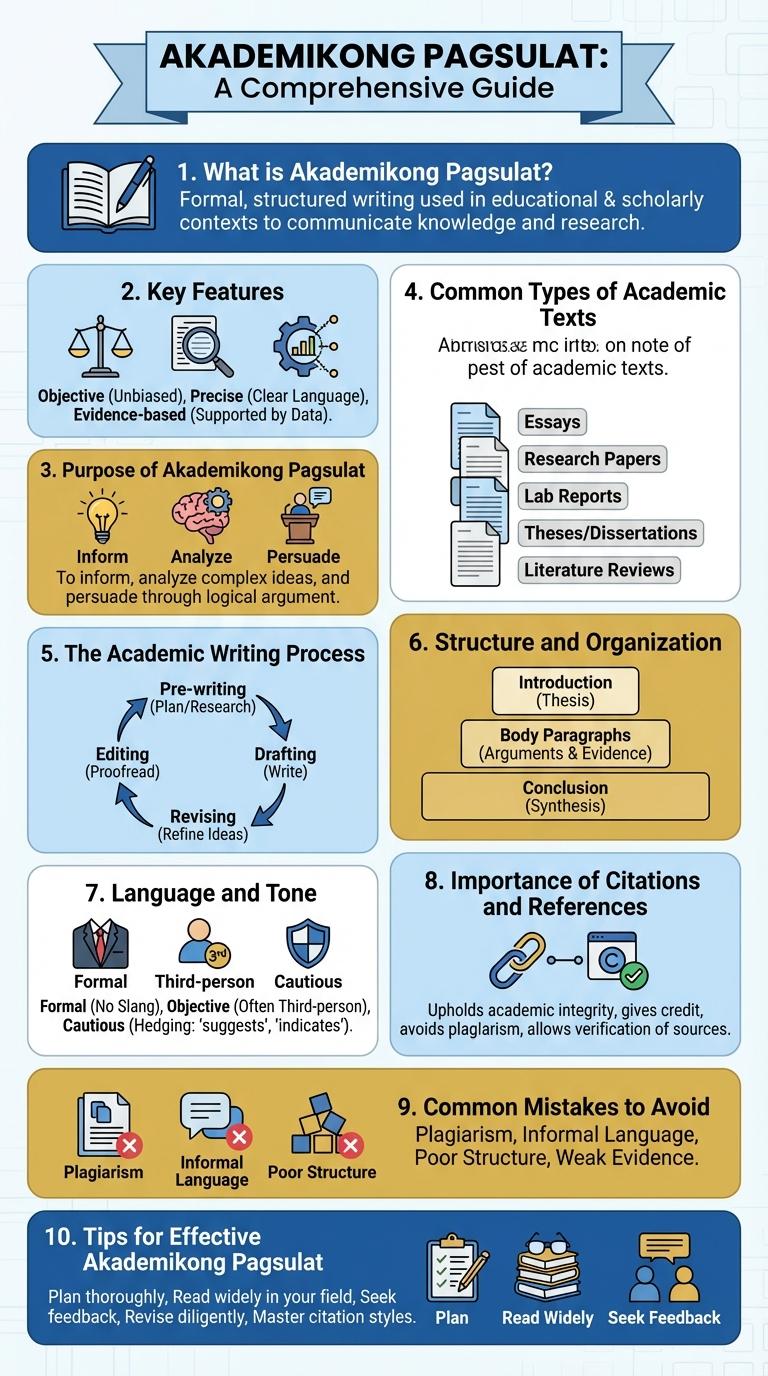
Academic writing demands clarity, precision, and structured presentation of ideas to effectively communicate scholarly information. This infographic highlights essential techniques, key components, and common challenges in akademikong pagsulat. Understanding these elements enhances one's ability to produce well-organized and impactful academic papers.
What is Akademikong Pagsulat?
Akademikong Pagsulat is a formal style of writing used in educational and scholarly contexts. It emphasizes clarity, precision, and evidence-based arguments to communicate ideas effectively.
- Purpose - To present research findings and support arguments logically for academic audiences.
- Structure - Typically follows a clear format including introduction, body, and conclusion to organize information systematically.
- Language - Uses formal vocabulary and avoids colloquialisms to maintain professionalism and objectivity.
Key Features of Academic Writing
Academic writing emphasizes clarity, precision, and formality to effectively communicate complex ideas. It requires well-structured arguments supported by credible evidence and proper referencing. The tone is objective, avoiding personal bias to maintain scholarly integrity.
Purpose of Akademikong Pagsulat
Akademikong pagsulat is a specialized form of writing aimed at conveying scholarly information clearly and effectively. Its primary purpose is to present research findings, arguments, and ideas in a structured and credible manner. This type of writing supports academic discourse, aids critical thinking, and contributes to the development of knowledge within various fields.
Common Types of Academic Texts
Academic writing encompasses various text types designed to communicate research, analysis, and critical thinking. Understanding common types of academic texts helps students and researchers effectively present their ideas.
- Research Papers - Present original research findings and support arguments with evidence and analysis.
- Essays - Explore specific topics or questions by providing a structured argument or discussion.
- Literature Reviews - Summarize and evaluate existing research on a particular subject to identify trends and gaps.
The Academic Writing Process
The academic writing process involves systematic steps that help in producing clear and well-structured scholarly work. Understanding each stage enhances the coherence and effectiveness of the final paper.
- Prewriting - Generating ideas and organizing information before drafting a paper.
- Drafting - Creating the initial version of the academic document with focus on content development.
- Revising - Improving the draft by clarifying ideas, refining arguments, and ensuring logical flow.
- Editing - Correcting grammar, punctuation, and formatting errors to polish the text.
- Publishing - Sharing the final version through academic journals, presentations, or other platforms.
Mastering these stages ensures academic writing is effective, credible, and impactful.
Structure and Organization
Akademikong pagsulat ay isang sistematikong paraan ng pagpapahayag ng mga ideya. Mahalaga ang wastong istruktura at organisasyon para malinaw ang mensahe sa mambabasa.
Ang pangunahing bahagi ng akademikong pagsulat ay introduksyon, katawan, at kongklusyon. Sa introduksyon, ipinapakilala ang paksa at mga layunin ng teksto. Sa katawan, inilalahad ang mga argumento at ebidensya nang lohikal at magkakaugnay, habang sa kongklusyon ay nilalagom ang mga mahahalagang puntos upang bigyang-linaw ang kabuuang mensahe.
Language and Tone in Academic Writing
What is the importance of language in academic writing? Language in academic writing must be clear and precise to effectively communicate complex ideas. It avoids ambiguity and supports logical argumentation.
How does tone affect academic writing? The tone in academic writing should be formal and objective to maintain professionalism and credibility. It refrains from emotional or biased expressions, focusing on evidence-based arguments.
Importance of Citations and References
| Aspect | Details |
|---|---|
| Definition | Citations and references acknowledge original sources used in academic writing. |
| Purpose | They provide evidence for claims and validate research findings. |
| Credibility | Proper citation enhances the writer's credibility and academic integrity. |
| Plagiarism Prevention | Accurate referencing prevents plagiarism by giving credit to original authors. |
| Research Verification | Readers can trace sources for further study or verification of information. |
Common Mistakes to Avoid
Akademikong pagsulat requires clarity and precision to effectively communicate ideas. Common mistakes can undermine the quality and credibility of your work.
Avoid using vague language and unsupported claims, as they weaken your arguments. Ensure proper citation of sources to prevent plagiarism and enhance reliability.
Grammar and spelling errors distract readers and reduce professionalism. Carefully proofread your writing to maintain accuracy and coherence.
Overloading paragraphs with too much information can confuse readers. Focus on one main idea per paragraph for better readability and structure.