
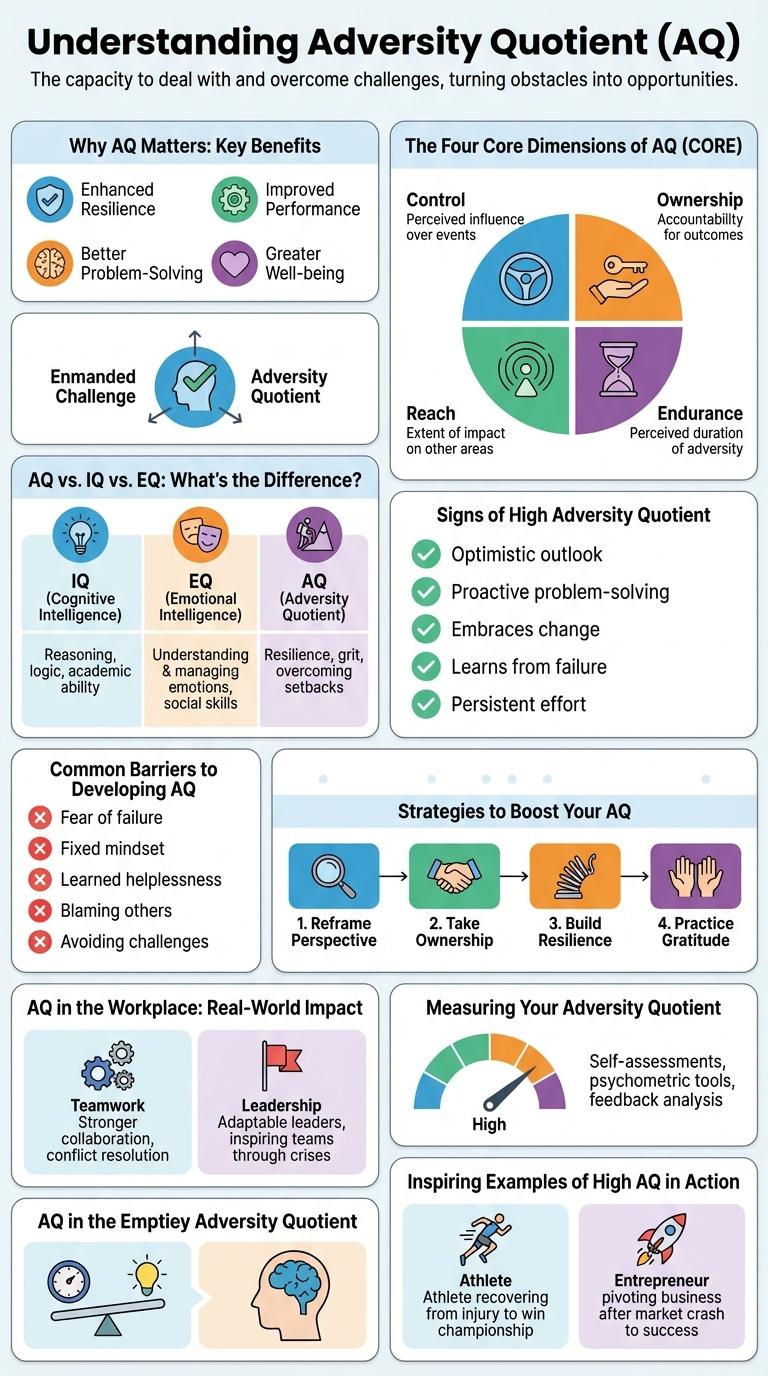
Adversity quotient measures an individual's ability to withstand and overcome challenges, reflecting resilience and problem-solving skills in difficult situations. High adversity quotient correlates with improved performance, mental toughness, and emotional strength. Understanding this concept helps individuals and organizations develop strategies to navigate setbacks effectively.
Understanding Adversity Quotient (AQ)
| Aspect | Description |
|---|---|
| Definition | Adversity Quotient (AQ) measures an individual's ability to withstand and overcome challenges and stress. |
| Core Components | Control, Ownership, Reach, Endurance (CORE model) |
| Importance | High AQ predicts resilience, problem-solving skills, and success in both personal and professional environments. |
| Assessment | Typically evaluated using the Adversity Response Profile (ARP) questionnaire, focusing on behavioral responses to setbacks. |
| Applications | Used in leadership development, mental health strategies, educational programs, and organizational success predictions. |
Why AQ Matters: Key Benefits
Adversity Quotient (AQ) measures an individual's ability to withstand and overcome challenges. High AQ is essential for personal growth and professional success.
People with strong AQ adapt quickly to change, improve problem-solving skills, and maintain motivation during hardships. Organizations benefit from employees with high AQ through increased resilience and productivity.
The Four Core Dimensions of AQ
Adversity Quotient (AQ) measures an individual's resilience and ability to overcome challenges. It evaluates how people respond to obstacles and setbacks in various aspects of life.
The Four Core Dimensions of AQ include Control, Ownership, Reach, and Endurance. These dimensions collectively determine how a person perceives and manages adversity.
| Dimension | Description |
|---|---|
| Control | Extent to which a person feels they can influence adverse events. |
| Ownership | Degree of responsibility taken for improving the situation. |
| Reach | How far the adversity spreads into other areas of life. |
| Endurance | Perceived duration of the negative impact caused by adversity. |
High scores in each AQ dimension indicate stronger resilience and better coping strategies. Organizations and individuals use AQ assessments to enhance performance and psychological endurance.
Understanding and improving the Four Core Dimensions of AQ helps individuals bounce back faster. This fosters greater adaptability in both personal growth and professional environments.
AQ vs. IQ vs. EQ: What's the Difference?
Adversity Quotient (AQ), Intelligence Quotient (IQ), and Emotional Quotient (EQ) are key measures of human capability. Understanding their differences helps in personal and professional development.
- Adversity Quotient (AQ) - Measures how well an individual withstands and overcomes challenges and setbacks.
- Intelligence Quotient (IQ) - Assesses cognitive abilities such as logic, reasoning, and problem-solving skills.
- Emotional Quotient (EQ) - Evaluates the ability to perceive, control, and express emotions effectively.
Signs of High Adversity Quotient
An individual with a high adversity quotient demonstrates resilience by quickly recovering from setbacks and maintaining a positive outlook during challenges. They exhibit strong problem-solving skills, consistently finding effective solutions despite difficulties. Their persistence and adaptability enable them to thrive in uncertain and demanding situations.
Common Barriers to Developing AQ
Adversity Quotient (AQ) measures an individual's ability to withstand and overcome challenges. Developing a high AQ is essential for personal and professional growth.
Common barriers include fear of failure, negative mindset, and lack of resilience skills. These obstacles hinder one's capacity to face adversity confidently. Overcoming these barriers requires targeted strategies and consistent practice.
Strategies to Boost Your AQ
Adversity Quotient (AQ) measures an individual's ability to overcome challenges and stress. Enhancing AQ fosters resilience, leading to better personal and professional outcomes.
- Develop a Growth Mindset - Embrace challenges as opportunities to learn and improve rather than obstacles to fear.
- Practice Stress Management - Use techniques like mindfulness, deep breathing, or exercise to maintain emotional balance during tough situations.
- Set Realistic Goals - Break down difficulties into smaller, manageable tasks to maintain motivation and clarity.
Improving your AQ equips you to navigate hardships effectively and achieve long-term success.
AQ in the Workplace: Real-World Impact
How does Adversity Quotient (AQ) influence performance in the workplace? Employees with high AQ demonstrate resilience, enabling them to navigate challenges effectively. This resilience leads to improved problem-solving skills and sustained productivity under pressure.
What role does AQ play in leadership within organizations? Leaders with strong AQ inspire teams by maintaining composure during setbacks. Their ability to adapt quickly fosters a positive work environment and drives consistent business growth.
How does AQ affect employee engagement and retention? Workers who manage adversity well tend to experience higher job satisfaction and commitment. Organizations benefit from reduced turnover and increased loyalty by cultivating AQ skills.
In what ways can companies develop AQ among their workforce? Training programs focused on stress management and adaptive thinking enhance employees' AQ. Such initiatives contribute to a more agile and resilient organizational culture.
What measurable outcomes result from increased AQ in the workplace? Enhanced AQ correlates with lower absenteeism, higher innovation rates, and better teamwork. These factors collectively boost overall organizational performance and competitiveness.
Measuring Your Adversity Quotient
Adversity Quotient (AQ) measures an individual's ability to withstand and overcome challenges. Understanding AQ helps in building resilience and improving problem-solving skills.
Measuring AQ involves evaluating how a person perceives and reacts to adversity in various situations.
- Control - Assesses the extent to which you feel in control during difficult situations.
- Ownership - Measures your willingness to take responsibility for overcoming setbacks.
- Reach - Evaluates how far adversity impacts other areas of your life.
- Endurance - Determines your perception of the duration of adversity and its effects.
- AQ Score - A composite score derived from control, ownership, reach, and endurance metrics to quantify resilience levels.