
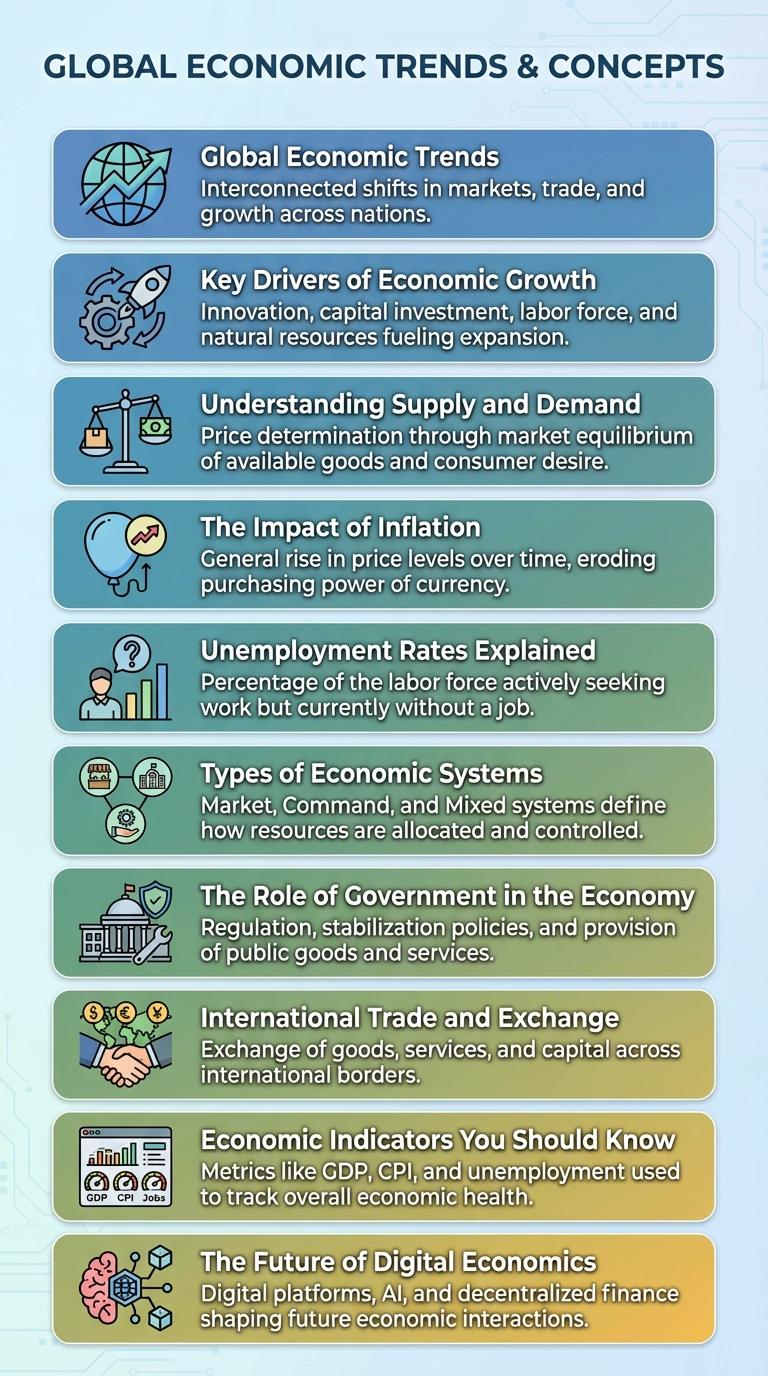
An infographic about economics visually simplifies complex financial concepts and data, making them easier to understand. It highlights key economic indicators, trends, and relationships through engaging charts and graphics. This approach enhances comprehension and provides valuable insights into market dynamics and economic performance.
Global Economic Trends
Global economic trends in 2024 highlight a gradual recovery from recent downturns, driven by increased consumer spending and technological advancements. Emerging markets are showing significant growth potential, supported by infrastructure investments and digital adoption.
Inflation rates are stabilizing in many regions, although supply chain disruptions continue to pose challenges. Trade policies are increasingly focused on sustainability and innovation, shaping the future of global commerce and investment flows.
Key Drivers of Economic Growth
Economic growth is influenced by multiple interconnected factors that drive productivity and development. Understanding key drivers helps policymakers and businesses foster sustainable expansion.
- Capital Investment - Increasing physical assets like machinery and infrastructure boosts production capacity and efficiency.
- Technological Innovation - Advances in technology enhance productivity by improving processes and creating new products.
- Human Capital - Education and skill development improve labor quality, leading to higher output and innovation.
Understanding Supply and Demand
Supply and demand are fundamental concepts in economics that determine the price and quantity of goods in a market. Supply refers to how much of a product producers are willing to sell at different prices, while demand indicates how much consumers are willing to buy.
When demand exceeds supply, prices tend to rise, encouraging producers to increase production. Conversely, if supply surpasses demand, prices usually fall, leading to a decrease in production and consumption.
The Impact of Inflation
Inflation influences the purchasing power of money, affecting both consumers and businesses worldwide. Understanding its impact is essential for economic stability and growth.
Inflation can lead to higher costs of goods and services, reducing consumer spending power and altering consumption patterns.
- Decreased Purchasing Power - Inflation causes prices to rise, diminishing the real value of money over time.
- Increased Cost of Living - Rising inflation pushes up expenses for essentials like food, housing, and transportation.
- Impact on Savings - Inflation erodes the value of savings if interest rates do not keep pace, affecting individual wealth.
Unemployment Rates Explained
Understanding unemployment rates is crucial for analyzing the health of an economy. These rates indicate the percentage of the labor force actively seeking but unable to find employment.
- Definition of Unemployment Rate - The unemployment rate is the ratio of unemployed individuals to the total labor force, expressed as a percentage.
- Types of Unemployment - Includes cyclical, frictional, structural, and seasonal unemployment, each influenced by different economic factors.
- Impact on Economy - High unemployment rates can signal economic distress and reduce consumer spending, affecting overall growth.
Monitoring unemployment rates helps policymakers implement strategies to improve job creation and economic stability.
Types of Economic Systems
Economic systems determine how resources are allocated and goods are distributed within a society. The primary types include traditional, command, market, and mixed economies, each with distinct methods of decision-making and control. Understanding these systems helps explain varying levels of government intervention, economic freedom, and societal roles in production.
The Role of Government in the Economy
| Role of Government | Economic Impact |
|---|---|
| Regulation | Ensures market fairness, prevents monopolies, protects consumers and workers |
| Fiscal Policy | Uses taxation and government spending to influence economic growth and control inflation |
| Monetary Policy | Central bank controls money supply and interest rates to stabilize currency and promote employment |
| Public Goods Provision | Funds infrastructure, education, and healthcare that support economic development and social welfare |
| Market Stabilization | Intervenes during economic downturns to reduce unemployment and maintain financial stability |
International Trade and Exchange
What drives the growth of international trade and exchange? International trade expands markets by allowing countries to specialize in producing goods where they have a comparative advantage. Exchange rates influence trade by determining the relative value of different currencies, impacting import and export prices.
How does exchange rate fluctuation impact global trade? Currency appreciation makes exports more expensive and imports cheaper, reducing trade competitiveness. Currency depreciation has the opposite effect, boosting export demand but increasing the cost of imported goods.
Why is trade balance important for a country's economy? A trade surplus indicates a country exports more than it imports, contributing positively to GDP. A trade deficit means higher imports than exports, which can lead to foreign debt but also provides access to a wider variety of goods.
What role do trade agreements play in international economics? Trade agreements reduce tariffs and barriers, promoting smoother and increased trade flows between member countries. They enhance economic cooperation and market access, fostering global economic growth.
How does globalization affect international trade patterns? Globalization increases interconnectedness, encouraging diverse and complex supply chains across nations. It leads to higher volumes of cross-border trade and investment, contributing to economic development worldwide.
Economic Indicators You Should Know
An infographic about economics highlights key economic indicators that provide insight into a health of an economy. Important indicators include Gross Domestic Product (GDP), unemployment rate, inflation rate, consumer confidence index, and trade balance. Understanding these metrics helps businesses, investors, and policymakers make informed decisions in economic planning and strategy.