
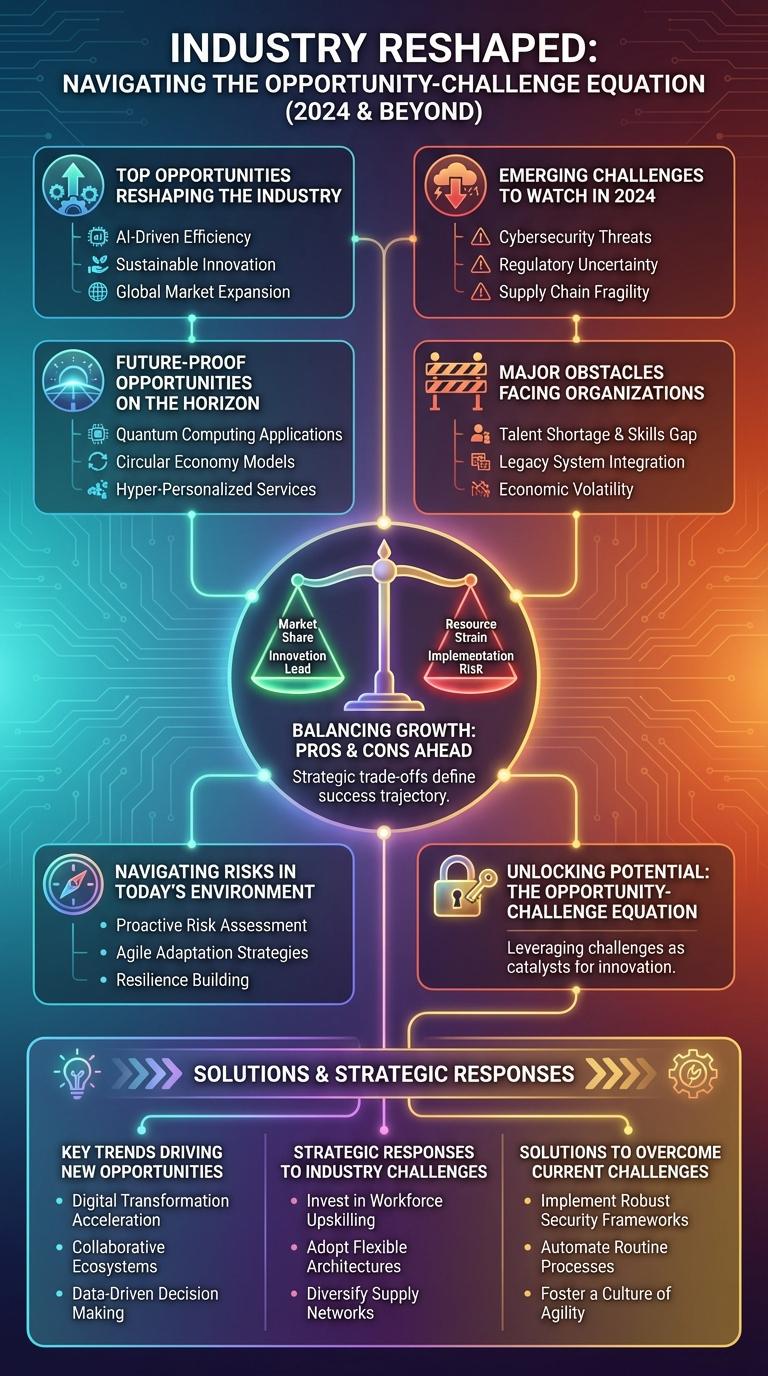
Infographics visually highlight key opportunities and challenges, making complex information easier to understand at a glance. They use clear graphics and concise data to reveal trends, risks, and potential growth areas effectively. This approach supports informed decision-making by presenting insights without overwhelming details.
Top Opportunities Reshaping the Industry
| Opportunity | Impact on Industry |
|---|---|
| Artificial Intelligence Integration | Enhances automation, improves decision-making, and reduces operational costs |
| Renewable Energy Adoption | Drives sustainability, lowers carbon footprint, and opens new market segments |
| 5G Connectivity Expansion | Enables faster communication, supports IoT growth, and improves customer experience |
| Data Analytics Utilization | Provides actionable insights, optimizes processes, and enhances personalized services |
| Remote Work Technologies | Increases workforce flexibility, reduces overhead, and attracts global talent |
Emerging Challenges to Watch in 2024
Emerging challenges in 2024 highlight critical risks affecting global industries and societies. Understanding these obstacles is essential for strategic planning and innovation.
- Cybersecurity Threats - Increasingly sophisticated cyberattacks demand advanced defense mechanisms to protect data integrity.
- Climate Change Impact - Rising environmental disruptions necessitate urgent adaptation and mitigation strategies.
- Supply Chain Disruptions - Global trade uncertainties require resilient logistics and diversified sourcing.
- Workforce Automation - Growing AI and robotics adoption challenge traditional employment models and skill requirements.
- Regulatory Changes - Evolving laws and policies across regions create compliance complexities for multinational organizations.
Balancing Growth: Pros & Cons Ahead
How can businesses successfully balance growth with potential challenges? Growth offers opportunities for increased revenue, market expansion, and innovation. However, it also presents challenges such as resource strain, operational complexities, and maintaining quality standards.
| Opportunities | Challenges |
|---|---|
| Increased market share | Scalability issues |
| Higher revenue potential | Cash flow management |
| Access to new customer segments | Maintaining product/service quality |
| Innovation and development | Employee workload and burnout |
| Brand recognition enhancement | Complex regulatory compliance |
Key Trends Driving New Opportunities
Emerging technologies and shifting consumer behaviors create significant opportunities across industries. Recognizing key trends is essential for leveraging growth and managing challenges effectively.
- Digital Transformation - Accelerated adoption of AI, cloud computing, and IoT enhances operational efficiency and customer engagement.
- Sustainability Focus - Increasing demand for eco-friendly products drives innovation in renewable energy and green technologies.
- Remote Work Evolution - Hybrid and remote work models expand talent pools and necessitate advanced collaboration tools.
Major Obstacles Facing Organizations
Organizations today encounter numerous obstacles that impede growth and innovation. Major challenges include adapting to rapid technological changes and managing cybersecurity risks effectively.
Workforce skill gaps and regulatory compliance add complexity to operational management. Balancing these issues requires strategic planning and continuous investment in resources.
Solutions to Overcome Current Challenges
Addressing current challenges requires innovative solutions that enhance operational efficiency and foster sustainable growth. Leveraging advanced technologies and collaborative strategies can unlock new opportunities in various industries.
Implementing automation reduces manual errors and accelerates productivity. Investing in skill development ensures a workforce capable of adapting to evolving market demands. Promoting transparent communication strengthens stakeholder trust and supports effective problem-solving.
Future-Proof Opportunities on the Horizon
Future-proof opportunities emerge from rapid advancements in technology, renewable energy, and digital transformation. Businesses embracing innovation can unlock sustainable growth and competitive advantages in evolving markets.
Challenges include adapting to disruptive technologies and changing regulatory landscapes. Companies must invest strategically in skills development and resilient infrastructure to thrive amidst uncertainty.
Navigating Risks in Today's Environment
Navigating risks in today's environment requires a clear understanding of both emerging opportunities and potential challenges. Businesses must strategically balance innovation with caution to thrive in a rapidly changing landscape.
- Cybersecurity Threats - Increasing digital dependence exposes organizations to sophisticated cyber attacks, demanding robust defense mechanisms.
- Regulatory Compliance - Evolving legal frameworks across regions require constant adaptation to avoid penalties and maintain market access.
- Technological Innovation - Leveraging cutting-edge technologies can create competitive advantages but involves substantial risk management.
- Supply Chain Disruptions - Global interdependencies increase vulnerability to logistical interruptions, affecting production and delivery.
- Market Volatility - Unpredictable economic conditions call for agile strategies to sustain growth and manage financial uncertainty.
Effective risk navigation integrates proactive planning, continuous monitoring, and flexible responses to secure long-term success.
Strategic Responses to Industry Challenges
Strategic responses to industry challenges involve proactive adaptation to market dynamics and competitor actions. Companies leverage innovation, operational efficiency, and customer-centric approaches to seize growth opportunities. Effective strategies address risks while aligning organizational capabilities with evolving industry demands.