
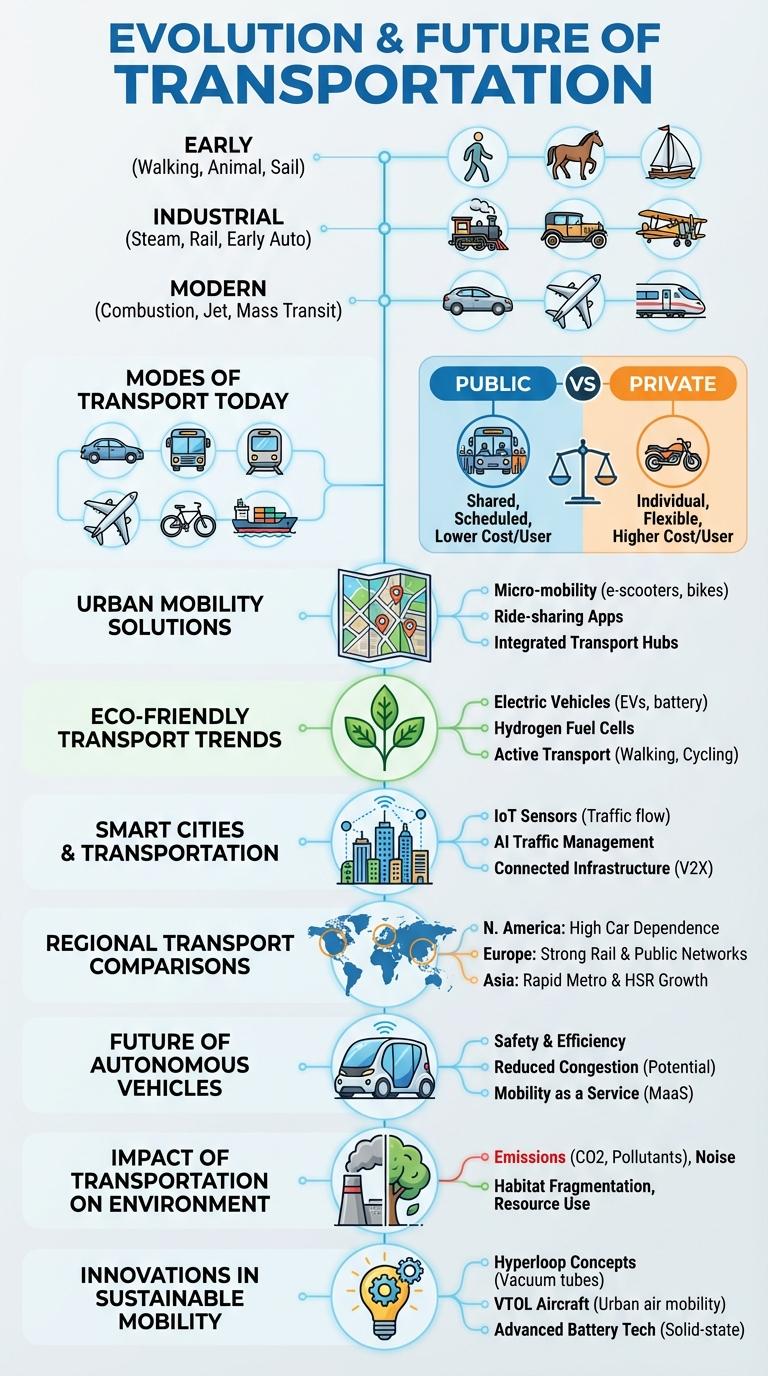
Transportation infographic presents key data on various travel modes, highlighting trends in usage, efficiency, and environmental impact. Visual elements vividly display statistics on public transit, personal vehicles, cycling, and walking, emphasizing their role in urban planning. This overview aids understanding of how transportation shapes mobility and sustainability efforts.
Evolution of Transportation
How has transportation evolved over time to shape modern society?
Transportation has transformed from simple walking and animal-powered travel to advanced machinery like automobiles, trains, and airplanes. This evolution has facilitated faster, safer, and more efficient movement of people and goods worldwide.
What were the key milestones in the development of transportation?
The invention of the wheel around 3500 BCE marked the beginning of land transportation. The Industrial Revolution introduced steam engines, leading to trains and steamships, while the 20th century brought automobiles and commercial aviation.
How did transportation impact economic growth throughout history?
Improved transportation networks enabled extensive trade, reduced costs, and expanded markets. Efficient movement of resources and products accelerated industrialization and globalization.
What role does technology play in modern transportation?
Technological advancements contribute to electric vehicles, high-speed rail, and autonomous transportation systems. Innovations focus on sustainability, safety, and connectivity to address future mobility challenges.
How is transportation expected to evolve in the future?
Future transportation emphasizes renewable energy, interconnected smart infrastructure, and innovative modes like hyperloop and drone delivery. These developments aim to reduce environmental impact while enhancing speed and accessibility.
Modes of Transport Today
Transportation today encompasses a variety of modes, including road, rail, air, water, and urban transit systems. Each mode serves specific purposes, ranging from personal travel and freight to public commuting and international shipping. Advancements in technology continue to enhance efficiency and sustainability across these transportation methods.
Public vs Private Transit
Transportation plays a critical role in urban mobility, with public and private transit offering distinct advantages. Understanding their differences helps optimize travel efficiency and environmental impact.
- Cost Efficiency - Public transit is generally more affordable for daily commuters compared to the higher expenses of private vehicles.
- Environmental Impact - Public transportation reduces carbon emissions by carrying more passengers per trip than private cars.
- Convenience and Flexibility - Private transit provides door-to-door service and flexible schedules, unlike fixed routes and times in public transit.
Urban Mobility Solutions
| Urban Mobility Solution | Key Features & Benefits |
|---|---|
| Electric Scooters | Eco-friendly, reduces traffic congestion, ideal for short distances |
| Bike Sharing Programs | Promotes healthy lifestyle, low emissions, accessible for all urban areas |
| Public Transit Networks | Cost-effective, reduces individual car use, connects distant neighborhoods |
| Carpooling Services | Decreases traffic volume, lowers commuting costs, fosters community |
| Autonomous Shuttles | Innovative technology, reduces labor costs, enhances last-mile connectivity |
Eco-Friendly Transport Trends
Eco-friendly transportation is revolutionizing the way people commute, emphasizing sustainability and reducing carbon footprints. Innovations like electric vehicles and bike-sharing programs lead the charge in this green movement.
Public transit systems are increasingly adopting clean energy sources, such as electric buses and solar-powered trains. These trends contribute significantly to lowering urban pollution and promoting healthier cities worldwide.
Smart Cities and Transportation
Smart cities leverage advanced technologies to revolutionize transportation systems, enhancing efficiency and sustainability. Intelligent transportation networks reduce congestion and improve urban mobility for residents and visitors.
- Connected Infrastructure - Smart sensors and IoT devices enable real-time traffic monitoring and management.
- Electric and Autonomous Vehicles - Integration of eco-friendly and self-driving vehicles reduces emissions and accidents.
- Data-Driven Transit Planning - Big data analytics optimize public transportation routes and schedules for better service.
Regional Transport Comparisons
Regional transportation systems vary significantly in terms of infrastructure, usage, and environmental impact. Comparing these aspects highlights the strengths and challenges faced by different areas worldwide.
- Europe - Extensive rail networks promote sustainable travel and reduce car dependency.
- North America - High reliance on automobiles drives infrastructure expansion and suburban sprawl.
- Asia - Rapid urbanization accelerates investment in public transit and high-speed rail.
Understanding regional transport differences supports better planning and policy-making for future mobility needs.
Future of Autonomous Vehicles
The future of autonomous vehicles promises to revolutionize transportation by improving safety and reducing traffic congestion. Advanced sensors and AI enable self-driving cars to navigate complex environments with precision.
Autonomous vehicles are expected to enhance mobility for elderly and disabled individuals, offering greater independence. Regulatory frameworks and infrastructure upgrades are crucial for widespread adoption and seamless integration into urban environments.
Impact of Transportation on Environment
Transportation significantly contributes to global greenhouse gas emissions, accounting for nearly 24% of global CO2 emissions from fuel combustion. Vehicles powered by fossil fuels emit pollutants such as nitrogen oxides and particulate matter, which degrade air quality and harm public health. Transitioning to sustainable transportation options, like electric vehicles and public transit, is essential to reduce environmental impact and combat climate change.