
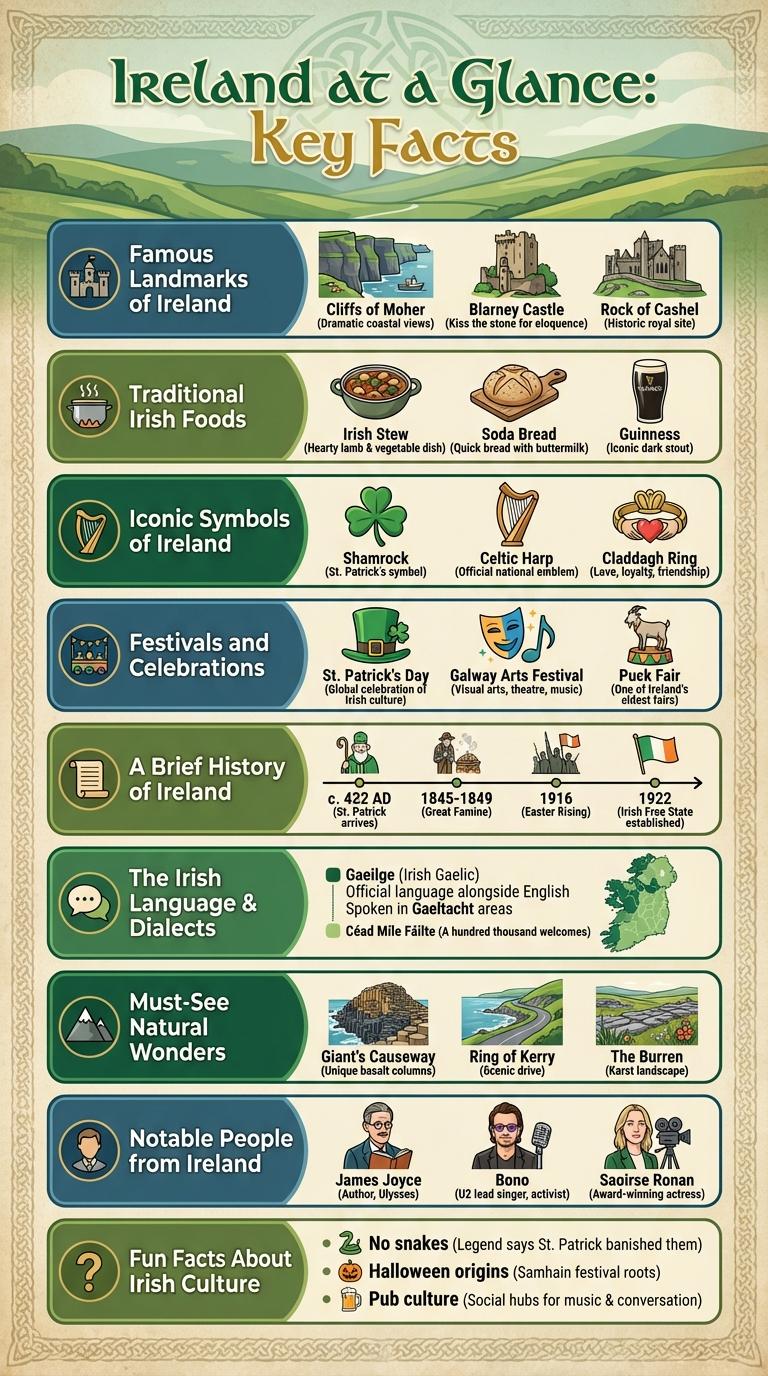
Ireland boasts a rich cultural heritage and stunning landscapes that captivate visitors worldwide. Its vibrant cities blend historic landmarks with modern attractions, offering a unique travel experience. This infographic highlights key facts and figures that showcase Ireland's charm and appeal.
Ireland at a Glance: Key Facts
Ireland is an island nation located in the North Atlantic, known for its rich cultural heritage and picturesque landscapes. It boasts a dynamic economy alongside a population deeply connected to its historical roots.
The following are key facts that provide an insightful overview of Ireland.
- Population - Ireland has approximately 5 million residents, with a majority living in urban areas such as Dublin.
- Geography - Covering about 70,273 square kilometers, Ireland features lush green countryside and rugged coastlines.
- Official Languages - Irish (Gaeilge) and English are both official languages, with English being the most widely spoken.
- Capital City - Dublin, the cultural and economic hub, is home to historic landmarks and multinational corporations.
- Economy - Ireland is known for its strong technology sector and favorable business environment, attracting global companies.
Famous Landmarks of Ireland
Ireland is renowned for its rich history and stunning landmarks that attract millions of visitors each year. Famous sites like the Cliffs of Moher and the Rock of Cashel highlight the country's natural beauty and ancient heritage.
The Giant's Causeway, a UNESCO World Heritage Site, showcases unique hexagonal basalt columns formed by volcanic activity. Dublin Castle and Blarney Castle offer a glimpse into Ireland's medieval past and architectural grandeur.
Traditional Irish Foods
Ireland offers a rich culinary heritage rooted in simple, hearty ingredients. Traditional Irish foods reflect the country's agricultural history and coastal location.
- Irish Stew - A classic dish made with lamb or mutton, potatoes, onions, and parsley, known for its warming flavors.
- Soda Bread - A quick bread leavened with baking soda, often incorporating buttermilk and wholemeal flour for a dense texture.
- Boxty - Potato pancakes that combine grated and mashed potatoes, typically fried to a crispy golden finish.
Iconic Symbols of Ireland
Ireland's iconic symbols reflect its rich cultural heritage and natural beauty. The shamrock, a three-leafed clover, represents luck and is closely associated with St. Patrick's Day. The Celtic harp, featured on Irish coins and official documents, symbolizes the nation's deep musical traditions and historical legacy.
Festivals and Celebrations
Ireland is renowned for its vibrant festivals and celebrations that showcase rich cultural heritage and lively traditions. These events attract visitors worldwide, offering a unique glimpse into Irish customs and community spirit.
One of the most famous festivals is St. Patrick's Day, celebrated on March 17th with parades, music, and green-themed festivities. The Galway International Arts Festival and the Dublin Theatre Festival highlight Ireland's artistic excellence through performances and exhibitions. Traditional music and dance are central to cultural celebrations like Fleadh Cheoil na hEireann, drawing musicians from across the globe.
A Brief History of Ireland
Ireland's rich history spans thousands of years, marked by ancient settlements and cultural evolution. From early Celtic tribes to modern independence, the island's past shapes its vibrant identity.
- Early Settlements - Ireland was first inhabited around 8000 BC by Mesolithic hunter-gatherers.
- Celtic Influence - Celtic culture emerged around 500 BC, deeply influencing language and traditions.
- Viking Invasions - Vikings arrived in the 9th century, establishing key coastal settlements like Dublin.
- English Rule - English control began in the 12th century, leading to centuries of political and religious conflict.
- Independence Movement - The early 20th century saw Ireland gain independence, culminating in the formation of the Republic of Ireland in 1949.
Ireland's historical milestones continue to shape its culture, politics, and global presence today.
The Irish Language & Dialects
The Irish language, also known as Gaeilge, is a Goidelic language native to Ireland and one of the oldest written languages in Europe. It holds official status in the Republic of Ireland and the European Union, reflecting its cultural significance.
Irish has several dialects: Munster, Connacht, and Ulster, each with distinct pronunciation and vocabulary. These dialects are preserved through education, media, and daily use in Gaeltacht regions where Irish remains the community language.
Must-See Natural Wonders
| Natural Wonder | Description |
|---|---|
| Cliffs of Moher | Stunning sea cliffs reaching 214 meters, offering panoramic views over the Atlantic Ocean, located in County Clare. |
| Giant's Causeway | UNESCO World Heritage Site featuring 40,000 interlocking basalt columns formed by volcanic activity in County Antrim. |
| Wicklow Mountains | Expansive mountain range with glacial valleys, peat bogs, and tranquil lakes, perfect for hiking near Dublin. |
| Ring of Kerry | Scenic circular route encompassing mountains, beaches, and waterfalls on the Iveragh Peninsula in County Kerry. |
| Killarney National Park | First national park in Ireland featuring ancient woodlands, lakes, and the famous Torc Waterfall in County Kerry. |
Notable People from Ireland
Ireland has produced many notable figures who have made significant contributions to literature, politics, and the arts. Famous individuals include writer James Joyce, playwright Samuel Beckett, and political leader Michael Collins. These figures have helped shape Ireland's rich cultural and historical legacy.