
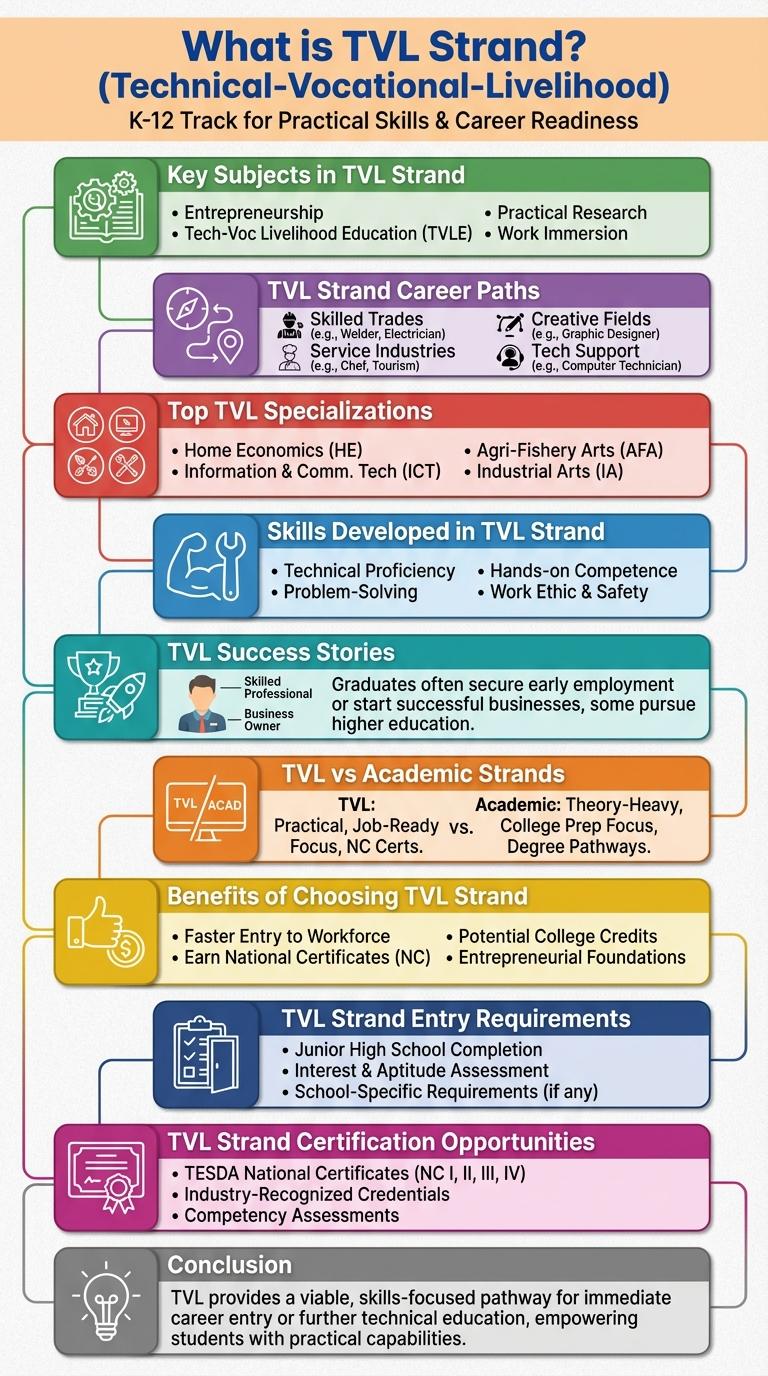
The TVL Strand example infographic clearly illustrates the key components and benefits of the Technical-Vocational-Livelihood program. It highlights various courses, their practical applications, and potential career paths, providing students with a comprehensive overview. Visual elements emphasize skill development and industry relevance to guide informed decision-making.
What is TVL Strand?
TVL Strand is a specific track within the Technical-Vocational-Livelihood (TVL) curriculum designed to equip students with hands-on skills and practical knowledge. It focuses on preparing learners for immediate employment or entrepreneurship in various technical fields.
- Technical Skills Development - Emphasizes acquiring industry-relevant skills such as electronics, automotive, and electrical installation.
- Livelihood Training - Provides training in small business management, food processing, and housekeeping to promote self-employment.
- Job-Ready Graduates - Prepares students for certifications and assessments that increase employability in technical and vocational sectors.
TVL Strand bridges education with practical work experience to enhance career opportunities for students in technical and livelihood industries.
Key Subjects in TVL Strand
The TVL (Technical-Vocational-Livelihood) strand in senior high school offers practical skills and knowledge for various industries. Key subjects focus on equipping students with competencies for immediate employment or entrepreneurship.
Core subjects include Home Economics, Information and Communication Technology (ICT), Agri-Fishery Arts, Industrial Arts, and Entrepreneurship. These subjects develop technical skills in culinary arts, computer programming, agriculture, automotive, and business management.
TVL Strand Career Paths
The TVL (Technical-Vocational-Livelihood) strand offers specialized training in various technical and vocational fields. Students can pursue careers in automotive, electronics, culinary arts, information technology, and health care services. These career paths provide hands-on experience and equip learners with industry-relevant skills for immediate employment or entrepreneurship.
Top TVL Specializations
Top TVL specializations offer students practical skills that align with industry demands and enhance employability. Examples include Information and Communications Technology (ICT), Home Economics, Agri-Fishery Arts, Industrial Arts, and Tourism. These fields provide hands-on training, preparing learners for immediate work or entrepreneurship opportunities.
| Specialization | Focus Area |
|---|---|
| Information and Communications Technology (ICT) | Computer programming, hardware servicing, animation |
| Home Economics | Cooking, caregiving, dressmaking, housekeeping |
| Agri-Fishery Arts | Crop production, animal production, aquaculture |
| Industrial Arts | Welding, automotive servicing, carpentry |
| Tourism | Travel services, tour guiding, hospitality management |
Skills Developed in TVL Strand
| Skill | Description |
|---|---|
| Technical Skills | Proficiency in specialized tools and equipment related to various trades such as automotive, electronics, and carpentry. |
| Practical Problem-Solving | Ability to diagnose issues and implement effective solutions in real-world technical scenarios. |
| Project Management | Planning, organizing, and executing projects efficiently within time and budget constraints. |
| Communication Skills | Effective verbal and written communication essential for teamwork and client interactions. |
| Hands-On Experience | Direct application of knowledge through internships, workshops, and on-the-job training. |
TVL Success Stories
TVL strands have empowered students to achieve remarkable career milestones. Success stories highlight how hands-on skills translate into real-world accomplishments.
- Skilled Graduates Securing Jobs - Numerous TVL strand graduates have landed positions in industries such as culinary arts, automotive technology, and computer programming.
- Entrepreneurial Ventures Launched - Several students started small businesses after acquiring practical skills from their TVL training.
- National and Regional Awards - TVL strand participants earned awards in competitions, showcasing excellence in technical and vocational disciplines.
TVL vs Academic Strands
What distinguishes TVL strands from Academic strands in senior high school? TVL (Technical-Vocational-Livelihood) strands emphasize practical skills and hands-on training, preparing students for immediate employment or entrepreneurship. Academic strands concentrate on theoretical knowledge, suited for students aiming for college degrees and professional careers.
| Aspect | TVL Strand |
|---|---|
| Focus | Technical skills and vocational training |
| Career Path | Direct employment, technical jobs, entrepreneurship |
| Learning Style | Hands-on, practical applications |
| Examples | Home Economics, Information and Communications Technology, Industrial Arts |
| Aspect | Academic Strand |
|---|---|
| Focus | Theoretical knowledge and academic subjects |
| Career Path | University education, professional courses |
| Learning Style | Lectures, research, critical analysis |
| Examples | Science, Technology, Engineering and Mathematics (STEM), Accountancy, Business and Management (ABM), Humanities and Social Sciences (HUMSS) |
Benefits of Choosing TVL Strand
TVL Strand offers specialized technical-vocational education designed to equip students with practical skills for immediate employment. This strand focuses on hands-on learning, making graduates highly desirable in various industries.
Choosing TVL Strand enhances career readiness by providing certifications that increase job opportunities. It also develops both technical expertise and soft skills, ensuring well-rounded professional growth.
TVL Strand Entry Requirements
The TVL (Technical-Vocational-Livelihood) strand in Senior High School prepares students for practical skills and technical knowledge. Entry requirements vary depending on the specific course under the TVL strand.
Students must have completed Junior High School and have a general aptitude for hands-on learning. Some courses require a background in related technical subjects or a basic skills assessment. Schools may also consider students' interests and physical capacity when admitting them into a TVL strand program.