
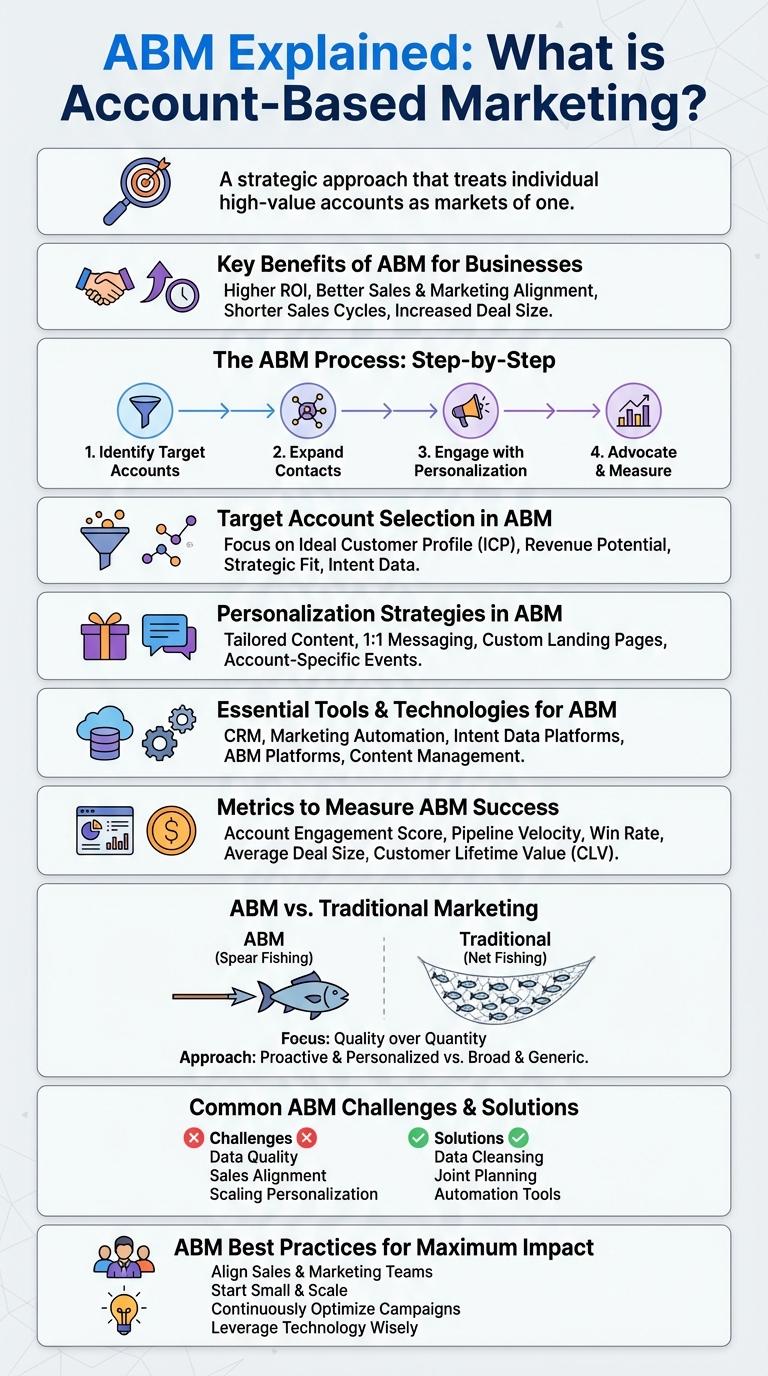
Account-Based Marketing (ABM) focuses on targeting specific high-value accounts with personalized campaigns to maximize engagement and ROI. This strategic approach aligns marketing and sales efforts to deliver tailored messaging that resonates deeply with key decision-makers. Infographics on ABM visually break down its core principles, benefits, and implementation steps, making complex strategies easy to understand.
ABM Explained: What is Account-Based Marketing?
Account-Based Marketing (ABM) is a strategic approach that targets specific high-value accounts with personalized marketing campaigns. It aligns sales and marketing teams to focus efforts on key decision-makers within these accounts. ABM increases engagement, shortens sales cycles, and drives higher ROI by tailoring messages to individual company needs.
Key Benefits of ABM for Businesses
Account-Based Marketing (ABM) offers businesses a targeted approach to engage high-value clients and optimize marketing resources. Focusing on specific accounts enhances personalization and drives better ROI compared to broad marketing strategies.
- Improved ROI - ABM targets high-value accounts, maximizing marketing spend efficiency and revenue generation.
- Enhanced Personalization - Customized campaigns resonate more effectively with key stakeholders, increasing engagement.
- Better Alignment - Sales and marketing teams collaborate closely, ensuring consistent messaging and faster deal closures.
- Shortened Sales Cycles - Focused efforts on priority accounts accelerate decision-making and purchasing processes.
- Stronger Customer Relationships - Tailored communication builds trust and long-term loyalty with strategic clients.
The ABM Process: Step-by-Step
Account-Based Marketing (ABM) is a strategic approach that targets high-value accounts with personalized campaigns. The process involves precise steps to align sales and marketing efforts effectively.
- Identify Target Accounts - Select key accounts based on firmographic, technographic, and behavioral data to focus resources efficiently.
- Research and Insights - Gather detailed information on target accounts to tailor messaging and understand buying intent.
- Personalized Campaign Development - Create customized content and offers that resonate with the specific needs of each account.
- Multichannel Execution - Use email, social media, direct mail, and events to engage contacts within the target accounts.
- Measure and Optimize - Analyze engagement metrics and pipeline impact to refine ABM strategies continuously.
The ABM process delivers higher ROI by focusing marketing efforts on accounts with the greatest potential value.
Target Account Selection in ABM
Personalization Strategies in ABM
Account-Based Marketing (ABM) leverages personalization strategies to target key accounts with tailored content and messaging. Personalization in ABM includes customized campaigns, personalized emails, and targeted ads designed to address the specific needs and pain points of each account. This strategic focus improves engagement, shortens sales cycles, and drives higher conversion rates by delivering relevant and timely interactions.
Essential Tools & Technologies for ABM
What are the essential tools and technologies for Account-Based Marketing (ABM)? ABM requires specialized platforms to identify, target, and engage high-value accounts effectively. These tools streamline personalized marketing efforts, improving campaign precision and ROI.
| Tool/Technology | Purpose |
|---|---|
| Account Identification Platforms | Analyze data to select target accounts based on fit and intent signals. |
| CRM Systems | Manage account interactions and track engagement throughout the buyer journey. |
| Personalization Engines | Deliver tailored content and messaging to specific accounts or contacts. |
| Marketing Automation Tools | Automate multi-channel campaigns aligned with account strategies. |
| Analytics and Attribution Software | Measure campaign performance and attribute revenue to specific accounts. |
Metrics to Measure ABM Success
Account-Based Marketing (ABM) focuses on targeting high-value accounts with personalized campaigns. Measuring the success of ABM requires monitoring specific metrics to evaluate engagement and ROI effectively.
- Engagement Rate - Tracks the level of interaction from target accounts across multiple channels, indicating campaign relevance.
- Pipeline Velocity - Measures the speed at which prospects move through the sales funnel, reflecting campaign efficiency.
- Deal Size Growth - Compares average deal sizes pre- and post-ABM implementation to assess revenue impact.
- Account Penetration - Evaluates the depth of engagement within each target organization, showing relationship strength.
- Return on Investment (ROI) - Calculates the financial return relative to ABM campaign costs, indicating overall profitability.
ABM vs. Traditional Marketing
Account-Based Marketing (ABM) targets specific high-value accounts through personalized campaigns, focusing on quality over quantity. Traditional marketing uses broad strategies to reach a wide audience with generalized messaging.
ABM tailors marketing efforts to individual businesses, increasing relevance and engagement. It aligns sales and marketing teams to target decision-makers, enhancing conversion rates. Traditional marketing aims to build brand awareness across a large market, often resulting in lower personalization and engagement.
Common ABM Challenges & Solutions
Account-Based Marketing (ABM) faces challenges such as identifying high-value accounts and aligning sales with marketing efforts. Proper targeting ensures resources focus on the most promising prospects, increasing ROI.
Another common challenge is creating personalized content that resonates with each account. Collaborating closely with sales teams helps develop relevant messaging and improve engagement rates.