
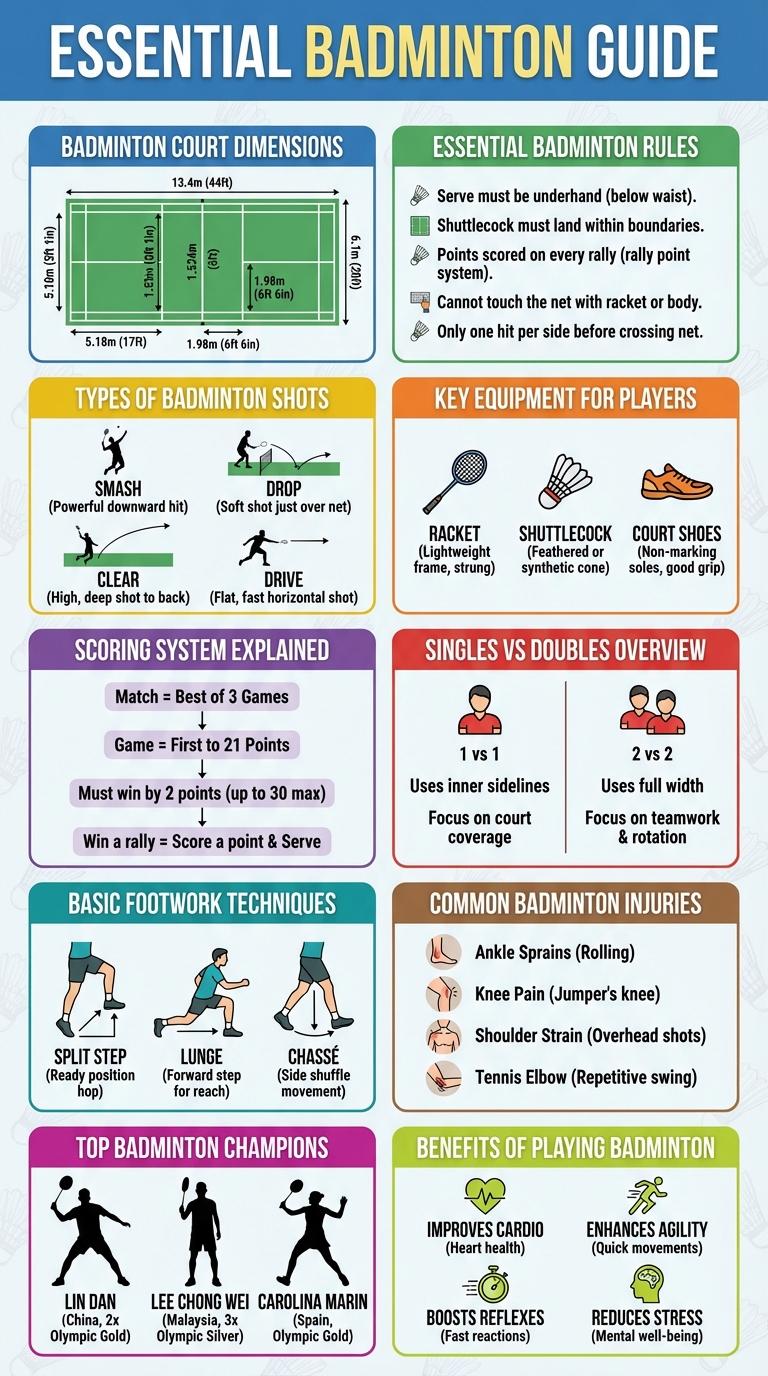
Badminton is a fast-paced sport that requires agility, precision, and strategy. This infographic breaks down essential techniques, scoring rules, and equipment used in badminton. Visual insights help players and enthusiasts understand the game's key elements quickly and effectively.
Essential Badminton Rules
What are the essential rules to play badminton effectively? Badminton is played with either singles or doubles, where players hit a shuttlecock over a net to score points. The shuttlecock must land within the opponent's court boundaries to earn a point.
How is scoring done in badminton? Each rally begins with a serve, and a point is scored when the opponent fails to return the shuttlecock properly. Matches are usually played to 21 points, requiring a two-point lead to win.
What are the basic serving rules in badminton? The serve must be delivered underhand and below the server's waist. The shuttlecock must travel diagonally across the net into the opponent's service court.
Are there specific faults to watch for in badminton? Faults include hitting the shuttlecock out of bounds, into the net, or touching the player's body. Double hits and carrying the shuttlecock are also considered faults.
How do boundary lines affect gameplay? The singles court is narrower, while the doubles court is wider, but both share the same length. Players must ensure the shuttlecock lands inside the correct boundary lines based on the mode being played.
Badminton Court Dimensions
Badminton court dimensions are standardized for both singles and doubles matches. The court is rectangular with specific measurements to ensure fair play and consistency in competitions.
The total length of a badminton court is 13.4 meters (44 feet), while the width varies depending on the match type. For singles, the court is 5.18 meters (17 feet) wide, and for doubles, it expands to 6.1 meters (20 feet) wide. The net height is set at 1.55 meters (5 feet 1 inch) at the edges and 1.524 meters (5 feet) at the center.
Types of Badminton Shots
Badminton features a variety of shots that players use to outmaneuver their opponents and score points. Mastery of these shot types is essential for competitive play.
- Clear - A high and deep shot sent to the opponent's backcourt to gain time and reset the rally.
- Drop Shot - A gentle, precise shot that falls just over the net, forcing the opponent to move forward quickly.
- Smash - A powerful downward shot aimed to finish the point with speed and force.
Key Equipment for Players
Badminton players rely on essential equipment including rackets, shuttlecocks, and appropriate footwear designed for agility and grip. High-quality rackets lightweight and durable, enhance control and power for precise shots. Specialized shoes provide stability and support, reducing the risk of injury during fast movements on the court.
Scoring System Explained
| Scoring Element | Description |
|---|---|
| Match Format | Best of 3 games |
| Game Points | First player to 21 points wins a game |
| Rally Scoring | Points scored on every serve regardless of who served |
| Winning Margin | Must win by at least 2 points |
| Maximum Points | If tied at 20-20, game continues until a player reaches 30 points or leads by 2 points |
Singles vs Doubles Overview
Badminton features two primary formats: singles and doubles. Singles matches involve one player per side, focusing on endurance and court coverage.
Doubles matches consist of two players per side, emphasizing teamwork and rapid-fire exchanges. Both formats demand agility, strategy, and precision.
Basic Footwork Techniques
Basic footwork techniques in badminton include the split step, lunge, and side step, essential for quick and efficient court movement. Proper footwork enhances balance, agility, and positioning, allowing players to reach shots faster and maintain control during rallies. Mastering these techniques reduces injury risk and improves overall game performance.
Common Badminton Injuries
Badminton players commonly experience injuries due to rapid movements and sudden changes in direction. These injuries often affect joints, muscles, and tendons, impacting performance and recovery time.
The most frequent injuries include sprains, strains, and tendonitis, primarily occurring in the ankles, knees, shoulders, and wrists. Proper warm-up, technique, and equipment can help reduce the risk of these common badminton injuries.
Top Badminton Champions
Badminton showcases remarkable athletes who have dominated the sport globally. The top champions have set records and won numerous titles in international competitions.
- Lin Dan - Renowned as one of the greatest badminton players, Lin Dan secured two Olympic gold medals and five World Championship titles.
- Lee Chong Wei - A Malaysian legend with three Olympic silver medals and a record 47 consecutive months as world number one.
- Carolina Marin - The first Spanish player to win Olympic gold in badminton, known for her aggressive playing style and multiple World Championships.