
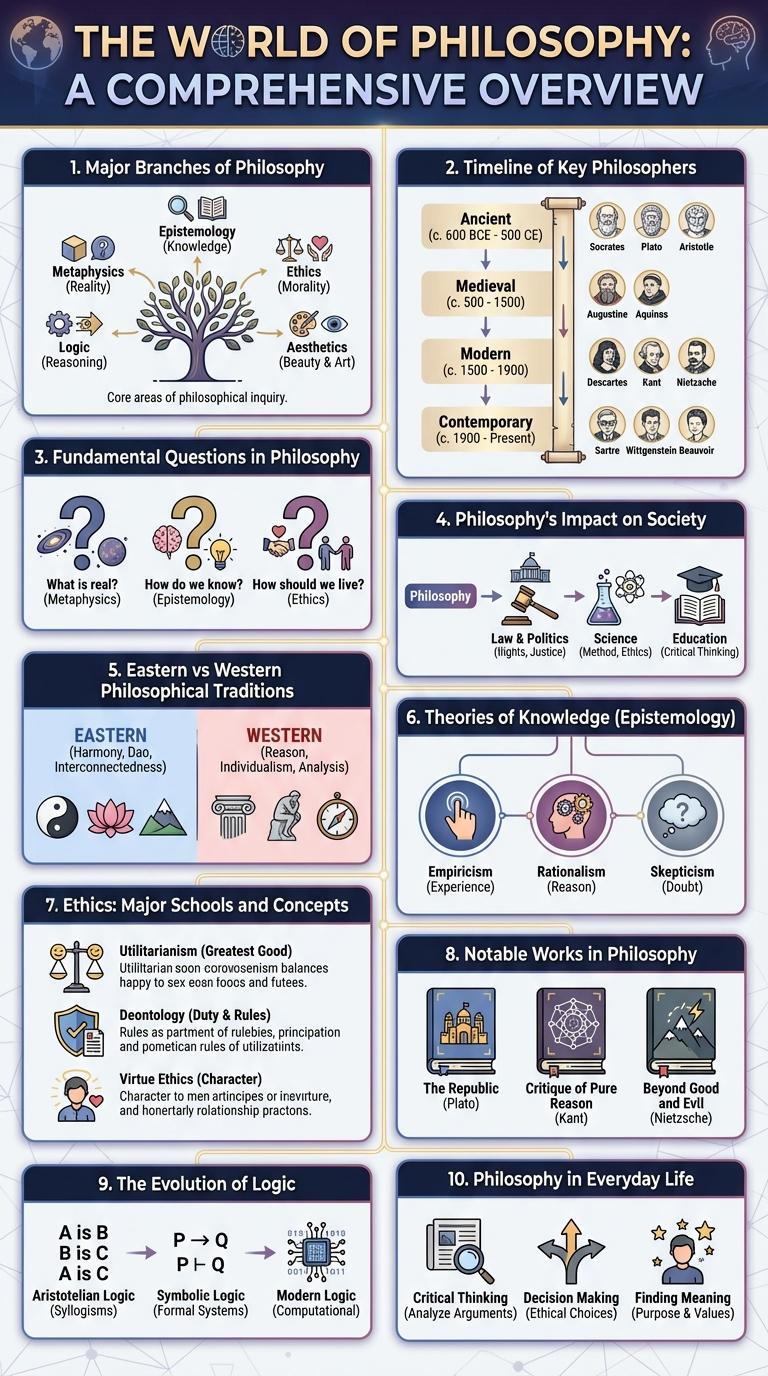
Philosophy explores fundamental questions about existence, knowledge, and values through critical thinking and reasoned argument. Infographics present complex philosophical concepts clearly and visually, making abstract ideas more accessible and engaging. This approach helps learners grasp key theories, influential philosophers, and core branches of philosophy efficiently.
Major Branches of Philosophy
What are the major branches of philosophy? Philosophy is divided into several core branches that explore different aspects of human thought and existence. These branches include metaphysics, epistemology, ethics, logic, and aesthetics.
How does metaphysics contribute to philosophical study? Metaphysics examines the nature of reality and existence, addressing questions about what is ultimately real. It explores concepts like being, time, and causality.
What is the focus of epistemology in philosophy? Epistemology investigates the nature and scope of knowledge and belief. It analyzes the sources, limits, and validity of human understanding.
Why is ethics important in philosophy? Ethics studies moral values and principles that govern human behavior. It seeks to define what is right, wrong, good, and just in various contexts.
How do logic and aesthetics impact philosophy? Logic provides the formal rules of reasoning that ensure coherent argumentation. Aesthetics explores the nature of beauty, art, and taste, shaping philosophical discussions on creativity and perception.
Timeline of Key Philosophers
Philosophy has evolved through the contributions of key thinkers across centuries. This infographic presents a timeline highlighting influential philosophers and their impact.
- Ancient Era: Socrates (470-399 BCE) - Considered the father of Western philosophy, he pioneered ethical inquiry and the Socratic method.
- Classical Period: Aristotle (384-322 BCE) - Developed foundational concepts in logic, metaphysics, and natural sciences, shaping Western intellectual tradition.
- Modern Age: Immanuel Kant (1724-1804) - Revolutionized epistemology with his critical philosophy, emphasizing the limits of human knowledge.
- 19th Century: Friedrich Nietzsche (1844-1900) - Challenged traditional morality and introduced existentialist ideas on individualism and power.
- 20th Century: Jean-Paul Sartre (1905-1980) - Key figure in existentialism, highlighting human freedom and responsibility in an absurd world.
Fundamental Questions in Philosophy
Philosophy explores essential questions about existence, knowledge, and ethics. It aims to understand the nature of reality and human experience.
Key questions include: What is truth? How should we live? These inquiries form the foundation of philosophical study.
Philosophy's Impact on Society
| Philosophical Concept | Impact on Society |
|---|---|
| Ethics | Shapes moral frameworks guiding laws, human rights, and social justice movements. |
| Political Philosophy | Influences governance models, democracy, and concepts of freedom and equality. |
| Epistemology | Enhances critical thinking, scientific inquiry, and education systems. |
| Metaphysics | Impacts religious beliefs and cultural perspectives on existence and reality. |
| Aesthetics | Shapes art, literature, and cultural values on beauty and creativity. |
Eastern vs Western Philosophical Traditions
Eastern and Western philosophical traditions offer distinct approaches to understanding reality and human existence. Eastern philosophy emphasizes harmony, balance, and the interconnectedness of all things, often exploring themes like mindfulness and spiritual enlightenment. Western philosophy focuses on analytical reasoning, individualism, and empirical evidence, advancing ideas through logic and scientific inquiry.
Theories of Knowledge (Epistemology)
Epistemology is the branch of philosophy that studies the nature, origin, and limits of human knowledge. It explores how knowledge is acquired and what justifies beliefs.
Key theories of knowledge include empiricism, which emphasizes sensory experience as the source of knowledge, and rationalism, which relies on reason and innate ideas. Constructivism highlights that knowledge is actively constructed by the learner rather than passively received. Skepticism challenges the possibility of certain knowledge, questioning the justification of beliefs.
Ethics: Major Schools and Concepts
Ethics is a branch of philosophy that explores the concepts of right and wrong behavior. It examines moral values and principles that guide human conduct.
- Utilitarianism - This school evaluates actions based on their outcomes, aiming for the greatest good for the greatest number.
- Deontology - Focuses on the inherent morality of actions, emphasizing duties and rules regardless of consequences.
- Virtue Ethics - Centers on developing moral character and virtues as the foundation for ethical behavior.
- Relativism - Suggests that moral standards are culturally based and subjective rather than absolute.
- Existential Ethics - Stresses individual freedom, choice, and responsibility in creating personal moral meaning.
Understanding these ethical frameworks helps clarify diverse perspectives on morality and decision-making.
Notable Works in Philosophy
Philosophy has produced numerous notable works that have shaped human thought across centuries. These texts explore fundamental questions about existence, knowledge, ethics, and reality.
Classic works like Plato's "Republic" and Aristotle's "Nicomachean Ethics" remain foundational in philosophical education. Modern texts, including Descartes' "Meditations" and Kant's "Critique of Pure Reason," revolutionized the understanding of consciousness and metaphysics.
The Evolution of Logic
Logic, originating in ancient Greece with Aristotle, has evolved from classical syllogistic reasoning to modern symbolic logic. The 19th century introduced formal systems by George Boole and Gottlob Frege, laying the groundwork for computer science and mathematics. Contemporary logic explores modal, fuzzy, and intuitionistic frameworks, expanding applications across technology and philosophy.