
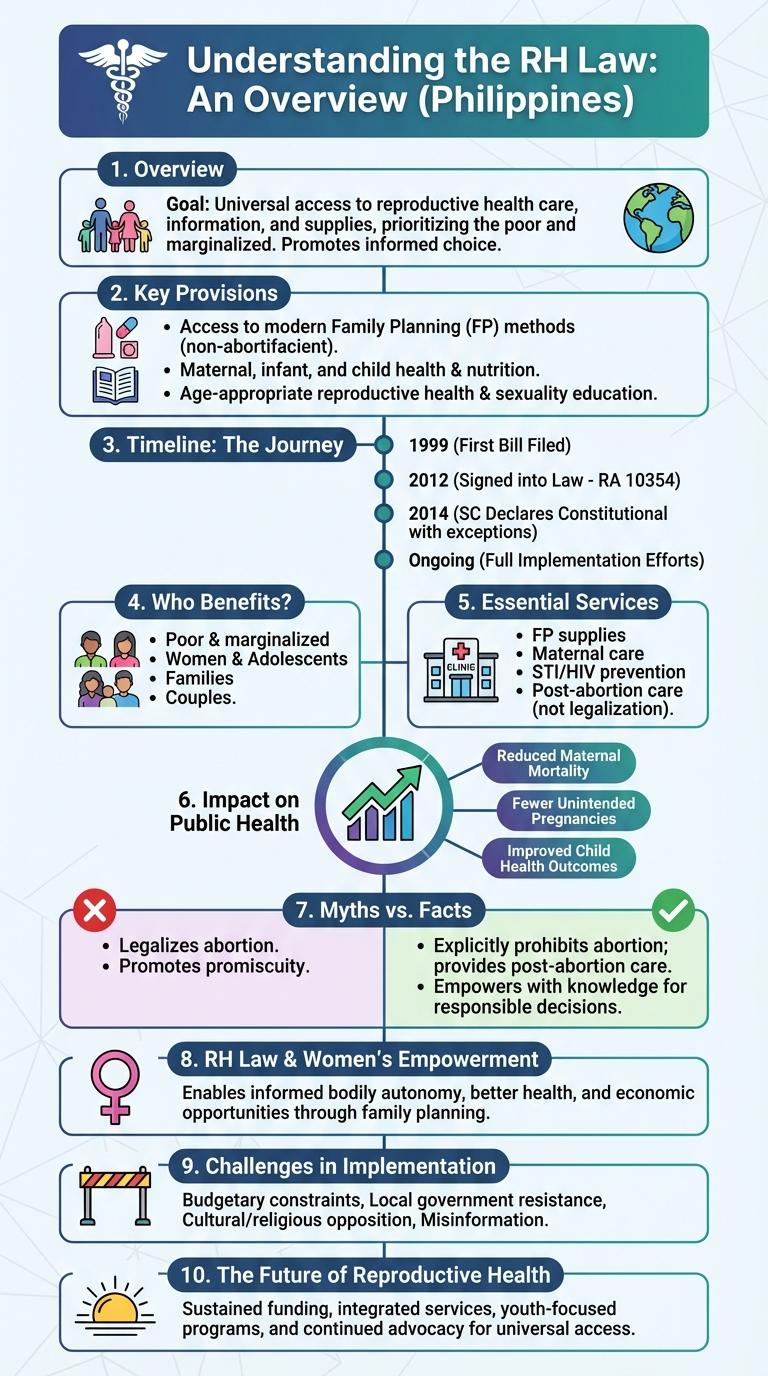
The infographic presents key facts and figures about the Reproductive Health (RH) Law, highlighting its impact on public health and family planning in the Philippines. It showcases data on access to contraceptives, maternal care, and educational programs aimed at reducing teenage pregnancies. Visual elements emphasize the law's role in promoting informed choices and reproductive rights for individuals nationwide.
Understanding the RH Law: An Overview
The Reproductive Health (RH) Law is a significant legislation aimed at promoting reproductive health and responsible parenthood in the Philippines. It provides access to information, education, and services on family planning and maternal health.
Understanding this law helps individuals and communities exercise their reproductive rights and make informed decisions about family planning and health care.
- Access to Family Planning - The law ensures access to modern contraceptives and family planning methods for all citizens.
- Maternal Health Programs - It establishes programs to reduce maternal and infant mortality through adequate health care services.
- Sex Education - The RH Law mandates age-appropriate reproductive health education in schools to foster responsible decision-making.
Key Provisions of the RH Law
The RH Law, officially known as Republic Act No. 10354 in the Philippines, aims to provide universal access to reproductive health services. This law focuses on promoting responsible parenthood through informed choice and access to modern family planning methods.
- Access to Contraceptives - The law ensures free access to a wide range of contraceptive methods in all government health facilities.
- Sex Education - It mandates age-appropriate reproductive health information across all levels of formal education.
- Maternal and Child Health - The RH Law supports programs to improve prenatal, delivery, and postnatal care.
- Population Management - Strategies for population development and responsible parenthood are integrated into government policies.
- Healthcare Provider Training - The law includes training for health workers on the delivery of reproductive health services.
This legislation plays a significant role in improving health outcomes and empowering individuals to make informed reproductive choices.
Timeline: The Journey of the RH Law
The RH Law, officially known as the Responsible Parenthood and Reproductive Health Act of 2012, marks a significant milestone in Philippine legislation. It aims to provide universal access to methods on contraception, fertility control, sexual education, and maternal care.
The journey of the RH Law spans decades of advocacy and debate. Initial efforts began in the 1990s, with substantial progress in the early 2000s as reproductive health became a national priority. The law was finally enacted in 2012 after overcoming numerous legal challenges, reflecting a pivotal shift in public health policy.
Who Benefits from the RH Law?
The Responsible Parenthood and Reproductive Health Act primarily benefits women by ensuring access to family planning and reproductive health services. Couples gain greater control over their reproductive choices, promoting healthier families and communities. Healthcare providers and local governments receive clear guidelines to support effective implementation and outreach.
Essential Services Provided by the RH Law
The Responsible Parenthood and Reproductive Health (RH) Law ensures access to essential health services related to family planning, maternal care, and reproductive health education. It aims to promote informed choices and improve overall health outcomes for individuals and families.
Key services under the RH Law include distribution of contraceptives, prenatal and postnatal care, and prevention of sexually transmitted infections (STIs). The law also supports counseling, health education, and promotion of responsible parenthood as part of comprehensive reproductive health services.
Impact of the RH Law on Public Health
How has the RH Law improved public health in the Philippines?
The Responsible Parenthood and Reproductive Health Act of 2012 has significantly enhanced access to family planning services nationwide. This access has contributed to reducing maternal and infant mortality rates by promoting responsible parenthood and reproductive health awareness.
Myths vs. Facts About the RH Law
The RH Law aims to provide access to reproductive health services and information in the Philippines. Misunderstandings about the law have led to widespread myths that often obscure its true purpose and benefits.
Clarifying these misconceptions helps promote informed decisions and supports public health initiatives.
- Myth: The RH Law promotes abortion - The law explicitly prohibits abortion and focuses on family planning and maternal health.
- Myth: The RH Law encourages promiscuity - The law emphasizes responsible parenthood and informed reproductive choices, not promiscuity.
- Fact: The RH Law provides free access to contraceptives - It mandates the government to supply modern family planning methods to all Filipinos at no cost.
RH Law and Women's Empowerment
| RH Law Aspect | Impact on Women's Empowerment |
|---|---|
| Access to Family Planning | Provides women control over reproductive choices, promoting autonomy and health. |
| Maternal Health Care | Ensures availability of prenatal and postnatal services, reducing maternal mortality rates. |
| Education and Information | Offers comprehensive education on reproductive health, empowering informed decisions. |
| Gender Equality | Supports women's rights to make decisions about their bodies, challenging societal norms. |
| Legal Protection | Grants legal backing for reproductive health services, reinforcing women's reproductive rights. |
Challenges in RH Law Implementation
The RH Law (Republic Act No. 10354) aims to provide universal access to reproductive health services in the Philippines. Despite its passage, implementation faces numerous challenges that hinder its full impact.
Funding limitations restrict the availability of essential contraceptives and maternal health services. Cultural and religious opposition significantly affect community acceptance and policy enforcement.