
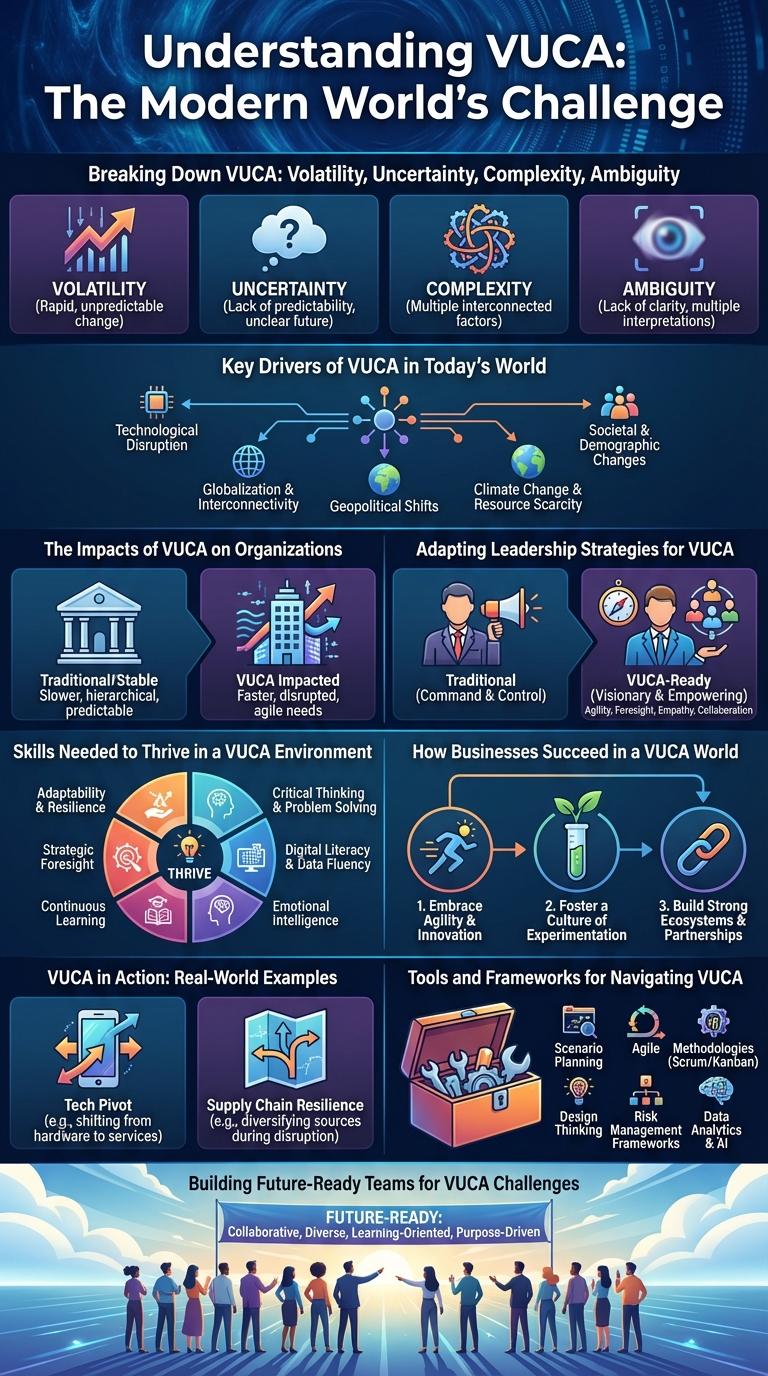
VUCA, an acronym for Volatility, Uncertainty, Complexity, and Ambiguity, defines the challenging conditions businesses face today. Visualizing these elements through an infographic helps clarify their impact on decision-making and strategic planning. Understanding VUCA dynamics enables organizations to develop resilient strategies in rapidly changing environments.
Understanding VUCA: The Modern World's Challenge
VUCA represents Volatility, Uncertainty, Complexity, and Ambiguity, describing the challenging conditions of the modern world. It highlights how organizations and individuals must adapt to rapid change and unpredictable environments.
- Volatility - Rapid and unpredictable changes disrupt stability in various sectors.
- Uncertainty - Lack of clear information makes future outcomes difficult to predict.
- Complexity - Multiple interconnected factors increase decision-making difficulty.
- Ambiguity - Situations lack clarity, making interpretation and response challenging.
- Adaptability - Success depends on flexibility and continuous learning in VUCA conditions.
Breaking Down VUCA: Volatility, Uncertainty, Complexity, Ambiguity
VUCA represents the challenges in today's dynamic environments. It stands for Volatility, Uncertainty, Complexity, and Ambiguity.
- Volatility - Refers to rapid and unexpected changes that disrupt normal patterns.
- Uncertainty - Describes the lack of predictability and difficulty in forecasting future events.
- Complexity - Involves multiple interconnected factors that complicate decision-making.
- Ambiguity - Indicates unclear information that leads to multiple interpretations and confusion.
Key Drivers of VUCA in Today's World
| Key Driver | Description |
|---|---|
| Technological Advancements | Rapid innovation and digital transformation create constant change and new uncertainties. |
| Globalization | Interconnected markets increase complexity and unpredictability in economic and political contexts. |
| Political Instability | Frequent shifts in policies and leadership cause volatility and unclear future outlooks. |
| Environmental Challenges | Climate change and natural disasters introduce significant ambiguity and long-term risks. |
| Social Dynamics | Rapid changes in demographics, cultural norms, and public opinion drive uncertainty in decision-making. |
The Impacts of VUCA on Organizations
VUCA, an acronym for Volatility, Uncertainty, Complexity, and Ambiguity, profoundly shapes modern organizational environments. These dynamic conditions challenge traditional management approaches, demanding agile strategies.
Volatility causes rapid and unpredictable changes, forcing companies to adapt swiftly to market fluctuations. Uncertainty limits the ability to predict future events, complicating strategic planning. Complexity involves multiple interconnected variables that require sophisticated problem-solving and decision-making processes to navigate effectively.
Adapting Leadership Strategies for VUCA
VUCA stands for Volatility, Uncertainty, Complexity, and Ambiguity, representing today's challenging business environment. Effective leadership in VUCA requires adaptive strategies that emphasize flexibility and resilience.
Leaders must prioritize clear communication and agile decision-making to navigate rapid changes. Embracing continuous learning and innovation enables organizations to thrive amid uncertainty and complexity.
Skills Needed to Thrive in a VUCA Environment
What skills are essential to navigate a VUCA environment? Thriving in a Volatile, Uncertain, Complex, and Ambiguous world demands adaptability and continuous learning. Key skills include critical thinking, emotional intelligence, and effective communication.
How does critical thinking help in a VUCA setting? It enables individuals to analyze complex problems and make informed decisions quickly. This skill reduces the impact of uncertainty by fostering clarity and logical reasoning.
Why is emotional intelligence important in VUCA environments? Managing emotions supports resilience amid change and stress. High emotional intelligence improves teamwork and conflict resolution under pressure.
What role does effective communication play in VUCA conditions? Clear communication bridges gaps created by ambiguity and complexity. It ensures alignment across teams and facilitates swift responses to emerging challenges.
| Skill | Benefit in VUCA |
|---|---|
| Adaptability | Adjusts strategies quickly to new circumstances |
| Continuous Learning | Keeps skills relevant and knowledge up to date |
| Critical Thinking | Enables problem-solving in complex situations |
| Emotional Intelligence | Enhances resilience and interpersonal relationships |
| Effective Communication | Facilitates clear information flow and collaboration |
How Businesses Succeed in a VUCA World
Businesses operating in a VUCA world--characterized by Volatility, Uncertainty, Complexity, and Ambiguity--must adopt agile strategies to thrive. Embracing flexibility and rapid decision-making enables companies to navigate unpredictable market conditions effectively.
Successful organizations invest in continuous learning and foster a culture of innovation to stay ahead. Utilizing data analytics and scenario planning helps businesses anticipate challenges and seize emerging opportunities.
VUCA in Action: Real-World Examples
VUCA, an acronym for Volatility, Uncertainty, Complexity, and Ambiguity, defines the modern business landscape. Real-world examples of VUCA include rapid technological advancements disrupting traditional industries, geopolitical tensions affecting global supply chains, and market fluctuations driven by unpredictable consumer behavior. Organizations successful in navigating VUCA environments leverage agility, strategic foresight, and strong leadership to adapt and thrive.
Tools and Frameworks for Navigating VUCA
VUCA, representing Volatility, Uncertainty, Complexity, and Ambiguity, challenges organizations to adapt quickly. Tools such as scenario planning, agile methodologies, and real-time data analytics help navigate these challenges effectively. Frameworks like the OODA Loop and Cynefin provide structured approaches for decision-making in unpredictable environments.