
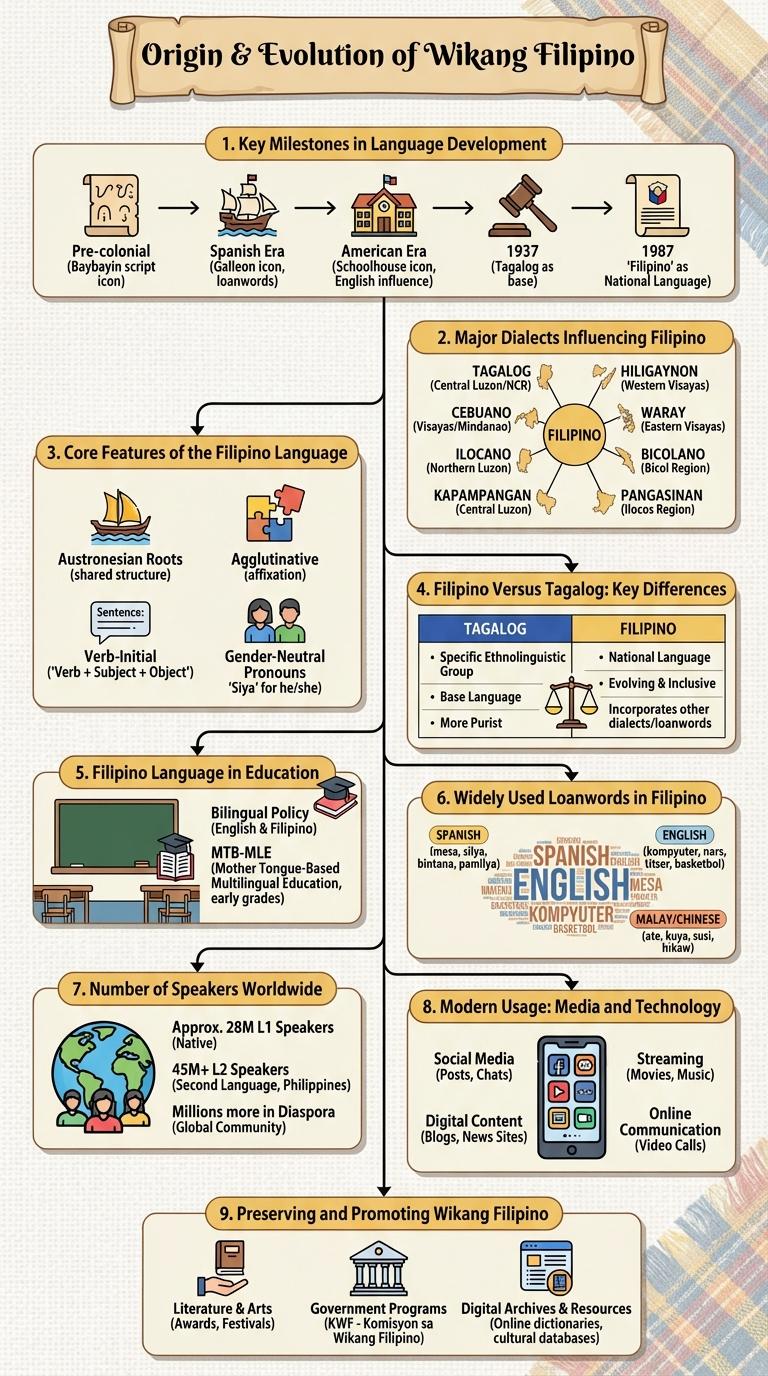
Wikang Filipino serves as the national language of the Philippines, uniting diverse ethnic groups through a shared means of communication. It incorporates elements from various Philippine languages, reflecting the country's rich cultural heritage and history. Understanding the evolution, structure, and significance of Wikang Filipino helps to appreciate its role in national identity and education.
Origin and Evolution of Wikang Filipino
Wikang Filipino is the national language of the Philippines, rooted deeply in the country's diverse linguistic heritage. It evolved from Tagalog and incorporated elements from various Philippine languages and foreign influences.
- Pre-colonial origins - Early Philippine communities spoke Austronesian languages, including Tagalog, which became the foundation for Filipino.
- Spanish colonization impact - Spanish rule introduced loanwords and influenced vocabulary, shaping the evolving language landscape.
- American period influence - English education policies during American colonization affected Filipino's development and bilingual nature.
- Adoption as national language - In 1937, Tagalog was selected as the basis of the national language, later renamed Filipino to reflect inclusivity.
- Modern evolution - Contemporary Filipino incorporates words from other Philippine dialects, English, and Spanish, reflecting cultural diversity.
Wikang Filipino continues to adapt, symbolizing national identity and unity across the Philippines.
Key Milestones in Language Development
| Year | Key Milestone in Wikang Filipino Development |
|---|---|
| 1935 | Commonwealth Act No. 184 mandates the development and adoption of a national language based on existing native tongues. |
| 1940 | Tagalog is selected as the basis for the national language, later termed "Pilipino." |
| 1959 | President Carlos P. Garcia renames the national language to "Filipino." |
| 1987 | Philippine Constitution recognizes Filipino as the national language and promotes its development and use. |
| 2013 | K to 12 Curriculum integrates Filipino as a core subject to foster national identity and cultural awareness. |
Major Dialects Influencing Filipino
What are the major dialects influencing the Filipino language? Filipino is primarily shaped by Tagalog, Cebuano, Ilocano, Hiligaynon, and Waray-Waray dialects. These dialects contribute to the rich linguistic diversity and cultural identity of the Philippines.
Core Features of the Filipino Language
Filipino is the national language of the Philippines, evolving from Tagalog and enriched by other Philippine languages and foreign influences. It serves as a unifying medium across the archipelago's diverse linguistic groups.
- Multilingual Roots - Filipino integrates vocabulary and grammar from Tagalog and various Philippine languages, creating a dynamic linguistic blend.
- Lexical Borrowings - The language incorporates loanwords from Spanish, English, Chinese, and Malay, reflecting historical and cultural interactions.
- Flexible Syntax - Filipino syntax allows variation in word order, enabling expressive and context-dependent communication.
Filipino Versus Tagalog: Key Differences
Filipino and Tagalog are often used interchangeably but represent different concepts. Filipino is the national language of the Philippines, while Tagalog is one of the many regional languages spoken in the country.
Filipino incorporates elements from various Philippine languages, making it more inclusive and standardized. Tagalog is the basis of Filipino but remains a specific native language primarily spoken in Metro Manila and neighboring provinces.
Filipino Language in Education
The Filipino language plays a vital role in the Philippine education system as the medium of instruction in primary grades and as a subject in higher levels. Integrating Filipino enhances comprehension and cultural identity among students, promoting better academic performance and national unity. Educational policies emphasize Filipino to preserve linguistic heritage while encouraging multilingual proficiency.
Widely Used Loanwords in Filipino
Filipino language incorporates numerous loanwords from Spanish, English, Chinese, and other languages, reflecting the Philippines' rich cultural history. These loanwords are widely used in everyday conversations and official communications.
Spanish loanwords dominate with terms like "silya" (chair) and "kutsara" (spoon), while English contributes words such as "kompyuter" (computer) and "trapis" (traffic). Chinese influence is evident in words like "mitsa" (candle).
Number of Speakers Worldwide
Wikang Filipino is the national language of the Philippines, with over 83 million native speakers worldwide. It serves as a unifying medium for communication across the archipelago's diverse linguistic landscape.
Filipino is one of the fastest-growing languages in terms of global speakers, expanding beyond the Philippines through diaspora communities. There are millions of Filipino speakers in countries such as the United States, Canada, Saudi Arabia, and the United Arab Emirates. This increasing number highlights the language's cultural importance and international presence.
Modern Usage: Media and Technology
Wikang Filipino continues to evolve in the digital age, prominently used across various media platforms and technologies. Its presence strengthens national identity while adapting to modern communication trends.
- Social Media Dominance - Filipino is widely used on platforms like Facebook, Twitter, and TikTok, facilitating everyday communication and content creation.
- Broadcasting and Entertainment - Major TV networks and radio stations use Filipino to reach a broad audience, blending traditional and contemporary themes.
- Digital Content Development - Apps, websites, and online learning platforms incorporate Filipino to enhance accessibility and cultural relevance.