
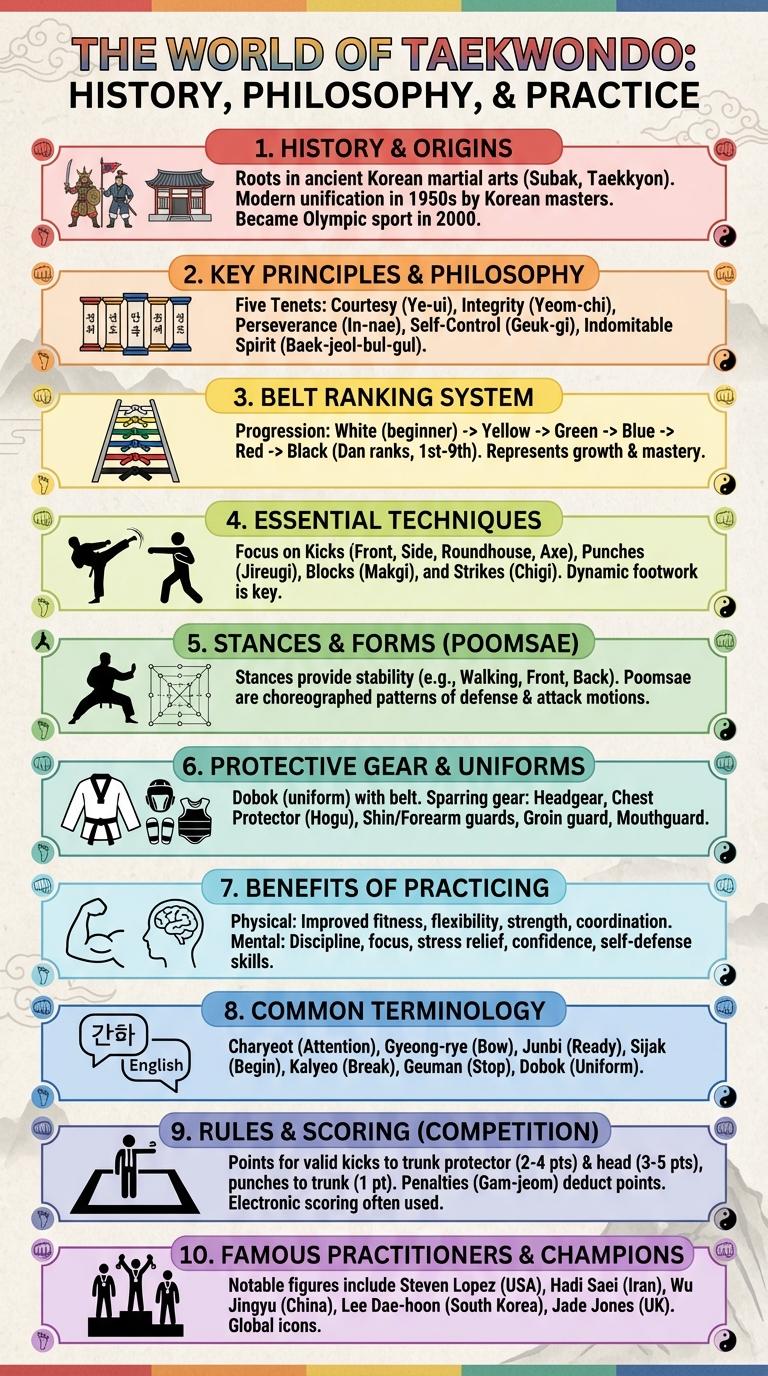
Taekwondo is a dynamic martial art renowned for its powerful kicks and disciplined techniques. This infographic breaks down the essential elements of taekwondo, from its history and fundamental moves to its health benefits and competitive aspects. Visualizing these key aspects helps practitioners and enthusiasts gain a deeper understanding of this Korean martial art.
History and Origins of Taekwondo
Taekwondo originated in Korea and developed as a martial art combining elements of traditional Korean fighting styles with influences from karate. It officially became distinct in the 1950s, emphasizing high, fast kicks and powerful hand techniques.
The roots of Taekwondo trace back over 2,000 years to ancient Korean martial arts like Taekkyeon and Hwa Rang Do. The name 'Taekwondo' means "the way of the foot and fist" and was adopted to unify different Korean martial arts under one system. It has since evolved into an Olympic sport and a global martial arts discipline.
Key Principles and Philosophy
Taekwondo is a Korean martial art emphasizing physical skill and mental discipline. It integrates a philosophy that promotes respect, integrity, and self-control.
- Courtesy (Ye Ui) - Practitioners show respect to instructors, opponents, and themselves to build harmony.
- Integrity (Yom Chi) - Honesty and moral uprightness are essential for personal and martial development.
- Perseverance (In Nae) - Consistent effort overcomes challenges and develops strength.
- Self-Control (Guk Gi) - Emotional regulation prevents unnecessary conflict and promotes peace.
- Indomitable Spirit (Baekjul Boolgool) - Courage and determination empower practitioners against adversity.
Taekwondo Belt Ranking System
Taekwondo features a structured belt ranking system that signifies a practitioner's level of skill and experience. Each belt color represents a specific stage in the journey from beginner to mastery.
The ranking typically starts from white belt and progresses through colors like yellow, green, blue, red, and culminates in black belt levels. Each black belt rank, or dan, reflects advanced expertise and years of dedicated training.
Essential Taekwondo Techniques
Taekwondo emphasizes powerful kicks, precise hand strikes, and dynamic blocks, forming the core of its techniques. Key moves include the front kick (Ap Chagi), roundhouse kick (Dollyo Chagi), and the axe kick (Naeryo Chagi), each offering unique speed and impact advantages. Mastering these essential techniques builds speed, flexibility, and self-defense skills fundamental to Taekwondo practice.
Taekwondo Stances and Forms (Poomsae)
Taekwondo is a Korean martial art known for its dynamic kicks and disciplined practice of stances and forms. Stances (Sogi) and forms (Poomsae) form the foundation of technique and physical control in this sport.
Mastering stances ensures balance and power, while practicing Poomsae develops precision, flow, and martial spirit.
- Walking Stance (Ap Sogi) - This basic stance provides stability for forward and backward movements and attacks.
- Horse Stance (Juchum Sogi) - A wide, strong stance used for building leg strength and solid defense.
- Basic Form (Taegeuk 1 Jang) - The introductory Poomsae emphasizing fundamental blocks and strikes to build a strong foundation.
Protective Gear and Uniforms
What are the essential protective gear items used in Taekwondo? Protective gear in Taekwondo includes headgear, chest protectors, forearm guards, shin guards, and mouthguards. These items ensure safety during sparring by minimizing injury risks.
Why is the Taekwondo uniform important? The Taekwondo uniform, called a "dobok," is designed for comfort and flexibility to allow a full range of motion. It also reflects discipline and respect within the martial art culture.
How does the chest protector enhance safety in Taekwondo? The chest protector, or "hogu," absorbs impacts from kicks and punches, preventing injuries to vital areas. It prominently displays competition scores during matches through electronic scoring sensors.
What role does headgear play in preventing injuries? Headgear protects the skull and face from accidental strikes during sparring sessions. It reduces the likelihood of concussions and facial injuries.
How are uniforms ranked in Taekwondo? Doboks often have colored belts that indicate practitioners' skill levels, ranging from white for beginners to black for advanced students. This ranking system encourages progress and goal-setting.
Benefits of Practicing Taekwondo
Taekwondo enhances physical fitness by improving strength, flexibility, and cardiovascular health. It fosters mental discipline, boosting focus, confidence, and stress relief. Practicing Taekwondo also develops self-defense skills and encourages respect and perseverance.
Common Taekwondo Terminology
Taekwondo is a Korean martial art known for its high, fast kicks and disciplined training. Understanding its terminology helps practitioners communicate effectively during practice and competitions.
Key terms include "Dojang," the training hall, and "Dobok," the uniform worn by practitioners. Mastery of these terms enhances both learning and teaching experiences in Taekwondo.
Rules and Scoring in Taekwondo Competitions
Taekwondo competitions follow strict rules to ensure fair play and athlete safety. Scoring is based on the accuracy, power, and technique of valid strikes and kicks.
- Match Duration - Typically, matches consist of three rounds lasting two minutes each with one-minute breaks.
- Scoring Areas - Points are awarded for strikes to the torso and head, with higher scores for spinning and head kicks.
- Point Values - Basic punches score 1 point, body kicks score 2 points, spinning body kicks score 4 points, and head kicks score 3 points.
- Penalties - Penalties deduct points for infractions such as illegal moves or stepping out of bounds.
- Victory Conditions - Winners are decided by points, knockout, or referee stoppage if safety is compromised.
Understanding these rules and scoring criteria is key for competitors and fans to follow the flow of a taekwondo match.