
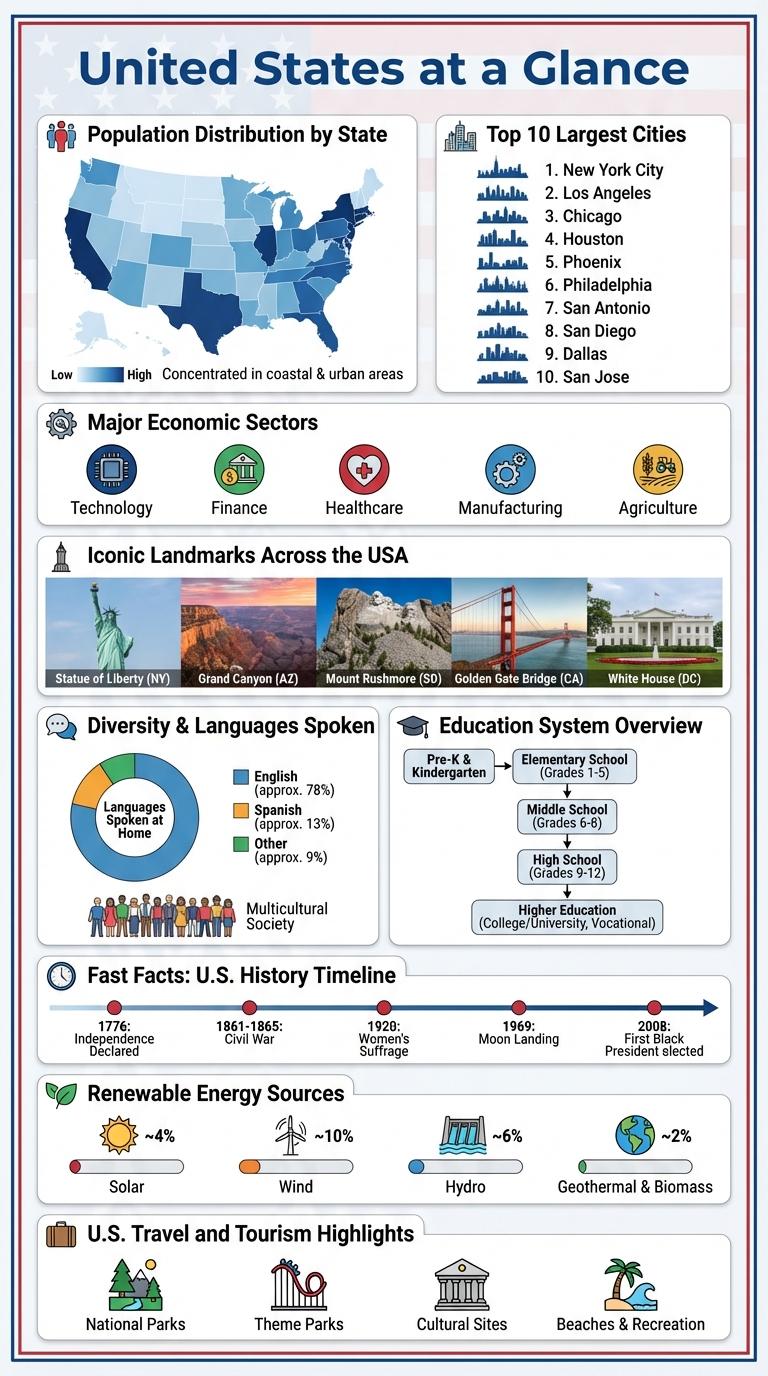
The infographic offers a comprehensive visual overview of key facts and statistics about the USA, highlighting its diverse geography, population distribution, and economic strengths. It illustrates important cultural landmarks, demographic trends, and technological advancements that define the nation. This data-driven portrayal provides valuable insights into the complexity and dynamism of the United States.
United States at a Glance
The United States is a vast country known for its cultural diversity and economic strength. It is a global leader in technology, innovation, and military power.
- Population - The United States has over 330 million residents, making it the third most populous country in the world.
- Geography - It covers approximately 3.8 million square miles, spanning six time zones and featuring varied landscapes.
- Economy - The U.S. boasts the largest national economy, driven by industries such as technology, finance, and manufacturing.
The United States plays a crucial role in international affairs and cultural influence worldwide.
Population Distribution by State
The United States has a diverse population distribution across its 50 states, with California, Texas, and Florida holding the largest populations. Urban centers such as New York City and Los Angeles significantly contribute to their state's population density. States in the Midwest and Mountain West generally have lower population densities compared to coastal states.
Top 10 Largest Cities
The United States is home to many large cities known for their cultural, economic, and historical significance. The top 10 largest cities are ranked by population size, showcasing major urban centers that drive the nation's growth. These cities include both coastal metropolises and inland hubs, each contributing uniquely to America's diverse landscape.
| City | Population (2023 estimate) |
|---|---|
| New York City, NY | 8,631,000 |
| Los Angeles, CA | 3,898,000 |
| Chicago, IL | 2,716,000 |
| Houston, TX | 2,344,000 |
| Phoenix, AZ | 1,608,000 |
Major Economic Sectors
The United States has a diverse and robust economy with several key sectors driving its growth. Major economic sectors include technology, manufacturing, agriculture, healthcare, and finance.
Technology is a leading sector, contributing significantly to innovation and employment. Manufacturing supports industries like automotive, aerospace, and chemicals, while agriculture remains vital for food production and exports.
Iconic Landmarks Across the USA
The USA is home to some of the most iconic landmarks recognized worldwide. These landmarks represent the country's rich history, culture, and natural beauty.
- Statue of Liberty - Located in New York Harbor, it symbolizes freedom and democracy as a gift from France.
- Grand Canyon - A vast natural wonder in Arizona known for its impressive geological formations and breathtaking views.
- Mount Rushmore - A monumental sculpture in South Dakota featuring the faces of four U.S. presidents carved into granite.
Diversity & Languages Spoken
The United States is renowned for its cultural diversity, hosting people from over 200 different countries. This rich mosaic contributes to a vibrant society where multiple languages coexist and thrive.
English is the most widely spoken language, but Spanish follows as the second most common, reflecting the large Hispanic population. Other frequently spoken languages include Chinese, Tagalog, Vietnamese, and French.
Education System Overview
The United States education system spans from early childhood education to higher education and vocational training. It is managed at federal, state, and local levels, with a diverse range of public and private institutions.
Education emphasizes critical thinking, creativity, and a broad curriculum designed to prepare students for a global economy.
- Compulsory Education - Students are required to attend school from ages 5 to 18, varying slightly by state regulations.
- Public vs Private Schools - Public schools serve the majority, funded by state and local taxes, while private schools operate independently with tuition fees.
- Higher Education - The U.S. boasts numerous world-renowned universities offering undergraduate, graduate, and professional degrees.
Fast Facts: U.S. History Timeline
The United States has a rich history marked by pivotal events shaping its development. This timeline highlights key moments from the nation's founding to modern times.
In 1776, the Declaration of Independence was signed, marking the birth of the U.S. The Civil War from 1861 to 1865 preserved the Union and ended slavery. The 20th century saw significant events such as the Great Depression, World War II, and the Civil Rights Movement.
Renewable Energy Sources
| Renewable Energy Source | Percentage of U.S. Electricity Generation (2023) |
|---|---|
| Wind Power | 11.5% |
| Solar Power | 4.7% |
| Hydropower | 7.2% |
| Biomass Energy | 1.4% |
| Geothermal Energy | 0.4% |