
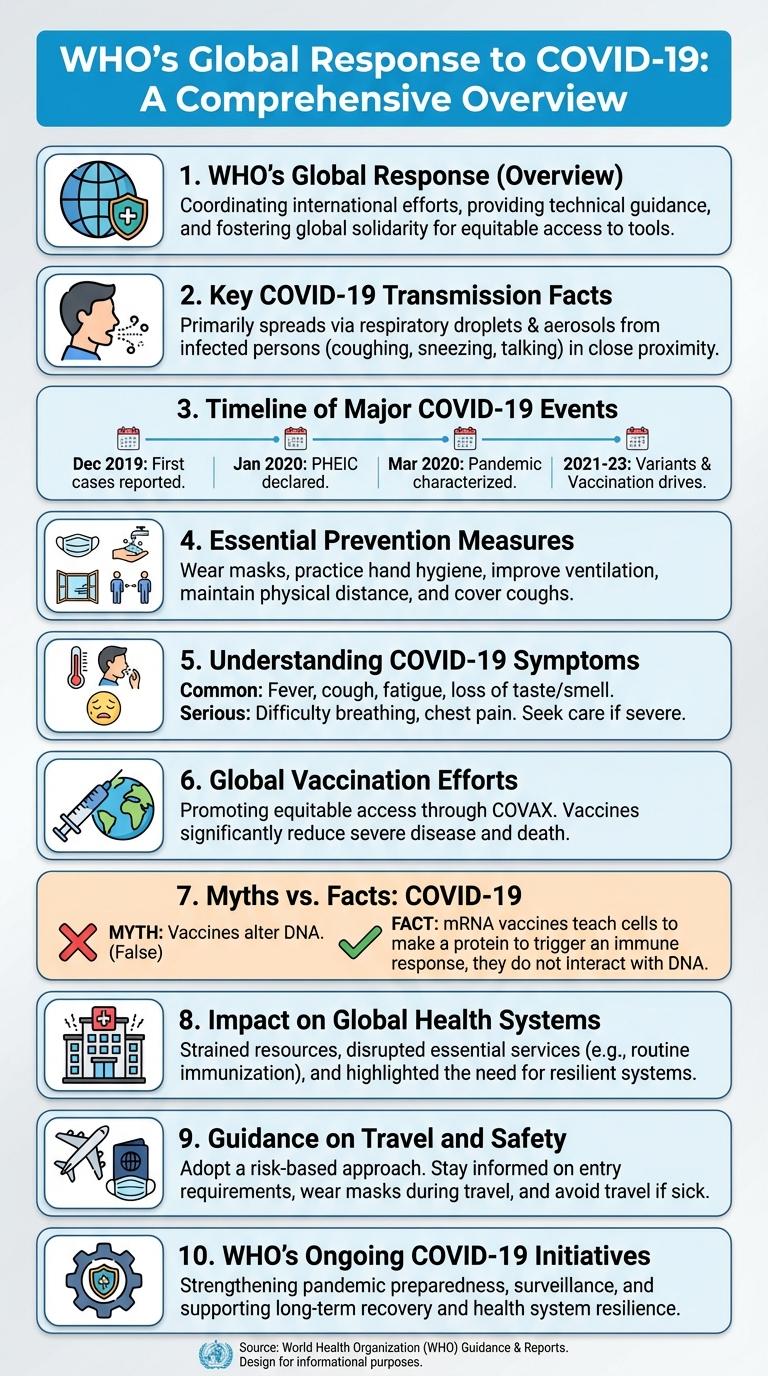
The World Health Organization provides critical insights and global data on COVID-19 to inform public health strategies. This infographic highlights key facts about the virus transmission, preventive measures, and vaccination efforts worldwide. Clear visualization of WHO's findings helps communities stay informed and prepared against the pandemic.
WHO's Global Response to COVID-19
The World Health Organization (WHO) led an extensive global response to combat COVID-19, coordinating efforts to reduce virus transmission and support healthcare systems worldwide. WHO provided guidelines, technical support, and emergency resources to help countries manage the pandemic effectively.
- Rapid Risk Assessment - WHO continuously evaluated COVID-19 risks to update global strategies and inform public health actions.
- Guidance for Countries - WHO issued detailed protocols on testing, treatment, and infection prevention to assist national health authorities.
- Access to Vaccines - WHO spearheaded the COVAX initiative to ensure equitable vaccine distribution across low- and middle-income countries.
- Information Sharing - WHO created platforms for sharing scientific data and best practices among researchers and policymakers.
- Emergency Supply Chain - WHO coordinated delivery of critical medical supplies and personal protective equipment to frontline workers globally.
Key COVID-19 Transmission Facts
How does COVID-19 primarily spread between people? COVID-19 mainly transmits through respiratory droplets when an infected person coughs, sneezes, or talks. Close contact within about 1 meter increases the risk of transmission.
Can COVID-19 spread through airborne particles? Yes, airborne transmission can occur in enclosed, poorly ventilated spaces where the virus remains suspended in the air for longer periods. This highlights the importance of proper ventilation.
Is surface transmission a significant risk for COVID-19? Surface transmission is possible but not the main way the virus spreads. Regular handwashing and surface cleaning reduce the likelihood of infection.
Do asymptomatic individuals spread COVID-19? People without symptoms can still transmit the virus to others. This makes mask-wearing and social distancing vital preventive measures.
How effective are masks in preventing COVID-19 spread? Masks significantly reduce the transmission of respiratory droplets. WHO recommends wearing masks in crowded or indoor public spaces to protect both wearer and others.
Timeline of Major COVID-19 Events
The World Health Organization (WHO) has played a critical role in managing the global response to the COVID-19 pandemic. A timeline of major events highlights key moments in the evolution and containment of the virus.
- December 31, 2019 - WHO was informed of several pneumonia cases of unknown cause detected in Wuhan, China.
- January 30, 2020 - WHO declared the COVID-19 outbreak a Public Health Emergency of International Concern.
- March 11, 2020 - WHO officially characterized COVID-19 as a global pandemic.
- December 31, 2020 - The first emergency use listing of a COVID-19 vaccine was granted by WHO.
- June 2022 - WHO transitioned COVID-19 from a global emergency to an ongoing health issue requiring sustained management.
These milestones demonstrate WHO's ongoing efforts in monitoring and guiding the global health response to COVID-19.
Essential Prevention Measures
The World Health Organization emphasizes essential prevention measures to control the spread of COVID-19. Key actions include frequent handwashing with soap, maintaining physical distancing of at least 1 meter, and wearing masks in crowded or enclosed spaces. These measures significantly reduce transmission and protect vulnerable populations worldwide.
Understanding COVID-19 Symptoms
COVID-19 is caused by the SARS-CoV-2 virus and primarily affects the respiratory system. The World Health Organization identifies common symptoms including fever, dry cough, and fatigue.
Other symptoms may include loss of taste or smell, sore throat, and difficulty breathing. Early identification of these symptoms is crucial for timely medical intervention and reducing transmission.
Global Vaccination Efforts
The World Health Organization (WHO) spearheads the global vaccination campaign against COVID-19, aiming to immunize billions across diverse populations. Efforts focus on equitable vaccine distribution, particularly targeting low- and middle-income countries.
WHO supports COVAX, a global initiative to ensure fair access to COVID-19 vaccines worldwide. Over 13 billion doses have been delivered globally, significantly reducing severe cases and deaths.
Myths vs. Facts: COVID-19
The World Health Organization (WHO) has addressed numerous myths surrounding COVID-19 to ensure public awareness and safety. Understanding the difference between myths and facts helps prevent misinformation and promotes effective health measures.
Myth: COVID-19 can be transmitted through mosquito bites. Fact: There is no evidence that mosquitoes spread the virus. Myth: Wearing masks causes carbon dioxide buildup. Fact: Masks are safe and effective in reducing virus transmission when used properly.
Impact on Global Health Systems
| Aspect | Impact on Global Health Systems |
|---|---|
| Healthcare Capacity | Overwhelmed hospitals and intensive care units due to COVID-19 patient surges worldwide |
| Health Workforce | Increased workload and burnout among healthcare workers; shortages caused by illness and quarantine |
| Access to Services | Disruption of essential health services including immunizations, maternal care, and chronic disease management |
| Health Financing | Reallocation of resources to emergency response led to funding gaps in routine health programs |
| Global Health Coordination | Strengthened international cooperation and data sharing through WHO-led initiatives for pandemic management |
Guidance on Travel and Safety
The World Health Organization (WHO) provides clear guidance on travel safety during the COVID-19 pandemic to minimize virus transmission globally. Travelers are advised to follow local health protocols, including wearing masks, practicing hand hygiene, and maintaining physical distance in crowded areas. WHO emphasizes the importance of vaccination and staying informed about regional travel restrictions and quarantine requirements.