
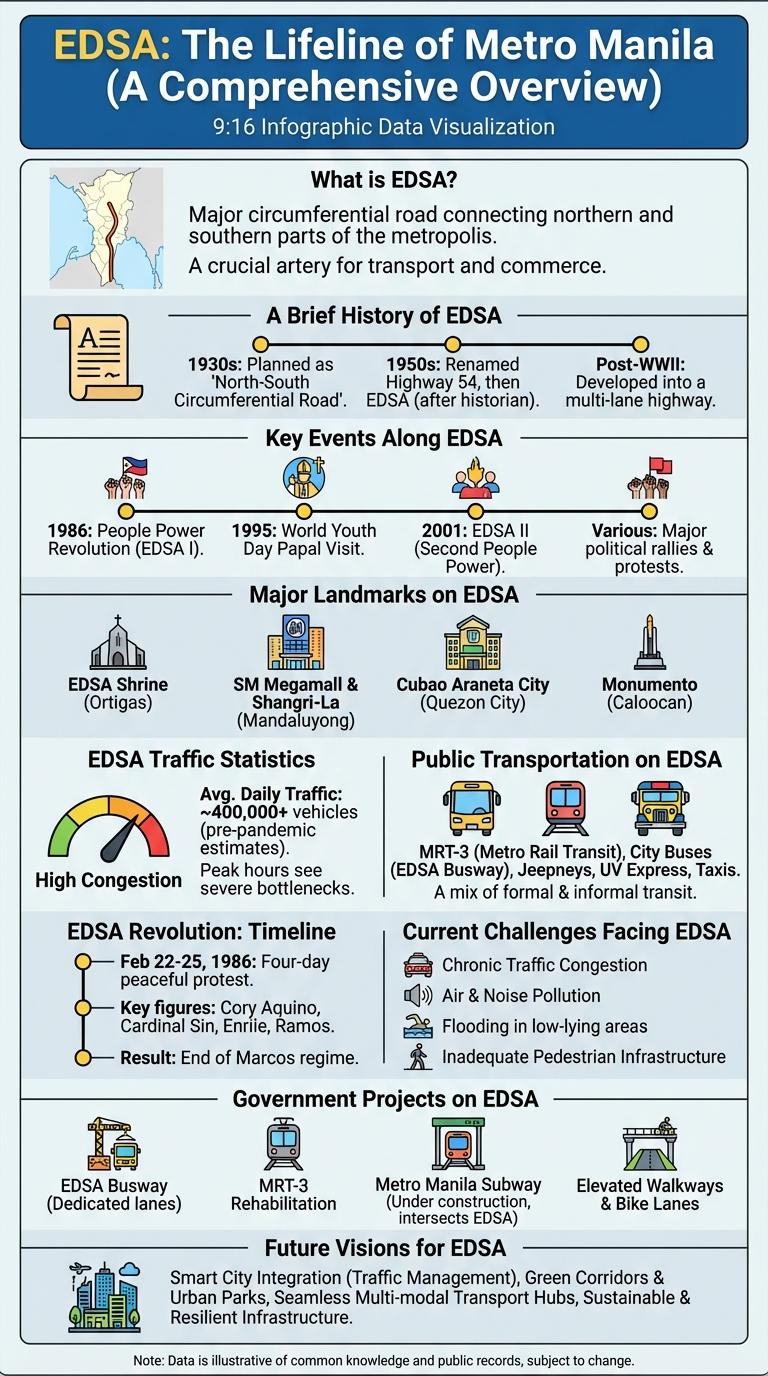
EDSA stands as a pivotal landmark in Philippine history, symbolizing the peaceful People Power Revolution that led to the end of dictatorship in 1986. This infographic highlights key moments, significant figures, and the lasting impact of EDSA on democracy in the Philippines. It offers a concise visual summary of how ordinary citizens united to restore freedom and justice through nonviolent protest.
What is EDSA?
EDSA, short for Epifanio de los Santos Avenue, is a major thoroughfare in Metro Manila, Philippines. It is known for its historical significance and heavy daily traffic.
- Main Artery of Metro Manila - EDSA connects key cities including Quezon City, Mandaluyong, and Pasay, serving millions of commuters daily.
- Site of the 1986 People Power Revolution - EDSA gained global recognition as the peaceful protest location that ended the Marcos dictatorship.
- Economic and Transport Hub - The avenue hosts commercial centers, government offices, and is served by the Manila Metro Rail Transit System (MRT).
A Brief History of EDSA
What is the historical significance of EDSA? EDSA, or Epifanio de los Santos Avenue, is a major thoroughfare in Metro Manila, Philippines, named after a Filipino historian and scholar. It became a symbol of unity and democracy during the 1986 People Power Revolution that ended the Marcos dictatorship.
Key Events Along EDSA
The Epifanio de los Santos Avenue (EDSA) is a major highway in Metro Manila, Philippines, known for its historical significance. Key events along EDSA include the People Power Revolution of 1986, which led to the peaceful overthrow of President Ferdinand Marcos. This avenue also witnessed subsequent political rallies and mass demonstrations shaping Philippine democracy.
Major Landmarks on EDSA
EDSA, or Epifanio de los Santos Avenue, is a major thoroughfare in Metro Manila, Philippines, known for its significant landmarks and historical importance. This highway connects several key commercial, cultural, and political sites along its route.
- SM Megamall - One of the largest shopping malls in the Philippines located in Mandaluyong, serving as a major retail and entertainment hub.
- EDSA Shrine - A monument commemorating the People Power Revolution of 1986, situated at the intersection of Ortigas and EDSA.
- Greenbelt Park - A landscaped urban park near Ayala Center in Makati, offering a green respite amid the bustling city surrounding EDSA.
- Cubao Commercial Center - A busy commercial district in Quezon City known for shopping centers like Gateway Mall and Araneta Coliseum, a major event venue.
- Magallanes Interchange - A critical junction connecting EDSA to South Luzon Expressway, facilitating traffic flow from Metro Manila to southern provinces.
These landmarks highlight the diverse cultural, economic, and historic significance embedded along EDSA's extensive route.
EDSA Traffic Statistics
EDSA, one of Metro Manila's major thoroughfares, handles over 300,000 vehicles daily, making it one of the busiest roads in the Philippines. Traffic congestion typically peaks during morning and evening rush hours, with average vehicle speeds dropping to below 10 km/h. Data from the Metropolitan Manila Development Authority (MMDA) highlights that traffic delays on EDSA can extend commute times by up to 60 minutes during peak periods, impacting millions of commuters.
Public Transportation on EDSA
EDSA, or Epifanio de los Santos Avenue, serves as Metro Manila's primary artery, accommodating a vast daily flow of commuters via public transportation. The avenue supports multiple transport modes, including jeepneys, buses, and the MRT Line 3, catering to millions of passengers each day.
Buses and jeepneys dominate EDSA's public transit, with dedicated bus lanes implemented to improve traffic flow and reduce congestion. The MRT-3 elevated rail line runs above EDSA, offering a faster alternative for commuters traveling along the 23-kilometer route from North to South Metro Manila.
EDSA Revolution: Timeline
The EDSA Revolution, also known as the People Power Revolution, occurred in the Philippines in February 1986. It marked a peaceful uprising that ended the 21-year authoritarian rule of President Ferdinand Marcos.
The revolution began on February 22, 1986, when defectors from the Armed Forces and civilians gathered at Epifanio de los Santos Avenue (EDSA). Over four days, millions of Filipinos joined protests demanding democratic reforms. This peaceful movement led to the restoration of democracy with Corazon Aquino becoming president.
Current Challenges Facing EDSA
EDSA, Metro Manila's major thoroughfare, experiences severe traffic congestion daily, impacting millions of commuters. The road struggles with inadequate public transportation options and high vehicle volume.
Frequent road maintenance and infrastructure limitations worsen traffic flow on EDSA. Urban development along the corridor adds complexity to traffic management and safety concerns.
Government Projects on EDSA
| Project | Description |
|---|---|
| EDSA Busway | Exclusive bus lanes designed to improve public transport efficiency along EDSA, reducing travel time and easing congestion. |
| Skyway Stage 3 | Elevated expressway connecting South and North Luzon Expressways, alleviating traffic on EDSA by providing an alternative route. |
| EDSA Greenways Project | Development of landscaped pedestrian walkways and bike lanes to promote sustainable and safer commuting along EDSA. |
| Unified EDSA Traffic Management | Implementation of synchronized traffic signals and real-time monitoring to enhance traffic flow and reduce bottlenecks on EDSA. |
| EDSA MRT-7 Extension | Extension of MRT-7 line towards EDSA to improve mass transit connectivity and decrease road vehicle volume. |