
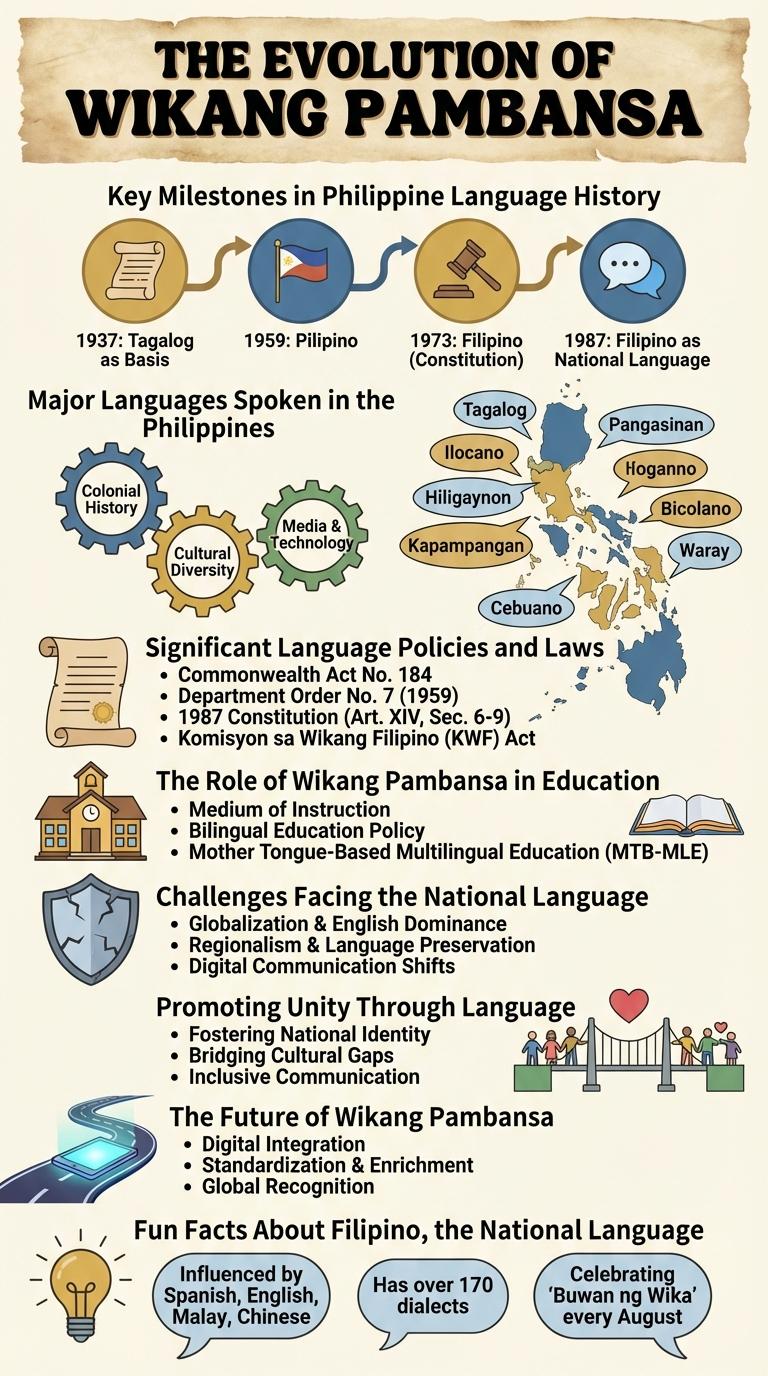
Wikang Pambansa serves as a vital symbol of national identity and unity in the Philippines. This infographic highlights key facts, historical developments, and the cultural significance surrounding the evolution of the national language. Understanding its role fosters greater appreciation for the country's diverse linguistic heritage and promotes effective communication across regions.
The Evolution of Wikang Pambansa
Wikang Pambansa, the national language of the Philippines, evolved from Tagalog and was officially adopted in 1937. Over time, it integrated elements from various Filipino languages and Spanish influences, reflecting the country's diverse culture. Today, Filipino, based on Tagalog, serves as the modern form of Wikang Pambansa, promoting unity across the archipelago.
Key Milestones in Philippine Language History
The term "Wikang Pambansa" refers to the national language of the Philippines, primarily based on Tagalog. Its development reflects the country's diverse linguistic heritage and cultural identity.
In 1937, Tagalog was officially chosen as the basis for the national language by the Philippine government. The 1987 Philippine Constitution designated Filipino as the national language, evolving from Tagalog to include other Philippine languages.
Major Languages Spoken in the Philippines
The Philippines is home to a diverse linguistic landscape with over 170 languages spoken across its islands. Among these, several major languages stand out due to their wide usage and cultural significance.
Tagalog, the basis of the national language Filipino, is the most widely spoken language in the country. Cebuano, Ilocano, Hiligaynon, and Waray also have substantial speaker populations, reflecting the rich linguistic diversity of the Philippines.
Factors Influencing the National Language
Wikang Pambansa, or the national language of the Philippines, unites the diverse linguistic groups across the country. Its development is shaped by historical, social, and political factors that influence language adoption and usage.
The choice of Tagalog as the base of the national language was influenced by its widespread use in Metro Manila and neighboring provinces. Political support during the Commonwealth period strengthened its status. Social integration and educational policies further propagated the language nationwide.
Significant Language Policies and Laws
Wikang Pambansa is the national language policy of the Philippines aimed at unifying diverse linguistic groups. It promotes Filipino as the medium of communication in government, education, and media.
- Commonwealth Act No. 184 (1936) - Established Tagalog as the basis for the national language to foster unity among Filipinos.
- Republic Act No. 7104 (1991) - Created the Komisyon sa Wikang Filipino to develop, preserve, and promote the national language.
- Republic Act No. 10533 (K-12 Law, 2013) - Mandated the use of Filipino and other regional languages as mediums of instruction in early education.
The Role of Wikang Pambansa in Education
What role does Wikang Pambansa play in the Philippine education system? Wikang Pambansa, primarily Filipino, serves as the medium of instruction in public schools, promoting national identity and cultural unity. It enhances comprehension and learning among students by using a language familiar to the majority.
Challenges Facing the National Language
The Wikang Pambansa plays a crucial role in uniting the diverse linguistic landscape of the Philippines. Several challenges hinder its full acceptance and development across the nation.
- Regional Language Dominance - Strong local dialects often overshadow the national language in daily communication and media.
- Educational Disparities - Unequal access to quality Filipino language education impacts proficiency among students.
- Globalization Effects - Increasing use of English and foreign languages reduces the frequency of Filipino usage.
- Technological Limitations - Lack of comprehensive Filipino language resources in digital platforms limits its modern application.
- Policy Implementation Challenges - Inconsistent enforcement of language policies affects the promotion of Filipino nationally.
Addressing these challenges is essential to strengthen the role of Wikang Pambansa as a unifying force.
Promoting Unity Through Language
Wikang Pambansa serves as a vital instrument in uniting diverse cultural groups across the Philippines. It fosters national identity by providing a common linguistic platform.
- National Cohesion - The national language bridges communication gaps among various ethnic communities.
- Cultural Integration - Promoting the Filipino language enhances mutual respect and appreciation of diverse traditions.
- Educational Empowerment - Teaching Wikang Pambansa in schools ensures equal access to information and opportunities nationwide.
The Future of Wikang Pambansa
The future of Wikang Pambansa reflects a dynamic evolution driven by technology and cultural preservation efforts. Digital platforms increasingly support learning and usage, enhancing accessibility nationwide. Government initiatives focus on integrating Wikang Pambansa in education and media to strengthen national identity.