
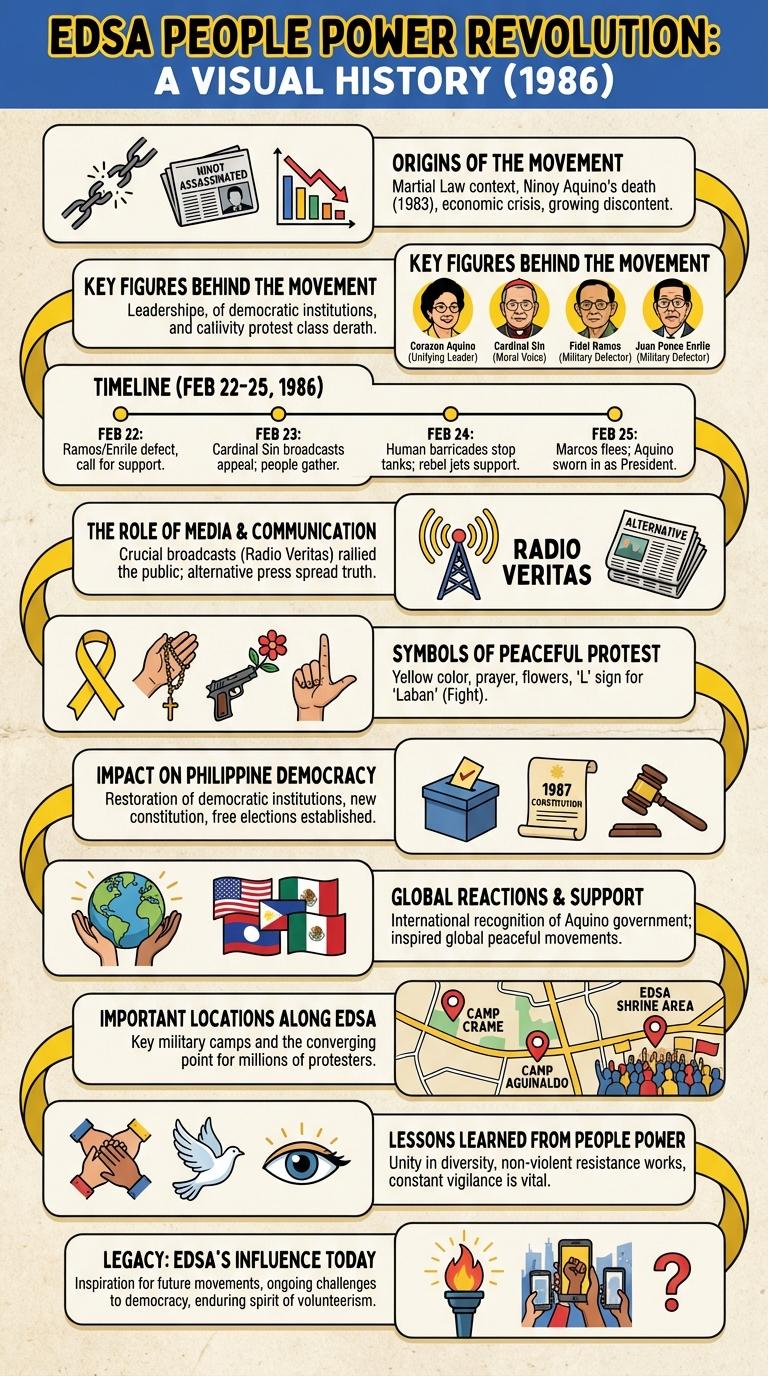
The EDSA People Power Revolution stands as a powerful symbol of peaceful protest and democratic triumph in Philippine history. This infographic highlights key events, influential figures, and lasting impacts of the 1986 revolution that ended decades of authoritarian rule. Explore how unity and courage reshaped the nation's political landscape through this visual representation.
Origins of the EDSA People Power Revolution
The EDSA People Power Revolution, also known as the Philippine Revolution of 1986, originated from widespread dissatisfaction with the authoritarian regime of President Ferdinand Marcos. Decades of political repression, economic inequality, and human rights abuses fueled public unrest across the nation.
The assassination of opposition leader Benigno Aquino Jr. in 1983 intensified calls for change, uniting diverse groups against the Marcos dictatorship. The fraudulent 1986 snap presidential election became a catalyst, as massive protests erupted demanding Marcos's resignation. Key figures, including leaders from the military and religious sectors, supported the peaceful uprising that ultimately ended Marcos's rule and restored democracy in the Philippines.
Key Figures Behind the Movement
The EDSA People Power Revolution was a pivotal moment in Philippine history, marked by the collective efforts of various key figures. These leaders inspired the masses to peacefully overthrow a dictatorial regime in 1986.
Corazon Aquino emerged as the symbol of democratic restoration, rallying Filipinos against Ferdinand Marcos' administration. Cardinal Jaime Sin played a crucial role by urging the public and military to support the revolution through his influential broadcasts.
Timeline of Major Events (February 22-25, 1986)
What were the key events during the EDSA People Power Revolution from February 22 to 25, 1986?
The revolution began on February 22 when Defense Minister Juan Ponce Enrile and General Fidel V. Ramos withdrew their support from President Ferdinand Marcos. Massive crowds gathered along Epifanio de los Santos Avenue (EDSA) to support the military rebels and demand Marcos' resignation.
How did the situation escalate on February 23, 1986?
By February 23, tens of thousands of civilians camped out at EDSA, armed only with prayer and makeshift barricades. Radio stations and news outlets broadcasted live updates, amplifying international awareness and pressure on the Marcos regime.
What occurred during February 24, 1986, that signaled a turning point in the revolution?
The Marcos loyalist forces attempted to attack the rebel camp at EDSA but were met with overwhelming civilian resistance. Key religious and political leaders mediated talks to prevent bloodshed, maintaining the peaceful nature of the uprising.
What was the significance of February 25, 1986, in the revolution's timeline?
On February 25, Marcos fled the Philippines, and Corazon Aquino was sworn in as the new president. This day marked the restoration of democracy following two decades of authoritarian rule under Marcos.
The Role of Media and Communication
The People Power Revolution in EDSA exemplified the transformative power of media and communication in mobilizing citizens against authoritarian rule. Media outlets and grassroots communication networks played a crucial role in uniting diverse groups to demand democratic change.
- Radio Broadcasts - Radio stations like Radio Veritas provided real-time updates that galvanized public participation and coordinated protests.
- News Coverage - Television and print media highlighted the regime's abuses, raising national and international awareness.
- Community Networks - Word-of-mouth and local communication channels spread calls for nonviolent resistance and solidarity.
Symbols of Peaceful Protest
The EDSA People Power Revolution symbolizes the triumph of nonviolent protest in the Philippines. Key symbols such as yellow ribbons and rosaries became emblems of unity and hope during the movement.
The "Laban" sign, made by raising the thumb and pinky finger, represented resistance and solidarity among protesters. White clothing and flowers highlighted the peaceful nature of the demonstration, emphasizing a collective call for democracy.
Impact on Philippine Democracy
The EDSA People Power Revolution in 1986 marked a pivotal moment in Philippine democracy by restoring civilian rule after years of martial law under Ferdinand Marcos. It empowered citizens to engage in peaceful protest, demonstrating the power of collective action in overthrowing an authoritarian regime. This revolution paved the way for democratic reforms, the drafting of a new constitution, and the strengthening of civil liberties in the Philippines.
Global Reactions and Support
The EDSA People Power Revolution in 1986 sparked widespread global admiration for its peaceful demonstration of democracy. Governments worldwide, including the United States, Canada, and several European nations, quickly expressed support for the Filipino people's demand for political reform. International media extensively covered the movement, highlighting the successful nonviolent overthrow of the regime and inspiring similar democratic efforts globally.
Important Locations Along EDSA
Lessons Learned from People Power
The EDSA People Power Revolution demonstrated the power of collective action in promoting democracy and justice. It set a historical example of peaceful resistance that inspired movements worldwide.
- Unity Overcomes Oppression - The revolution showed that united citizens can successfully challenge authoritarian regimes without violence.
- Peaceful Protest is Powerful - Nonviolent demonstrations can effectively bring about political change and uphold human rights.
- Civic Engagement is Vital - Active participation of the public in governance protects democracy and ensures accountability.